Single Drops Every 4 Weeks vs. Full Album Dumps: Which Strategy Grows Rap Followers Faster?
If you are sitting on a hard drive full of finished records and trying to figure out should rappers release singles or albums on Spotify, the data points to a clear winner: dropping one tightly promoted single every 4 to 6 weeks grows your follower count much faster than unloading a full album all at once.
A lot of independent rappers fall into the same trap. You spend six months locked in the studio, pay for mixing and mastering, design cover art, and drop a 12-track album on a Friday night expecting your monthly listeners to explode. By the following Tuesday, two songs have a few hundred streams, the other ten are sitting under fifty, and the hype is completely dead. You just burned six months of studio work in seventy-two hours.
Major label artists can vanish for two years and drop a surprise 18-track album because they have million-dollar billboard budgets, radio deals, and millions of die-hard fans waiting on their every move. When you are building an audience from scratch, you are playing by completely different rules. On Spotify, consistency beats volume every single time.
How the Spotify Algorithm Actually Treats Your Uploads
To understand why single drops beat album dumps, you have to look at how Spotify decides who hears your music. Spotify does not care how hard you worked on a project or how cohesive your tracklist is. Its recommendation engine tracks listener behavior during the first 7 to 14 days after a song goes live. It watches for three main signals: how many people save the track to their library, how many add it to personal playlists, and how fast listeners hit the skip button.
Every time you schedule an unreleased track through your distributor at least two to three weeks in advance, you unlock two major tools:
-
Spotify for Artists Editorial Pitching: You get to pitch one song to Spotify’s playlist editors for consideration on official playlists.
-
Release Radar: Spotify automatically places your new song into the Release Radar playlist of everyone who follows you, plus listeners who have recently streamed your catalog.
Here is the catch most rappers miss: Spotify only puts one song per artist into a listener’s Release Radar during any given release cycle.
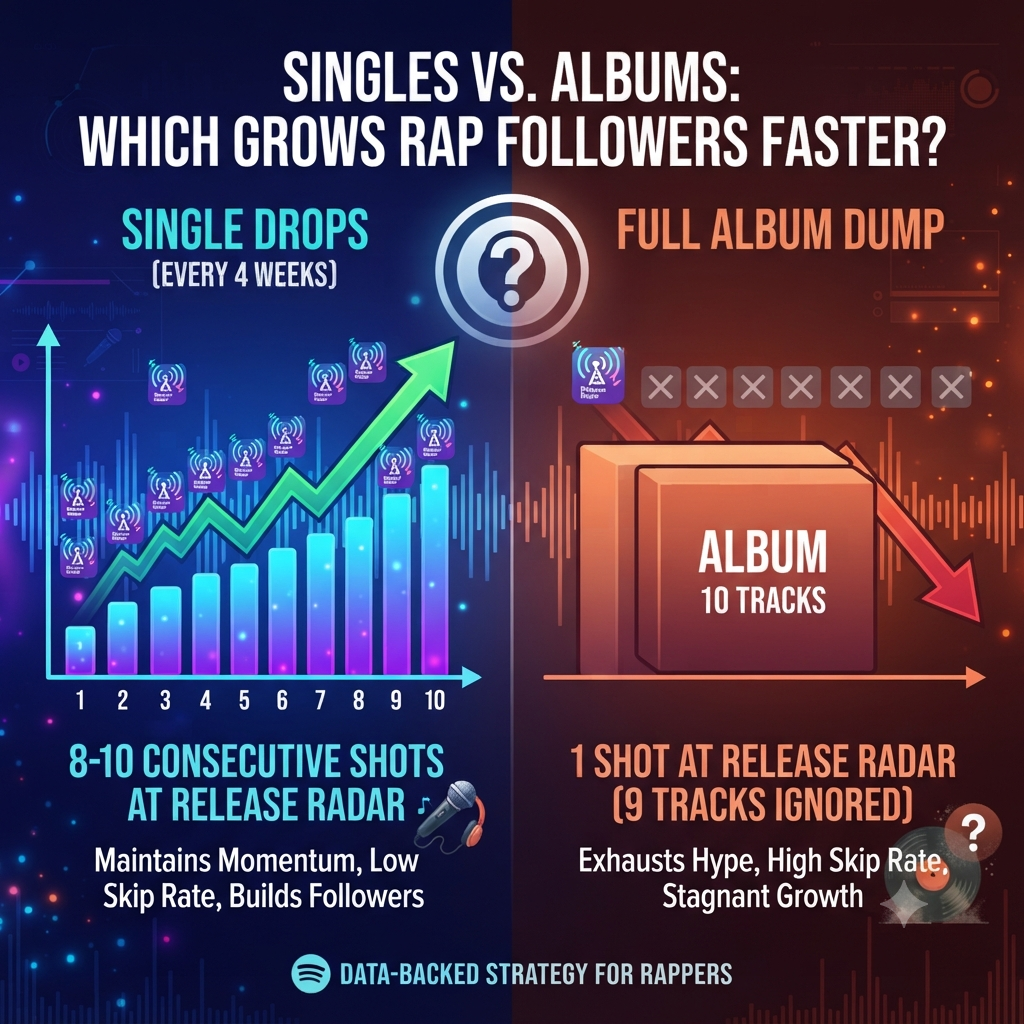
Think about what that means when you dump a 10-track album on Friday. Spotify picks your one pitched focus track and sends it to your followers’ Release Radar feeds. The other nine songs on your album get zero automated Release Radar push. You effectively throw away 90 percent of your algorithmic reach in a single weekend.
Now flip that math around. If you take those exact same 10 songs and release them one by one every 4 to 6 weeks, you get 8 to 10 consecutive shots at Release Radar over the course of a year. Every month and a half, you show up in your listeners’ feeds again. Instead of one loud weekend followed by months of silence, you stay in front of your audience all year long.
Breaking Down the Numbers: Single Cadence vs. Album Dumps
When you compare both strategies side by side over a 12-month period using the same 10 songs, the difference in growth potential becomes obvious.
Why High Skip Rates Kill Independent Albums
Attention spans on streaming platforms are brutal, especially in hip-hop. A listener who just discovered your page through a TikTok clip or an Instagram Reel is rarely going to sit down and listen to a 38-minute album from top to bottom.
When you drop a full project, curious listeners usually click around. They play the first fifteen seconds of track one, skip to track three, listen for ten seconds, and bounce to another artist. To Spotify’s algorithm, rapid skipping looks like listeners rejecting your music. High skip rates tell the system not to push your songs into Discover Weekly, Spotify Radio, or Autoplay.
Releasing one single at a time solves this problem immediately. Every social media post, every story link, and every dollar you spend on promotion points to one exact track. Because listeners are clicking directly for that song, they are far more likely to listen all the way through and hit the save button. High completion rates and strong save-to-listener ratios are the exact triggers that convince Spotify to start testing your song with cold audiences who have never heard of you.
Building Momentum With a 4-to-6-Week Cycle
Spacing your drops out every four to six weeks hits the natural sweet spot of Spotify’s data cycle. Usually, a new single gets its biggest algorithmic push during its first two to three weeks. Around week four or five, those initial streams start to level off.
If you drop your next single right as the previous one starts cooling down, you create a snowball effect. Returning listeners head back to your profile to hear the new record, end up streaming your previous release again, and push your monthly listener baseline higher with every cycle.
Of course, the algorithm needs early fuel to work. If a song drops to total silence in the first 48 hours, Release Radar alone will not save it. You still have to drive real people to the track right away so Spotify sees active engagement. That is why so many independent artists sustain high algorithmic momentum across every single drop through our hip-hop music promotion (https://itshiphopmusic.com/submit/music-submission/) network, giving each release a reliable wave of early listeners and playlist activity right out of the gate.
A Simple 5-Week Routine for Every Single
Running a steady single schedule also saves you from marketing burnout. Trying to shoot videos and write captions for twelve different songs at once is exhausting. With one single every five weeks, your promo schedule stays simple and repeatable:
-
Weeks 1 and 2 (Before Release): Upload the track to your distributor, submit your Spotify editorial pitch, post raw studio clips of the hook on Reels and TikTok, and share the pre-save link with your core supporters.
-
Week 3 (Release Week): Drop the official audio, post a clean visualizer or performance clip, share playlist placements on your stories, and message your supporters directly to save the track.
-
Weeks 4 and 5 (Post-Release and Pivot): Break down a verse, post an acoustic or live mic performance of the song, and start teasing a snippet of the next record to bridge the gap.
When Does It Make Sense to Drop an Album?
Sticking to singles does not mean you can never release a cohesive project. It just changes the order of operations. Use singles to earn attention first, and save the album for when you actually have a fanbase waiting for it.
Once you have spent eight to ten months dropping 6 to 8 strong singles and building a solid core of followers, you can bundle your best-performing singles together with 3 or 4 brand-new tracks into an EP or album. By matching the original ISRC codes when you upload the project, all your existing stream counts carry straight over into the album tracklist. You get the best of both worlds: a complete body of work for your real fans, without sacrificing a single Release Radar placement along the way.
Maintain consistent release velocity all year long. Submit your track via our Music Submission Portal (https://itshiphopmusic.com/submit/music-submission/).