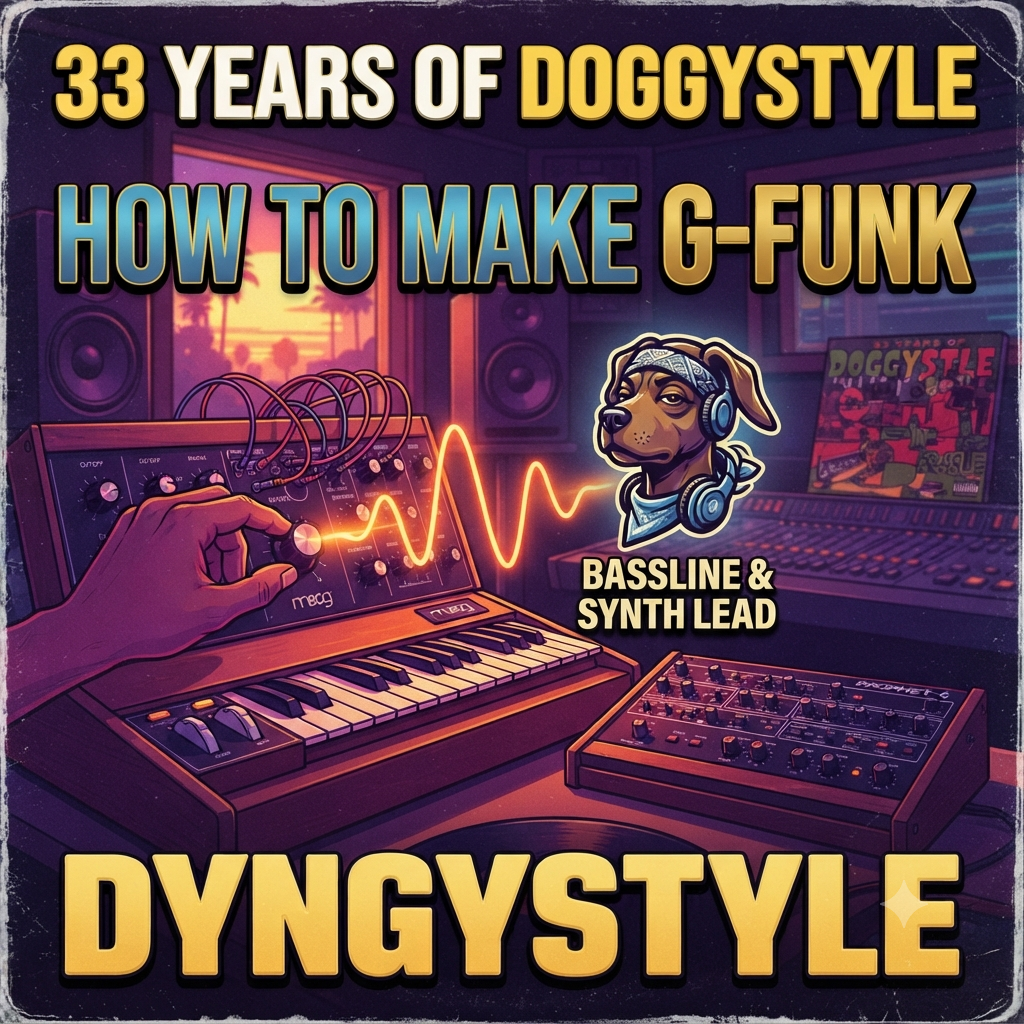
33 Years of Doggystyle: How to Make a G-Funk Bassline and Synth Lead That Still Dominate Playlists
Think back to November 23, 1993. When Snoop Dogg dropped Doggystyle, it did not just top the charts; it completely changed the temperature of hip-hop. Thirty-three years later, records like “Gin and Juice,” “Who Am I? (What’s My Name?),” and “Doggy Dogg World” are still heavy hitters on summer barbecue queues, late-night cruising mixes, and everyday streaming playlists.
A lot of trends from the nineties sound dated when stacked next to modern mixes, yet G-Funk refuses to age out. The secret is not just nostalgia or Snoop’s effortless delivery. It comes down to two foundational pieces of sound design that leave massive room for an artist to breathe: a rubbery, live-feeling Moog bassline and a gliding, high-pitched monophonic synth lead.
If you are producing West Coast beats today and want to understand how to make g funk bassline and synth lead patches that actually carry a track—without cluttering up your mix—you do not need a studio full of rare 1970s hardware. You just need to understand how those classic circuits behave and how to play them with the right pocket.
Why the Doggystyle Sound Still Wins on Streaming Playlists
Modern streaming listeners skip tracks fast, and muddy mixes are usually the first to go. One big reason Doggystyle holds up so well next to contemporary releases is space. Instead of stacking dense, chopped-up soul loops that fight the vocal for midrange territory, Dr. Dre and the Death Row camp leaned into clean, spacious arrangements built around live-sounding synthesis.
First, the low end does the heavy lifting without getting messy. A round synth bass gives the speakers real physical weight while staying tucked neatly beneath the voice. Second, that high whistle lead acts almost like a second vocalist, gliding between notes in a way that feels human and conversational rather than stiff or robotic. Add in a laid-back tempo—usually sitting right around 88 to 96 BPM—and you get a bounce that feels natural whether someone is driving down the highway or listening on earbuds.
How to Make a G-Funk Bassline and Synth Lead From Scratch
Whether you are using a Minimoog emulation like Arturia Mini V, u-he Diva, Monark, or a stock synth inside FL Studio, Logic, or Ableton, the architecture stays the same. Here is how to dial in both elements so they lock together.
-
Shaping the Live Moog-Style Bassline
Classic G-Funk bass never sounds like a static, quantized MIDI block. Even when it is played on a keyboard, it carries the phrasing, slides, and subtle velocity shifts of an electric bass player sitting in the room.
Start with your oscillator selection. A pure triangle wave gives you deep, subby warmth, while a sawtooth wave brings the harmonic grit that helps the bass cut through smaller phone and laptop speakers. Blending a dominant sawtooth with a quieter triangle wave an octave down gives you the best of both worlds: punch on top and weight underneath.
Next, reach for a 24 dB/octave low-pass filter. Roll the cutoff frequency down until the buzz of the sawtooth melts into a thick, woody thump. From there, nudge the resonance up just a hair. You are not trying to make an acid bassline here; you just want enough resonance so that when the filter opens slightly on accented notes, you get that subtle, vocal “wah” character.
Your filter envelope is where the groove comes alive. Keep the attack near zero so the front of every note hits cleanly alongside the kick drum. Set a medium decay, bring the sustain down around thirty to forty percent, and keep the release fairly short so notes stop cleanly before stepping on the next hit.
Finally, play the part rather than clicking every note onto the grid. Syncopated eighth- and sixteenth-note runs, quick octave jumps, and ghost notes right before the snare are what give West Coast bass its signature swing. Leave plenty of air between phrases so the low end feels bouncy instead of heavy-handed.
-
Dialing In the Monophonic Sine-Wave Portamento Whistle Lead
Once the drums and bass are rolling, that unmistakable high-register lead is what hooks the ear from across the room. Producers often call it the G-Funk whistle or worm lead, and its magic comes down to two settings: monophonic voicing and portamento.
First, switch your synth from polyphonic to monophonic mode. This forces the synth to play only one note at a time. Whenever you hit a new key while still holding the previous one, the pitch has to travel from note A to note B instead of playing a chord.
For the waveform, keep it simple with a pure sine wave. Because a sine wave has no upper harmonics, it sits high above the beat like a human whistle without sounding harsh or fatiguing on repeat listens. If it feels a little too thin in a busy mix, blend in a tiny amount of a triangle wave—just enough to give it body without losing that glassy, airy tone.
Now turn on portamento, sometimes labeled as glide. Set it to legato mode if your synth offers it, which means the pitch only slides when your notes overlap. Adjust the glide time until the transition between notes feels smooth and expressive. If the time is too short, the notes sound stepped and choppy; if it is too long, the melody drags behind the beat and feels out of tune.
To keep held notes from sounding static, route a slow LFO very subtly to pitch so a gentle vibrato blooms near the end of longer notes. Keep your melodies simple, memorable, and vocal-friendly—usually a two- or four-bar call-and-response phrase is all a record needs.
-
Getting the Bass and Lead to Sit Together in the Mix
Even great patches can clash if they fight for the same space. Keep your Moog bass focused in the sub and low-mid range, and play your sine lead two or three octaves higher so there is a wide open pocket in the middle for your drums, Rhodes chords, and lead vocals.
Use arrangement to let each element shine. Let the bassline carry the verse on its own, then bring the gliding whistle lead in during the hook or in the spaces right after a vocal bar ends. Because high sine frequencies can pierce the ear quickly at high volume, tuck the lead slightly lower in the mix than you think it needs to be and use a gentle high-shelf cut if any specific note jumps out too loudly.
Bringing Classic West Coast Bounce to Today’s Listeners
Thirty-three years after Doggystyle set the blueprint, listeners still gravitate toward music that feels warm, unhurried, and built for real-world playback. Mastering these synthesis fundamentals gives your beats an authentic foundation that stands apart from copy-and-paste templates.
Once your low end is knocking, your synth lead is gliding smoothly, and your master is ready for public ears, put your West Coast grooves and laid-back cadences into active rotation through our multi-platform rap promotion (https://itshiphopmusic.com/submit/music-submission/) packages.
Deliver timeless West Coast bounce to active listeners. Pitch your single via our Music Submission Page (https://itshiphopmusic.com/submit/music-submission/).