How Major Rap Features Boost Back Catalog Streams: Lessons from Mez’s “Hell Nah”
Landing a verse from J. Cole or Anderson .Paak is every independent rapper’s dream, yet most artists still misunderstand what makes a big guest appearance pay off long after release week. Too many rollouts treat a marquee feature like a lottery ticket—drop the song, watch the first-week numbers spike, and hope the hype magically sticks. In reality, the artists who win in the streaming era know how major rap features boost back catalog streams by turning one high-profile record into a front door for everything they made years earlier.
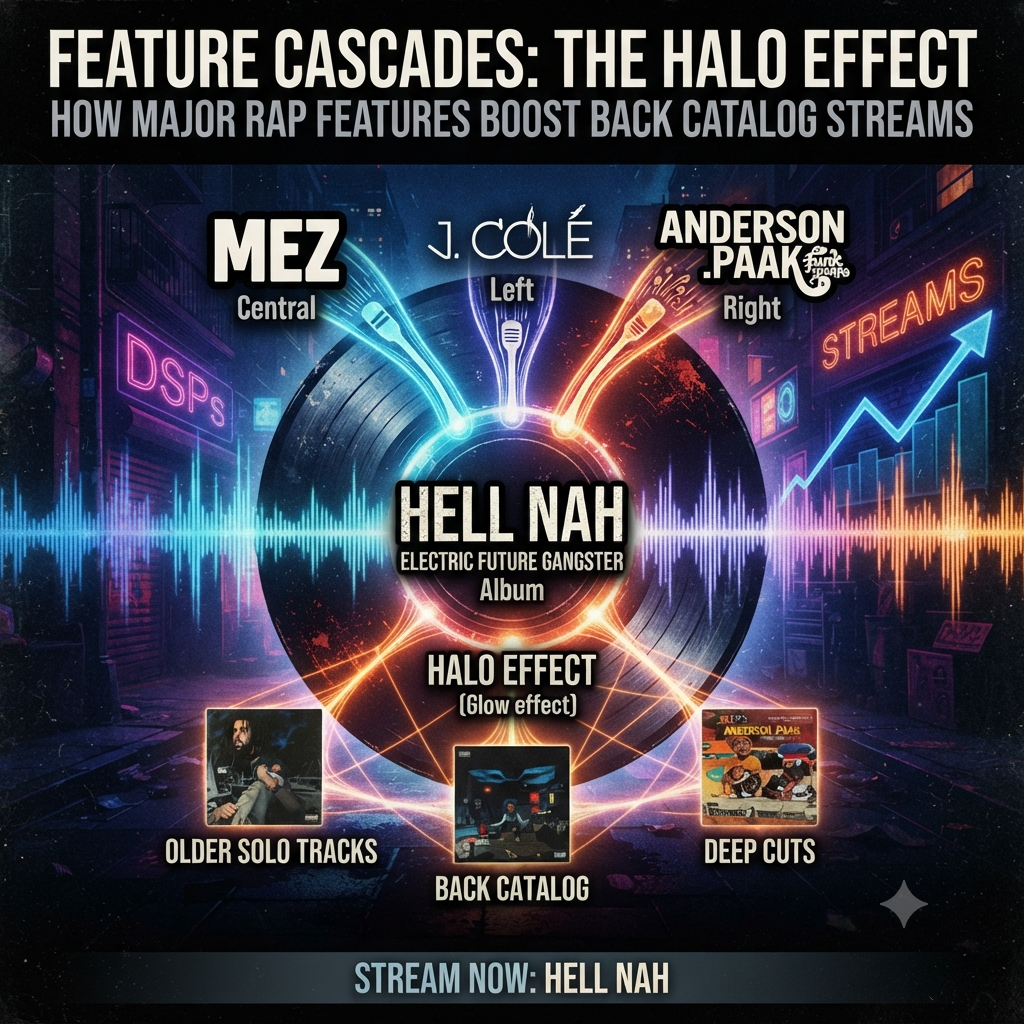
Mez’s “Hell Nah” featuring J. Cole and Anderson .Paak on Electric Future Gangster is a textbook example of how that works on modern Digital Service Providers (DSPs). When an independent or critically respected MC puts two heavyweight voices on the same track, the result is more than a single buzz record. It creates a halo effect that pulls curious listeners out of passive playlists and straight into an artist’s older solo discography.
Why a Big Feature Is Really a Catalog Play
On Spotify, Apple Music, and YouTube, listeners rarely discover music in a vacuum anymore. Every stream feeds recommendation engines that map out who listens to whom, which tracks get saved together, and where fans click after a song ends. When Mez teams up with J. Cole and Anderson .Paak on “Hell Nah,” that single record bridges three overlapping yet distinct audiences—lyrical rap purists, soulful groove heads, and underground hip-hop fans who follow North Carolina’s broader musical ecosystem.
That overlap is where the real value sits. A major feature borrows trust from artists who already command millions of habitual listeners. Instead of asking a cold audience to gamble three minutes on an unfamiliar name, the guest credits remove the friction. Fans show up for J. Cole’s pen or Anderson .Paak’s pocket, hear Mez hold his own right next to them, and suddenly want to know what else he has in the vault.
Once a listener taps through to Mez’s artist profile, the economics of streaming shift dramatically. One spin on a new single is nice, but five or six spins across older EPs, loosies, and deep cuts turn a fleeting spike into sustained monthly listener growth. That is the quiet engine behind catalog momentum: the new collaboration gets the click, while the back catalog builds the actual fanbase.
Breaking Down the Feature Cascade on DSPs
Industry marketers often talk about a “feature cascade,” which simply describes the chain reaction that happens when a high-profile collaboration fires up multiple discovery channels at once. Instead of relying on one editorial playlist or a single social clip, the song enters the ecosystem from several directions simultaneously.
-
Algorithmic Cross-Pollination: Every time a longtime J. Cole or Anderson .Paak listener streams “Hell Nah” and saves it to a personal library, DSP algorithms register a tighter connection between those catalogs and Mez’s profile. Over the following weeks, Mez’s solo cuts begin surfacing more often in Autoplay queues, artist radio stations, and “Fans Also Like” carousels.
-
Multi-Entry Discovery Loops: Different fans enter through different doors. Some click because of release-radar alerts tied to the featured guests, others find the record through hip-hop curators, and plenty stumble across YouTube visualizers or lyric breakdowns. Each entry point funnels traffic back toward the lead artist’s main catalog hub.
-
Stronger Engagement Signals: Marquee collaborations tend to generate higher completion rates, repeat listens, and playlist adds than standard solo singles. Streaming platforms read those signals as proof that the lead artist can hold listener attention, which gives newer and older releases alike a healthier shot at algorithmic rotation.
What Electric Future Gangster Does Right for Back Catalog Discovery
What makes “Hell Nah” especially effective is that it does not feel like a forced label mashup. J. Cole brings razor-sharp conversational cadence, Anderson .Paak injects rhythmic warmth and melodic bounce, and Mez anchors the track with his own unmistakable perspective. Because the chemistry feels natural rather than transactional, listeners come away impressed by Mez as a curator and MC—not just someone who bought a verse.
For independent artists, that distinction matters enormously. Listeners can tell within thirty seconds whether a lead rapper belongs on the beat with heavyweights or got carried through their own song. When the lead artist matches the energy and songwriting standard set by top-tier guests, new listeners immediately start asking questions: What did this guy sound like two years ago? Which solo project should I play first?
That curiosity sends traffic straight into older releases that may have flown under the radar when they first dropped. A track from three years ago suddenly gets fresh context because listeners now hear the through-line between Mez’s earlier foundations and the sharpened execution on Electric Future Gangster. In hip-hop especially, fans love feeling like they uncovered a catalog gem ahead of the crowd, and a standout collaboration gives them the exact excuse to go digging.
How Independent Artists Can Capture the Halo Effect
Landing a major guest verse is only half the job. Plenty of artists secure an impressive feature and still watch the momentum evaporate within a month because their profile is not built to catch incoming traffic. If you want a collaborative single to lift your entire catalog, the groundwork has to be in place before the song goes live.
1. Build a Clear Entry Point on Your Artist Profile
When new listeners click over from a featured track, do not leave them guessing where to start. Pin a curated “Best Of” or “Start Here” artist playlist right at the top of your profile. Put the new collaboration at track one, then immediately sequence five to eight of your strongest solo records right behind it so Autoplay keeps new fans locked into your world.
2. Keep Your Visuals and Bio Sharp
First impressions on streaming platforms happen fast. Make sure your artist bio tells a clear, compelling story, your profile banner matches the current era, and your top tracks have clean cover art and Canvas loops or visualizers. If a new visitor lands on a dusty, outdated profile, they will bounce back to their main playlist after one song.
3. Pair Algorithmic Reach with Targeted Curation
Algorithmic momentum moves much faster when real human tastemakers and niche hip-hop communities are actively spinning your record alongside your peers. You can maximize dual-fanbase discovery and funnel new listeners into your catalog using our targeted rap playlist placements https://itshiphopmusic.com/submit/music-submission/. Putting a strong collaboration into active, genre-aligned rotations helps reinforce the exact listener data DSPs need to keep recommending your older solo tracks.
4. Connect New Clips Back to Older Cuts
During post-release promotion, do not talk about the single in isolation. Break down the story behind the verse, share studio context, and point new followers toward the older solo songs that share the same DNA. A simple caption or short-form clip saying, “If you rocked with my second verse on this record, go spin this 2023 cut next,” turns passive scrollers into active catalog explorers.
Turning One Big Moment into Lasting Catalog Equity
The biggest mistake independent artists make is viewing back catalog streams as something that happens automatically once they get famous. In truth, catalog growth is designed deliberately—one smart bridge at a time. Mez’s “Hell Nah” with J. Cole and Anderson .Paak shows what happens when strong artistry meets smart positioning: marquee guests spark the initial wave, credibility earns the profile click, and a cohesive discography turns first-time visitors into long-term listeners.
When every release is treated as part of a connected body of work rather than a disposable single, even one major collaboration can keep paying dividends across your catalog for years.
Amplify your collaborative hip-hop records across active feeds. Submit via our Music Submission Portal.
Hell Nah featuring J. Cole and Anderson .Paak on YouTube
Give the official stream of “Hell Nah” a spin above to hear how Mez balances his own pocket alongside J. Cole and Anderson .Paak in full context.