How to Get on Apple Music’s “Rap Life” & “The Plug” Playlists: A Real-World Guide for Indie MCs
If you are an independent rapper trying to figure out how to get on Apple Music Rap Life playlist rotations, you have probably already realized that the usual streaming advice does not apply here. On other platforms, you can sometimes get lucky with a passive algorithm that randomly drops your song into a listener’s radio queue. Apple Music does not work like that.
Apple Music is run by real people. Their hip-hop editorial team—led by veteran tastemakers like Ebro Darden alongside a tight-knit network of regional scouts—relies heavily on human curation. You cannot hack your way into their flagship playlists with fake streams, and sending cold emails begging for a placement will get you ignored. To catch the eye of an Apple editor, you have to prove that your record is actually moving people in the real world.
For an independent artist, the two biggest targets in the building are Rap Life and The Plug. Getting added to either one can change the trajectory of your career overnight, bringing serious industry credibility and thousands of high-intent listeners. Here is how both playlists actually operate and the exact steps you need to take to get your music on their radar.
Rap Life vs. The Plug: Know Where You Fit
Before you spend a single dollar on promotion, you need to understand the hierarchy of Apple’s hip-hop ecosystem. Editors do not treat these two playlists the same way, and pitching yourself for the wrong tier will only waste your leverage.
The Plug is Apple Music’s testing ground for emerging hip-hop, street records, and regional buzz. Editors use The Plug to spotlight new voices that are bubbling up in local scenes before they hit the mainstream. If you are an independent MC without major label backing, The Plug is your most realistic entry point. Think of it as the proving ground.
Rap Life is the main event. It is Apple Music’s premier global hip-hop showcase, sitting right alongside chart-topping heavyweights and major label priorities. Rarely does an indie artist jump straight onto Rap Life out of nowhere. Usually, a record catches fire regionally, gets added to The Plug, proves it can hold listener retention, and then graduates to Rap Life once the momentum becomes undeniable.
| Feature | The Plug | Rap Life |
| Artist Profile | Emerging indie MCs, regional risers, underground favorites | Mainstream stars, viral breakouts, major label priorities |
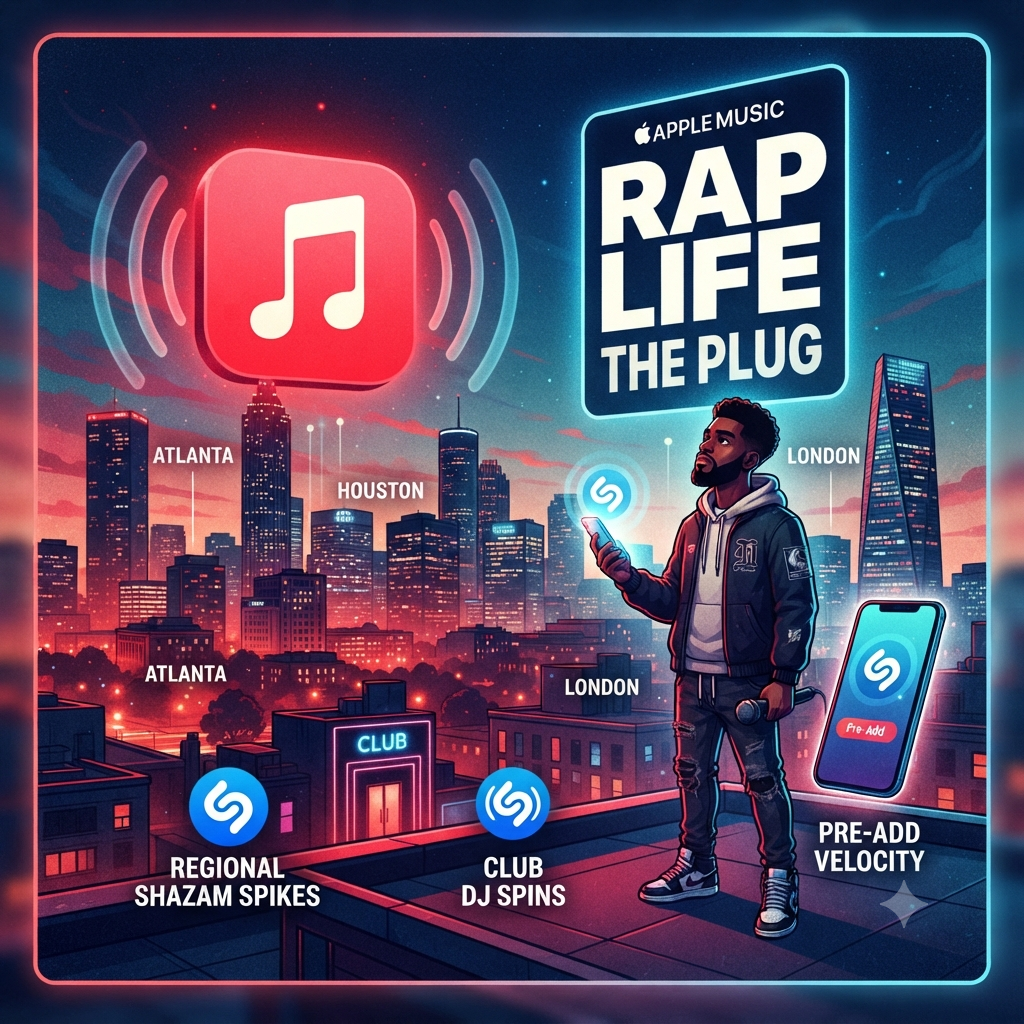
| What Editors Look For | City-specific Shazam spikes, club spins, local radio mixshows | National chart velocity, heavy Pre-Add numbers, massive cultural traction |
| Main Purpose | Break new street records and test audience reaction | Showcase the biggest records dominating hip-hop culture |
1. Engineer Localized Shazam Spikes
One of the biggest secrets in music marketing is how closely Apple Music editors watch Shazam data. Apple owns Shazam, and their internal A&R dashboards are wired directly into Shazam’s search metrics. When a song suddenly starts getting Shazamed hundreds of times in a specific city over a single weekend, it sets off an alarm on an editor’s screen.
Instead of running broad, nationwide ads that spread your budget too thin, focus on creating a concentrated data spike in one or two cities—whether that is your hometown or a major hip-hop market like Atlanta, Houston, or New York.
A smart trick used by savvy indie teams is running geo-targeted short-form video ads on TikTok, Instagram Reels, and YouTube Shorts without putting the song title or artist name in the text. Pick the hardest 15 seconds of your hook, target a specific metro area, and let the music play over a compelling visual. When people hear a track slap on their feed and cannot see the name of the song, their natural instinct is to hit the Shazam button.
You can do the exact same thing offline. If you are performing at local showcases, college parties, or open mics, have someone in your crew encourage the crowd to Shazam the track while you perform it. A sudden cluster of Shazams coming from the exact same zip code on a Friday night tells Apple’s regional scouts that a record is breaking organically in the streets.
2. Win Over Club DJs and Tastemaker Radio
Hip-hop has always broken from the clubs and the streets upward, and Apple Music’s curators still respect that tradition. Because Apple runs its own global live radio stations like Apple Music 1, its editors are constantly talking to club DJs, mixshow hosts, and nightlife tastemakers to find out what is actually working in the room.
If a DJ plays your record at 1:00 AM and the crowd goes crazy, that carries way more weight with an Apple editor than a thousand passive streams from a random playlist. To get your record into DJ crates, you need to treat your rollout like a proper street campaign:
-
Service Record Pools Early: Upload clean, dirty, instrumental, and acappella versions of your single to respected DJ pools like DJcity, BPM Supreme, or Heavy Hits at least a month before your official release date. DJs cannot spin your record if they do not have the right versions formatted for their sets.
-
Document the Crowd Reaction: If you are working with club promoters or local DJs to get spins, make sure someone is filming the booth and the dance floor when your track drops. Having crisp video proof of a packed club singing your hook gives your distributor real ammunition when they pitch your song to Apple.
-
Build Relationships with Radio Mixshow DJs: Local FM late-night mixshows and prominent internet radio stations are heavily monitored by editorial scouts. Getting a co-sign from a respected regional DJ puts your name directly in the conversation.
3. Build Real Apple Music Pre-Add Velocity
While other streaming platforms obsess over Pre-Saves, Apple Music places massive importance on Pre-Add velocity. When a fan Pre-Adds your upcoming single or EP, it automatically drops into their Apple Music library the second it goes live. To an editor, high Pre-Add numbers prove that real people are actively anticipating your release—not just passively stumbling across it.
Never rush a release date. Set up your distribution at least three to four weeks in advance so you have plenty of runway to collect Pre-Adds. Instead of just posting a generic smart link and hoping people click the Apple button, give your core supporters a specific reason to Pre-Add on Apple Music. Offer an unreleased freestyle, a private Discord link, early access to merch, or free entry to your next local show for anyone who sends a screenshot of their Pre-Add.
Consistency leading up to release week is everything. You want steady upward momentum across all your channels so that when your track finally lands on a curator’s desk, the numbers back up the hype. Many independent artists build the foundational streaming velocity required to catch editorial curators’ attention with our hip-hop playlist networks, using third-party momentum to validate their track’s appeal before pitching major platforms.
4. Nail Your Distributor Pitch and Profile Aesthetics
Unlike Spotify, which lets every artist submit one unreleased track directly through their artist dashboard, Apple Music relies primarily on distributor and label relations teams to pitch records for flagship playlists like Rap Life and The Plug.
If you use a reputable distributor like DistroKid, TuneCore, UnitedMasters, or EMPIRE, check their dashboard for editorial pitching forms or marketing submission portals. You should submit your release at least three weeks ahead of drop day. When you fill out that pitch form, skip the generic fluff about how hard you worked in the studio. Editors read hundreds of pitches a week—they only care about leverage and data. List your exact Shazam numbers, name the specific DJs spinning your track, mention any press coverage, and highlight your Pre-Add totals.
Finally, make sure your Apple Music for Artists profile looks like you belong on a major playlist. Claim your account early, upload a sharp, high-resolution press photo, and keep your bio clean and updated. Before an editor puts your song next to Future, Drake, or Kendrick Lamar, they are going to click on your profile. If your page looks unfinished or amateurish, they will move on to the next record.
Build the metrics editorial scouts look for. Submit your release to the Music Submission Portal.
Breaking onto Rap Life or The Plug is not about finding a secret backdoor. It is about building undeniable heat in your city, getting real DJs behind your music, driving Pre-Adds, and giving Apple Music’s editors the exact real-world data they are already looking for.