


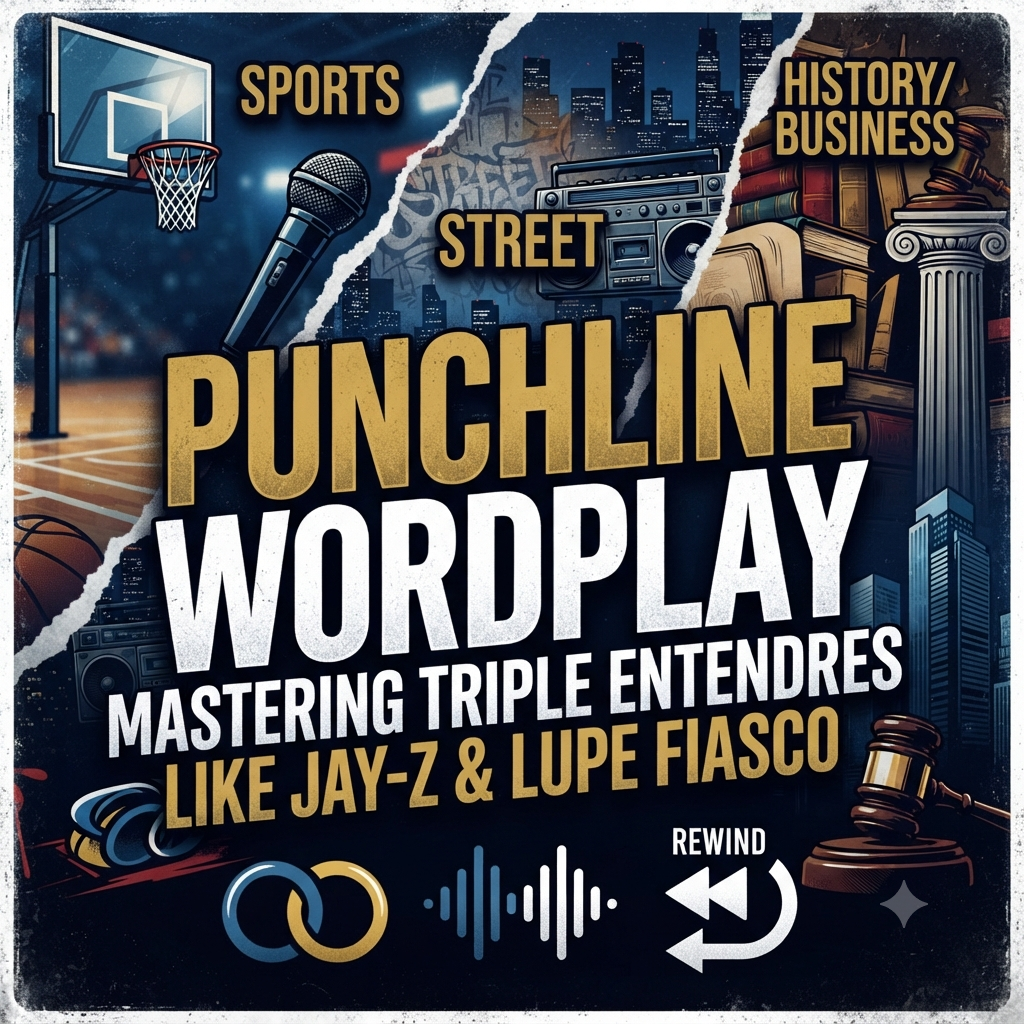
Punchline Wordplay: How to Write Double and Triple Entendres in Rap Like Jay-Z & Lupe Fiasco
There is a very specific feeling every hip-hop fan knows by heart. You are listening to a track for the first time, nodding along to the pocket, when a line hits you so hard you physically reach for the scrub bar to rewind it twenty seconds. You catch the surface meaning first. Then, on the second spin, you catch the street flip. By the third spin, you realize the rapper was also talking about a 1994 NBA playoff game or a piece of American history the entire time.
That is the difference between a decent punchline and true lyrical architecture.
Anyone can rhyme two words together, and plenty of writers can pull off a basic simile. If you want to separate yourself from the pack, though, you have to learn how to write double and triple entendres in rap. At the highest level—think Jay-Z in his prime or Lupe Fiasco dissecting an entire concept over sixty-four bars—wordplay isn’t just about sounding clever. It is about packing two or three completely separate worlds into one single phrase without making the sentence sound clunky or forced.
If you are trying to level up your pen game, treat this as your workshop. Let’s break down how the greats actually build these bars, why certain words act as cheat codes for layered writing, and the exact steps you can use to write rewind-worthy punchlines of your own.
What Actually Makes a Double or Triple Entendre Work?
Before you start filling notebooks, it helps to strip away the textbook definitions and look at how rap wordplay actually functions in the human ear. Hip-hop is an audio-first medium. When you spit a bar, the listener hears the phonetics before their brain sees the spelling on a Genius lyric page.
Because of that, almost every great multi-layered bar relies on one of two mechanics:
-
Homophones and Near-Homophones (Sound-Alike Pivots): These are words or phrases that sound identical when spoken aloud, even though they are spelled differently and mean completely different things. Think reign and rain, prophet and profit, or karats and carats. When you drop a homophone cleanly, the listener’s brain has to process both definitions at the exact same time.
-
Polysemous Words (One Word, Multiple Worlds): Certain English words naturally live in several different subcultures at once. Words like court, brick, scale, draft, clip, rock, and bar are absolute goldmines for lyricists. Why? Because a single word like court belongs to basketball, the legal system, street territory, and royal history all at the same time.
When you combine a polysemous word with a sharp homophone, you suddenly have the raw materials for a triple entendre.
The Jay-Z Approach: Conversational Economy and Three-World Collisions
One of the biggest misconceptions young rappers have about complex lyricism is thinking they need to swallow a thesaurus to sound deep. Jay-Z built a Hall of Fame career doing the exact opposite.
Hov’s superpower has always been conversational economy. He rarely uses big, academic words. Instead, he takes everyday street slang and places it right at the crossroads of three distinct eras of his life: hustling in Marcy, owning a piece of an NBA franchise, and sitting in corporate boardrooms.
Take a classic Jay-Z bar like “I’m not a businessman; I’m a business, man”—or look at how he flips words like rock, nets, weight, and keys. When Jay talks about moving weight or owning the net, you are hearing three different stories in one breath:
-
The Street Layer: Moving product in Brooklyn during the nineties.
-
The Sports Layer: His ownership stake in the Brooklyn Nets and his agency, Roc Nation Sports.
-
The Executive Layer: Net worth, business leverage, and corporate equity.
The lesson for your own writing: Stop looking for obscure words. Look at the ordinary words you already use every day and ask yourself where else those exact words are native slang. If a word works on the block, on the hardwood, and in a bank, you have a triple entendre waiting to happen.
The Lupe Fiasco Approach: Structural Engineering and Extended Concepts
If Jay-Z is a master of the effortless two-bar flip, Lupe Fiasco is a structural engineer who builds entire songs on three parallel tracks.
Lupe doesn’t just drop a triple entendre and move on to the next topic; he often weaves a triple meaning through an entire sixteen-bar verse—or an entire album track like “Mural” or “Failure.” When Lupe writes a layered verse, he is usually running three completely separate movies at once:
-
Track 1 (The Visual Scene): A concrete, literal image you can picture right away—like someone driving a sports car, playing a video game, or painting on a canvas.
-
Track 2 (The Historical or Political Subtext): A commentary on systemic oppression, American history, war, or philosophy running right underneath the literal scene.
-
Track 3 (The Meta-Lyrical Layer): A direct comment on the rap game, his own career, or the mechanics of writing rhymes itself.
The magic of Lupe’s style is how every noun and verb reinforces the others. If he uses a word from art history in line one, he will pair it with a word from street warfare in line two that also happens to be an art term. Once you catch the second meaning, the entire verse unlocks a third layer you completely missed on the first listen.
Step-by-Step Workshop: How to Write Double and Triple Entendres in Rap
You don’t have to wait for divine inspiration to write bars like this. You can treat it like a mechanical drill during your writing sessions. Next time you sit down to write a verse, run through these four steps.
1. Build a “Pivot Word” Grid
Start with a single anchor word that carries at least three legit meanings across unrelated fields. Stay away from tired clichés (like bread for money) and look for words that cross over between sports, finance, history, music, and street vernacular.
2. Map Out the Homophones
Once you pick your pivot word, say it out loud—don’t just look at it on paper. Write down every word or two-word combination that sounds identical when delivered in your natural cadence.
-
Example: Capitol (the government building in D.C.) / Capital (investment money / uppercase letter / punishable by death).
-
Example: Reign (a king’s rule) / Rain (weather / throwing cash / gunfire) / Rein (holding back a horse / control).
-
Example: Cents (money) / Sense (common logic) / Scents (colognes or smells).
3. Build a Setup Line That Bridges the Worlds
A punchline falls flat if the listener has to pause the song just to decode basic grammar. Your setup bar—the line right before the punch—needs to establish the surface meaning smoothly while planting subtle triggers for the hidden layers.
If your punchline pivots on the word Draft, use your setup line to casually mention either basketball, war, or writing. That way, when the punchline lands, the listener’s brain already has the bridge built to connect the two other meanings immediately.
4. Put It Through the “First-Listen” Test
Read your two-bar couplet out loud over the beat. Ask yourself one honest question: Does this sentence make 100% logical sense to someone who only catches the surface meaning?
If the sentence sounds awkward, robotic, or twisted backward just to make a pun fit, scrap it and rewrite it. The hardest-hitting triple entendres sound completely casual on the first listen. The listener shouldn’t feel like they are solving a math equation—they should feel like they just uncovered a secret hidden in plain sight.
Three Mistakes That Ruin Good Wordplay
Even talented lyricists ruin great concepts by tripping over a few common habits:
-
Using “Yoda Syntax”: Never twist your sentence structure backward just to force a homophone to land on the snare drum. If nobody would ever say the sentence in a real conversation, it loses its punch.
-
Over-Explaining the Bar: Trust your listeners. Nothing kills the thrill of a double entendre faster than following it up with “get it?” or explaining the second meaning in the next line. Let the people who catch it feel smart for catching it.
-
Losing the Pocket: A triple entendre means nothing if your flow stumbles while you deliver it. Cadence and rhythm always come first. If cramming a third meaning into a bar ruins your breath control or pocket, strip it down to a razor-sharp double entendre that rides the beat effortlessly.
Ready to Get Your Bars Broken Down by Real Hip-Hop Heads?
Spending hours crafting multi-layered verses is only half the battle—when you finally drop the record, you want listeners and critics who actually catch the references you spent all night piecing together. When your next single or project is ready for the world, ensure your intricate wordplay gets the analytical breakdown it deserves via our music review portal.
Submit Your Latest Release: Find the right editorial write-up option for your latest release. Secure your slot via our Music Review Portal.









Liked the sounds of beats playing, we shared you here http://www.thewrapupmagazine.com/2018/01/alien-mammalian-cosmic.html