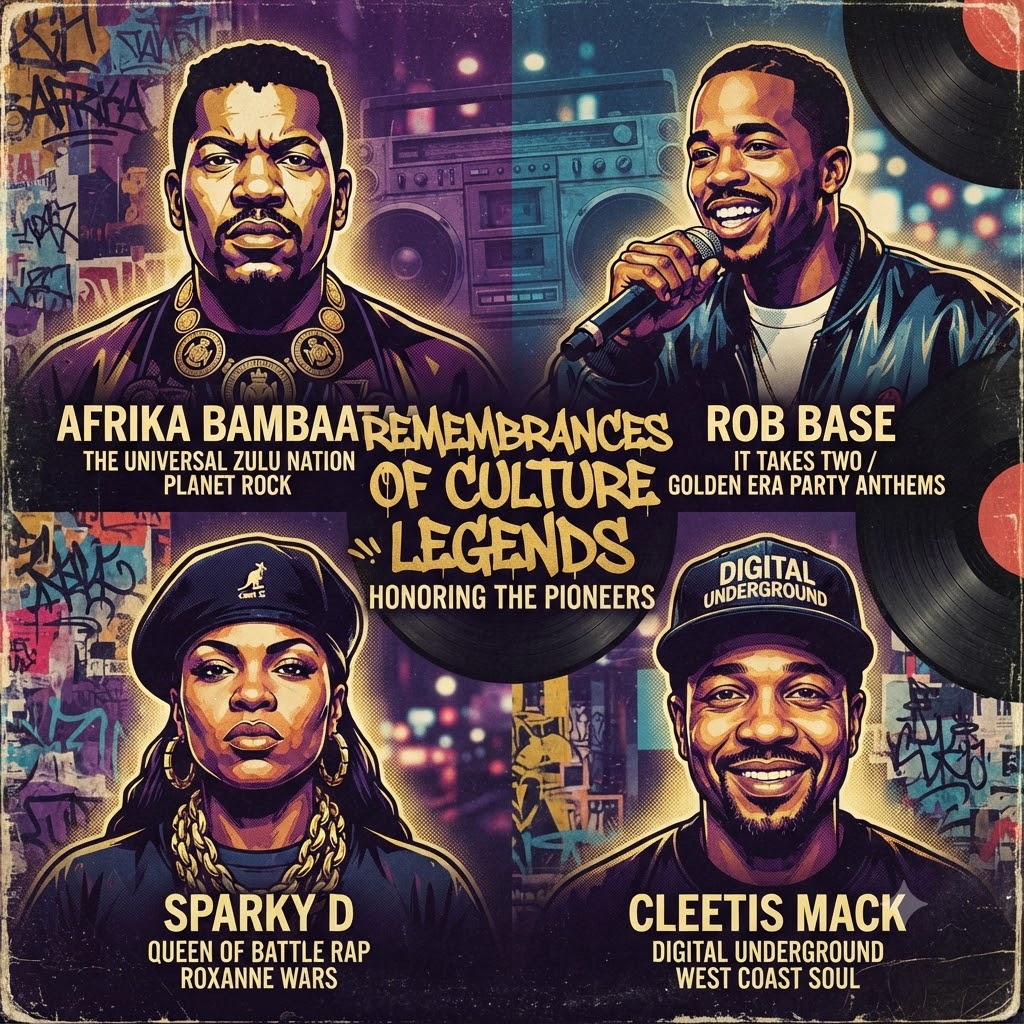
Remembrances of Culture Legends: Honoring the Architects and Icons Who Shaped the Golden Era of Hip-Hop
Hip-hop culture isn’t just a genre of music; it’s a living, breathing archive of history, survival, innovation, and community. Every 808 kick, every turntable scratch, and every cadence we hear today stands on the shoulders of the architects who built this culture from the ground up in the parks, basements, and recording studios of decades past. Lately, the music community has had to pause and reflect heavily, mourning the loss of several foundational figures whose contributions altered the course of modern music forever.
When we talk about the passing of icons like Afrika Bambaataa, Rob Base, Sparky D, and Digital Underground’s Cleetis Mack, we aren’t just reading obituaries. We are looking at chapters of cultural history closing. These artists were visionaries who gave voice to marginalized communities, turned local movements into a global phenomenon, and left behind catalogs that continue to inspire generation after generation. Let’s take a deep dive into the lives, careers, and enduring impact of these culture legends.
Afrika Bambaataa: The Universal Soundbuilder and Global Visionary
To understand how hip-hop evolved from a hyper-local South Bronx subculture into a worldwide empire, you have to look at the monumental footprint of Afrika Bambaataa. As the founder of the Universal Zulu Nation, Bambaataa recognized early on that hip-hop could be used as a vehicle for peace, unity, and self-expression, steering youth away from destructive street gang violence and toward artistic competition through the four pillars: DJing, MCing, breakdancing, and graffiti writing.
Musically, Bambaataa completely altered the trajectory of popular culture with the 1982 release of “Planet Rock.” By fusing the eerie, futuristic synthesizer melodies of German electronic pioneers Kraftwerk with the heavy, driving funk breaks of James Brown, he birthed the electro-funk and hip-hop crossover genre. “Planet Rock” wasn’t just a song; it was a blueprint that showed producers everywhere that electronic music and urban street rhythms could collide in spectacular fashion.
Of course, Bambaataa’s later years involved complex controversies and severe public scrutiny that heavily damaged his standing in the community. Yet, looking at the pure timeline of the culture, his foundational role in organizing the Zulu Nation and codifying the early aesthetics of hip-hop remains a historical reality. His early efforts helped export hip-hop across international borders, ensuring that kids in Europe, Asia, and beyond could pick up a turntable or a can of spray paint and find their own community.
Rob Base: The Voice of Pure Celebration and Golden Era Club Royalty
If Afrika Bambaataa built the experimental foundation, Rob Base (born Robert Ginyard) came along and threw the ultimate party on top of it. Teaming up with his lifelong friend and partner DJ E-Z Rock in Harlem, Rob Base delivered a track in 1988 that would instantly become immortalized in music history: “It Takes Two.”
Sampling Lyn Collins’ heavy funk vocal loop from “Think (About It)” and wrapping it around an infectious, high-energy rhythm, “It Takes Two” captured the absolute essence of late-80s hip-hop club culture. Rob Base’s delivery was smooth, charismatic, and completely focused on one thing: making sure nobody stayed seated. The track became a massive crossover success, dominating radio airwaves, street corner boomboxes, and roller rinks across the globe.
Rob Base proved that hip-hop could be universally celebratory. Decades later, you can still drop “It Takes Two” at a wedding, a sporting event, a festival stage, or a backyard cookout, and watch people of all ages rush the dance floor. It’s a testament to the timeless joy embedded in his music, reminding us that hip-hop has always been about bringing people together to have a good time.
Sparky D: A Trailblazing Queen of the Battle Rap Arena
Long before battle rap leagues became heavily structured digital phenomena, the battle scene was forged on wax and park stages. During the golden era of the mid-1980s, Doreen Broadnax—universally known to hip-hop history as MC Sparky D—stepped into the ring and proved that female MCs were an absolute powerhouse in a heavily male-dominated landscape.
Sparky D rose to prominence during the legendary “Roxanne Wars,” a massive series of answer records sparked by UTFO’s hit “Roxanne, Roxanne.” Dropping fierce tracks like “Sparky’s Turn (Roxanne You’re Through),” she didn’t just respond to a trend; she dominated it with razor-sharp lyricism, unmatched breath control, and an undeniable competitive fire. She stood toe-to-toe with the best lyricists of her era and carved out a permanent space for women in rap.
Later in life, Sparky D made a powerful pivot, transitioning from secular battle anthems into ministry and gospel hip-hop. She used her platform to mentor younger artists, share her survival stories, and guide others through the turbulent waters of the music industry. Her legacy is one of pure resilience—showing that true hip-hop royalty isn’t just about winning battles, but about adapting, surviving, and using your voice to uplift your community.
Cleetis Mack: The Quiet Strength and Soul of Digital Underground
When people talk about West Coast hip-hop, groups like N.W.A or Snoop Dogg often dominate the conversation, but the Bay Area’s Digital Underground introduced a wildly inventive, eccentric, funk-infused alternative that changed the West Coast landscape forever. Behind the quirky outfits, comedic alter egos, and Parliament-Funkadelic samples was a tight-knit family of musicians, and Cleetis Mack (Clee) was a vital driving force within that collective.
Joining Digital Underground in 1993 during the era of The Body-Hat Syndrome, Cleetis Mack brought a deep musicality, loyalty, and steady presence to the crew. While characters like Shock G and Humpty Hump grabbed the spotlight with theatrical antics, Mack was a crucial foundational element of the group’s live sound and studio production. Fans of the golden era fondly remember his contributions to standout cuts like “Wussup Wit the Luv”—which famously featured an appearance by a young Tupac Shakur during his time touring with the group.
Mack’s passing leaves a heavy silence in the extended Digital Underground family. He represented the hardworking, unsung musicianship that allows eccentric frontmen to shine. His work reminds us that behind every massive group success are dedicated artists who put everything they had into the craft, away from the flashing cameras and mainstream spotlight.
Why Preserving Hip-Hop’s History Matters More Than Ever
Losing legends like Afrika Bambaataa, Rob Base, Sparky D, and Cleetis Mack in relatively close proximity serves as a sobering reality check. Hip-hop is no longer a young, rebellious teenage genre; it is a mature, historical art form entering its fifth decade. The pioneers who invented these styles are aging, and every time we lose one of them, a piece of living history goes with them.
These artists didn’t just write rhymes or cut records—they built cultural institutions from scratch with very little infrastructure, turning raw talent and resourcefulness into a global economy. As current music journalists, fans, and creators, our responsibility is to keep their stories alive. We need to do more than just stream their legacy tracks on anniversaries; we need to study the samples, understand the socio-political contexts they came from, and respect the heavy groundwork they laid down.
The culture survives only as long as we remember who handed us the torch.