How to Pitch Songs for New Year’s Eve Party Playlists (High-BPM Club & Trap Anthems)
Getting an independent track onto a New Year’s Eve party playlist comes down to one basic reality: you are competing for the loudest hour of the entire year. Between December 28 and January 2, streaming habits completely pivot. Nobody is looking for introspective storytelling, intricate acoustic arrangements, or slow-burn soundscapes when midnight is approaching. Curators, room runners, and house party DJs want raw momentum, heavy low-end, and pure energy.
If you want to know how to pitch songs for New Year’s Eve party playlists, you have to look past standard pitch templates. You need to understand how peak-hour holiday queues are assembled, how curators filter high-tempo submissions, and how to structure independent trap and club records so they slide seamlessly alongside heavy commercial hits.
Here is the straightforward breakdown of how to prepare your music, nail your timing, and land your high-BPM records on active NYE lists.
1. The Sonic Blueprint: What Makes an NYE Anthem Work?
Playlist curators build NYE sets backward from midnight. The music played between 11:00 PM and 1:00 AM serves a distinct job: keeping a crowd moving without letting the room cool down. If your submission forces a DJ or host to reach for the skip button, it won’t make the cut.
To survive the first ten seconds of an editorial or independent audit, your record needs to fit three core structural criteria.
Keep the Tempo Above 130 BPM
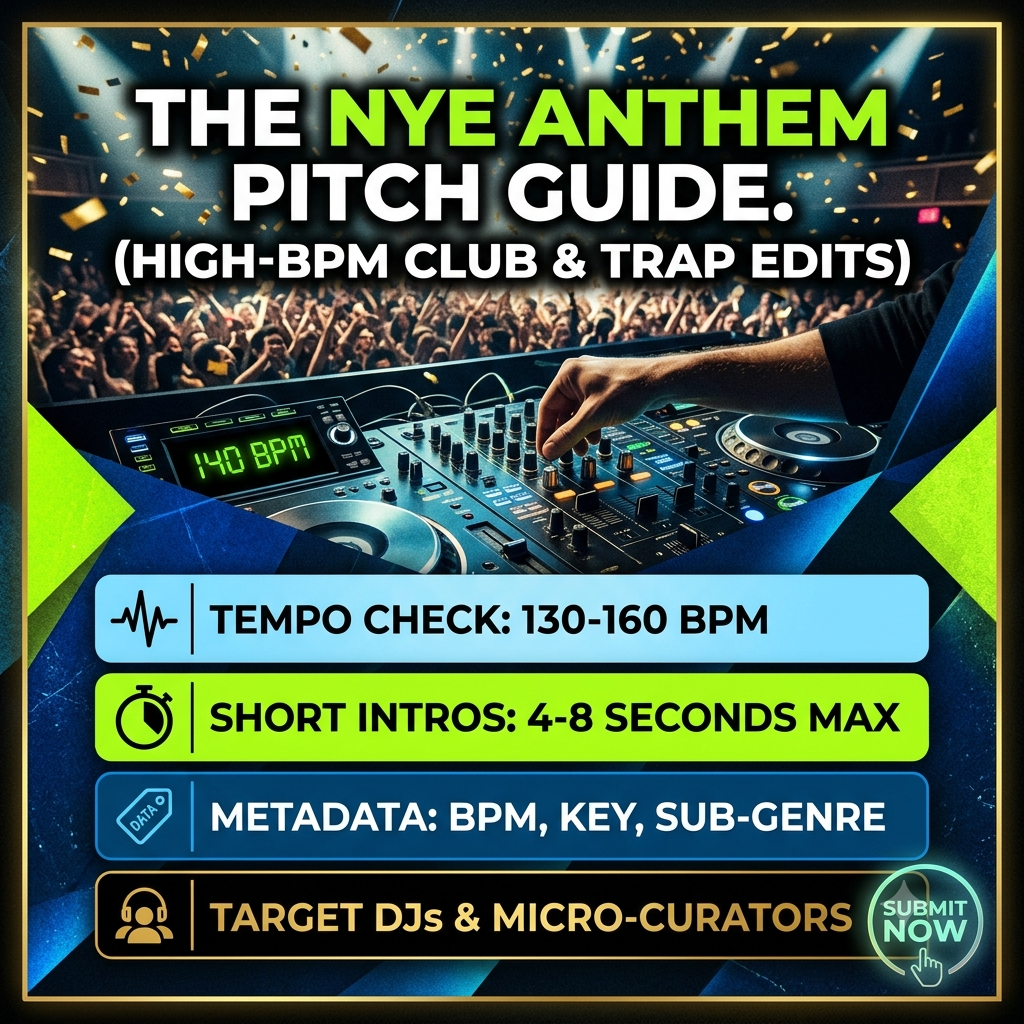
Peak-hour holiday lists live on speed and bounce. Aim for a native tempo of 130 to 160 BPM, or a half-time trap grid sitting between 65 and 80 BPM with dense, rolling hi-hats and double-time percussion. Slow tempos kill momentum. Even if your track hits hard at 105 BPM, it creates an awkward dip when placed next to fast-paced club records.
Cut the Intros Down to the Bone
Long, atmospheric 30-second intros do not work on event-driven playlists. In a crowded party setting, a quiet half-minute opening feels like dead air.
-
Your intro should establish the main rhythm within 4 to 8 seconds max.
-
If possible, jump straight into the hook or a distinct vocal drop.
-
Curators test submissions by clicking directly into the first five seconds; if nothing happens, they move on to the next file in their inbox.
Strip Out Slow Bridges and Unexpected Beat Switches
Mid-song energy drops are immediate playlist risks. A long breakdown, a soft bridge, or an experimental outro works great on a studio album, but on a party playlist, it drains the room’s energy. Keep your low-end driving, maintain a steady bounce, and ensure the energy level at minute two matches the energy level at minute one.
2. Setting Up Your Pitching Window
Timing your outreach is just as critical as the record itself. A common mistake independent artists make is submitting their tracks on December 30 or 31. By that point, curators have already locked their sequences, tested their crossfades, and shared their links across social channels.
The heavy lifting happens weeks before the holiday actually lands.
3. How to Package Your Submission (Without Looking Like Spam)
Curators skim through hundreds of emails and submission links every afternoon during December. They are not reading lengthy artist bios, press releases, or backstories about your creative process. They want clear, functional details so they can instantly judge where your song fits.
Keep your pitch direct, professional, and informative.
Metadata Checklist
When you reach out, make sure the following details are easy to spot right at the top of your message:
-
Track Title & Artist Name (Matching your streaming profiles exactly)
-
Exact BPM and Key Signature (e.g., 142 BPM / D Minor)
-
Sub-Genre & Vibe Markers (e.g., Hard Trap, Jersey Club, Festival Hype)
-
Mix Details (Mastered for high-volume playback, explicit or clean option available)
-
Direct Streaming & Download Links (Use accessible streaming or audio player links rather than bulky email attachments)
Subject: NYE Playlist Pitch: [Artist Name] - "[Track Title]" (140 BPM Trap / Club Anthem)

Hey [Curator Name],

Hope your holiday season is off to a strong start.

I’m reaching out with a high-energy trap record built for peak-hour NYE party queues. It sits at 140 BPM, features an immediate vocal hook, and holds a heavy low-end end-to-end with no mid-song energy dips.

- Track: [Artist Name] – "[Track Title]"
- BPM / Key: 140 BPM / G Minor
- Vibe: Festival Trap / Club Anthem
- Link: [Streaming Link]

Appreciate your time and consideration for your upcoming holiday rotations!
Providing specific details shows you understand how playlist placement works. You aren’t just asking for a spot; you are telling the curator exactly where your track fits into their set—such as the high-intensity block right around midnight.
If you want to cut through the noise and land direct placements, you can get your high-energy records into celebration queues through our independent music promo network.
4. Don’t Ignore Independent and User-Curated Playlists
Major editorial playlists get thousands of pitches a day, but they aren’t the only driver of holiday streams. User-generated lists, working DJ rotations, and independent platform networks draw massive traffic on New Year’s Eve.
When people host house parties, they frequently search for specific party themes like “NYE 2027 Hype,” “Banger Trap Party,” or “Midnight Club Mix.”
-
Reach out to working DJs: Local and touring DJs build custom sets on streaming platforms to test tracks before performing. A placement on a DJ’s personal prep list often translates directly to live spins.
-
Target active micro-curators: Independent curators with lists of 1,000 to 10,000 engaged followers often yield higher completion rates and better listener retention than massive, unspecific playlists.
-
Leverage promo networks: Partnering with established promotional hubs allows you to tap into existing distribution channels without spending weeks hunting down individual email addresses.
5. Master Output and Sonic Consistency
One final detail that frequently trips up independent artists is mastering volume. If your track is mastered quiet compared to commercial club releases, a DJ or curator will hear an immediate drop in volume when your song comes on.
Before pitching your track, check your master against commercial benchmarks in your genre. Ensure your low-end is tight and punchy without distorting at louder playback levels. A clean, competitive master makes your track feel right at home alongside major-label records, instantly boosting its chances of staying in the queue all night long.
🚀 Lock In High-Energy Spins for Your Biggest Records
Don’t let your high-BPM club anthems sit on the shelf this holiday season. Get your tracks featured on active party playlists when streaming traffic hits its absolute peak.