How to Pitch Music Blogs for “Best Verses of the Month” Editorial Roundups
Landing a spot on a “Best Rap Verses of the Month” list is low-key one of the biggest co-signs an independent lyricist can get. Platforms like Complex, Stereogum, and dedicated underground rap blogs regularly publish these roundups to shine a light on raw pen game, insane pocket flows, and lines that make you rewind the track. But if you glance inside a music editor’s inbox on any given Monday, you’ll see why 99% of submissions get deleted without a second thought. Most artists send the same lazy, copy-pasted email: “Hey fam, check out my new single, it’s a banger!”
That is not how you pitch a culture writer. Editors curating verse roundups aren’t looking for broad promotional hype—they’re looking for specific moments of genius. If you want to figure out how to pitch music blogs best rap verse placements, you have to stop pitching your entire song and start pitching the exact 16-bar pocket that makes your track special.
Here is the exact blueprint for pulling out your best bars, dissecting your technique on paper, and landing your music on monthly editorial best-of lists.
1. Stop Pitching Tracks—Start Isolating the “16”
The biggest mistake artists make when reaching out to music publications is dumping a whole album or a full 4-minute track on an overworked editor. When a writer sits down to assemble a monthly verse list, they are looking for specific high-water marks in lyrical performance.
Before you draft a single email line, sit down with your project and ruthlessly audit your own work. You are looking for one specific section that stands completely on its own feet.
What makes a verse pitch-worthy?
-
Intricate Technical Construction: We’re talking dense multi-syllabic rhyme schemes, internal cadence switches, compound rhymes, and flawless pocket control.
-
Layered Wordplay: Lines that require a second listen to fully unpack—double entendres, extended metaphors, subtext, and sharp pop-culture or historical references.
-
Concept and Narrative Impact: A verse that stops the listener in their tracks because of its emotional weight, vivid storytelling, or sharp social commentary.
If a verse is just a standard, catchy verse designed to bridge a chorus, skip it. Pick the verse where you genuinely flexed your highest level of writing. When you hand an editor a pre-selected 16-bar stretch, you save them time and signal right away that you understand what their column is actually about.
2. Transcribe Your Bars and Highlight the Scheme
Writers read fast. If your pitch is just a block of plain text, the technical brilliant work you put into your rhyming scheme can easily get lost. You need to make your pen game jump off the screen before the editor even hits the play button.
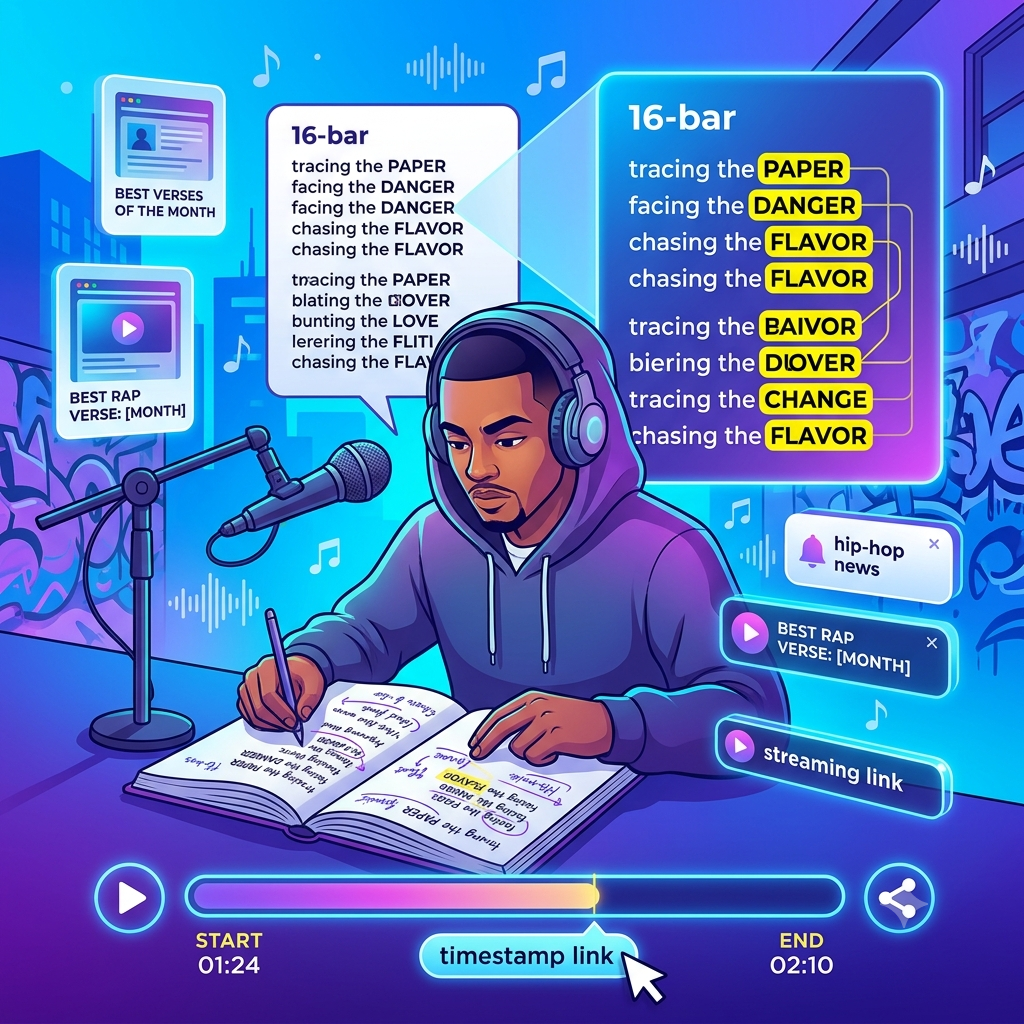
Instead of just pasting your lyrics, transcribe the section and visually map out your multi-syllabic rhyme scheme directly inside the email body.
Visual Layout Tip:
Use bolding or italics to highlight corresponding rhyme sounds. Use clean line breaks that map to your actual breath control and delivery pocket, rather than standard grammatical sentences.
Here’s what a lyric breakdown should look like in your pitch:
“I’m tracing the paper, facing the danger /
Chasing the flavor, turning strangers to neighbors /
Got the pen game insane, never chasing the fame /
Just mapping out the pain till they remember the name.”
When you annotate your own lyrics, you aren’t being pretentious—you’re showing respect for the craft of music journalism. You’re giving the writer a head start on their article write-up. If they can immediately see how your internals line up on the page, they are ten times more likely to give the audio a serious listen.
3. Kill the Friction: Use Timestamped Streaming Links
Music journalists deal with hundreds of emails every single day. If they open your link and have to scrub through a two-minute intro, a long hook, and a skippable feature verse just to find the bars you talked up in your pitch, they’ll close the tab.
Your job is to get them to the exact second your pocket starts with zero effort on their end.
How to format your links:
-
YouTube Links: Use YouTube’s timestamp feature. Click Share, check the Start at box, or manually add
&t=XmYsto the end of your URL (for instance:[youtube.com/watch?v=EXAMPLE&t=1m45s](https://youtube.com/watch?v=EXAMPLE&t=1m45s)). -
Spotify / Apple Music: Since deep-linking directly to a exact second on standard DSPs can be clunky, explicitly write the time range in bold right next to the link: [Listen on Spotify – Verse Starts at 01:45].
-
Private Soundcloud / Bandcamp: If the track is unreleased, make sure the private link doesn’t require a password download step, and drop the timestamp in your text note.
The fewer clicks an editor has to make to hear your best line, the higher your chances of getting picked up for that month’s roundup.
4. Draft a Clean, No-BS Pitch Email
Keep your pitch short, focused, and respectful of the writer’s time. Mentioning a specific article they wrote recently proves you actually read their work and aren’t just blasting a blind mailer list.
Here is a straightforward template you can adapt:
Subject: Pitch: Best Rap Verses of [Month] - [Artist Name] ("Track Title")

Hey [Editor's Name],

Loved your write-up on [Artist Name]'s verse in last month's roundup—that breakdown on their cadence switches was spot on.

I'm reaching out to submit a standout 16-bar verse from my new release, "[Track Title]," for your upcoming "Best Rap Verses of [Month]" feature consideration.

• Track: [Song Title]
• Verse Timestamp: 01:20 - 02:10
• Direct Link: [Insert YouTube/DSP Timestamped Link]

Here is a quick look at the multi-syllabic scheme and internal rhyme structure in the second verse:

"[Insert 4 to 8 lines of transcribed lyrics with bolded rhyme schemes]"

[Add 1-2 brief sentences giving context—like who produced the track, the story behind the song, or a key thematic point.]

Appreciate your time and everything you do to highlight independent lyricism!

Best,

[Your Name / Stage Name]
[Link to Press Kit / Socials]
5. Build Long-Term Relationships vs. Direct Submissions
Pitching cold inboxes is a numbers game, and building genuine rapport with writers takes time. You might send ten perfectly formatted pitches and only get two replies. That’s completely normal. The key is to keep showing up with quality music while respecting the editorial workflow.
However, if you have a key release date approaching and need guaranteed eyes on your work, combining organic outreach with established review channels can speed up your results. For instance, you can put your pen game directly in front of seasoned culture writers through our rap blog review service, which cuts through the cold-email clutter and gets your music evaluated by editors actively listening for top-tier pen game.
Winning over hip-hop editors isn’t about having a massive budget or millions of followers; it’s about respecting the art of lyrical rap and making the writer’s job as easy as possible. Pull out your sharpest 16, lay out the rhyme schemes clearly, send direct timestamped links, and pitch with confidence.
Get Reviewed by Industry Insiders
Get your project reviewed directly by our senior editorial staff. Submit your project via our Music Review Submission Portal.