Setting Up an Apple Music Station for Your Artist Profile: The Complete Guide to Curated Playback & Algorithm Optimization
For independent artists, producers, and music marketers, cracking the code of platform algorithms often feels like chasing a moving target. You spend weeks recording, mixing, mastering, and distributing a track, only to wonder how some artists effortlessly pull in thousands of passive listeners through automated radio streams while others stall out.
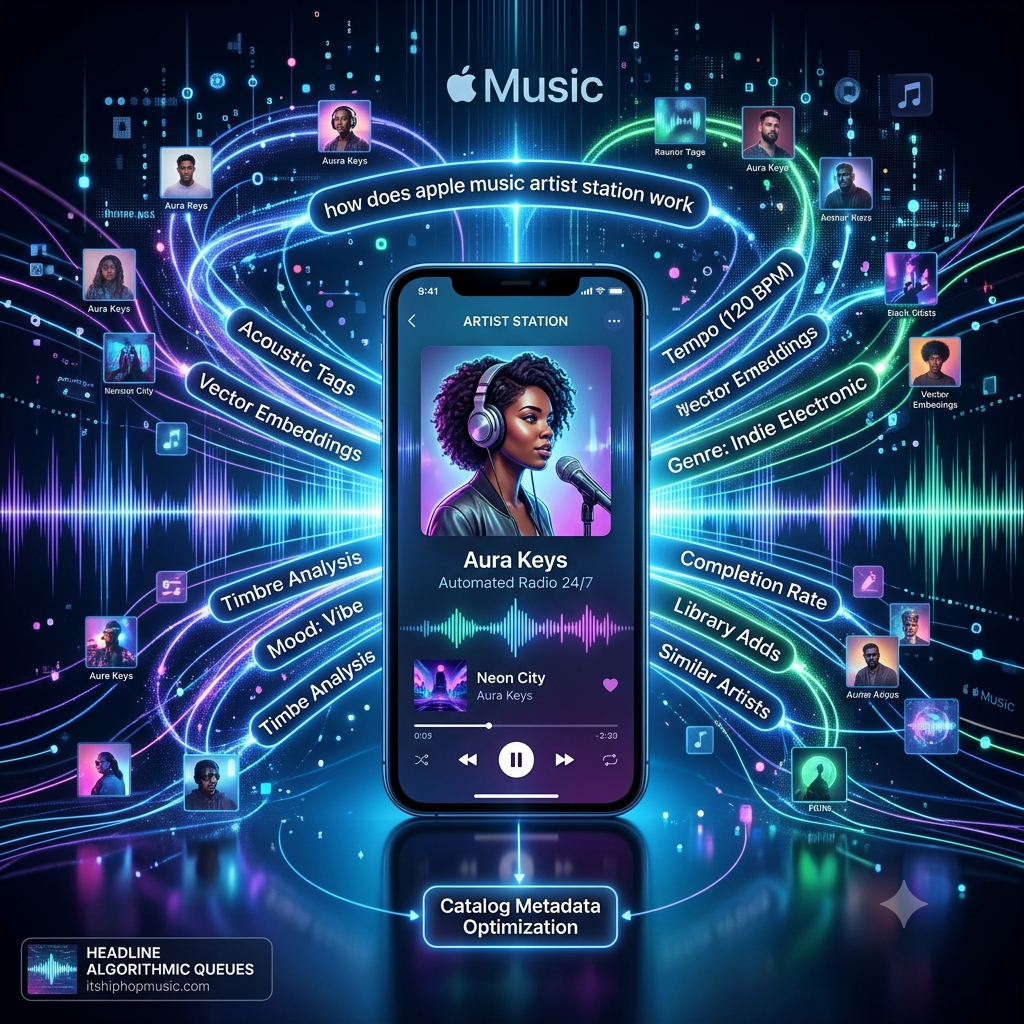
One of the most powerful, yet frequently misunderstood, discovery engines in the streaming ecosystem is the Apple Music artist station. When a fan or a casual listener taps “Create Station” on your profile or track, Apple Music spins up an automated 24/7 radio broadcast tailored to that specific sonic footprint.
Understanding how does apple music artist station work gives you a massive advantage. It allows you to reverse-engineer your release strategy, clean up your catalog architecture, and optimize your metadata so that your tracks headline algorithmic queues instead of getting lost in the digital noise.
The Anatomy of an Apple Music Artist Station
To dominate algorithmic radio, you first need to understand what happens under the hood when someone triggers a station on Apple Music. Unlike static human-curated playlists—which rely on tastemaker editors choosing tracks based on trends, mood, or label relationships—an artist station is a dynamic, machine-learning-driven broadcast.
Apple Music relies on a hybrid recommendation engine that blends collaborative filtering with deep acoustic and vector-based analysis.
Vector Embeddings and Acoustic Clustering
Apple maps songs, albums, and artists as high-dimensional vectors. Think of this as a massive, invisible map where musical attributes are translated into coordinates. The algorithm evaluates underlying acoustic markers:
-
Tempo and Rhythm: Beats per minute, groove structures, and rhythmic cadence.
-
Vocal Timbre: Frequency ranges, texture, processing style, and harmonies.
-
Instrumentation: The presence of live drums, 808s, acoustic guitars, synth pads, or orchestral arrangements.
-
Energy Curves: How a track builds, drops, and resolves dynamically from intro to outro.
If your catalog maintains high sonic consistency, the system easily places you into precise “taste clusters” alongside peer artists. However, if your releases swing wildly from acoustic folk ballads to heavy, distorted trap beats without clear contextual separation, you confuse the embedding model. The algorithm won’t know which listener pool to feed your music into, resulting in erratic radio placement.
Behavioral Feedback Loops (The Signal Hierarchy)
Once an automated station starts playing, the algorithm constantly measures real-time listener behavior to decide what plays next. Apple’s internal signal hierarchy values actions in a strict order of importance:
-
Library Adds: This is the ultimate positive signal. When a user adds your track from a radio station directly to their personal library or playlist, the algorithm registers a high-intent endorsement.
-
Completion Rate (Play-Through Rate): Finishing a track past the critical 30-second mark proves engaging content. If listeners constantly skip your song before the first chorus, the station engine penalizes its rotation weight.
-
Favorites (“Love”) & Shares: These act as active reinforcement signals, telling Apple’s system that this specific track resonates deeply with a particular listener demographic.
-
Skips: Quick skips under 30 seconds act as powerful negative feedback. High skip rates will rapidly push your tracks down in station rotation pools across similar artist seeds.
Catalog Architecture: Why Your Release Strategy Dictates Radio Success
Many independent artists make the mistake of treating digital distribution as a passive dumping ground. They upload singles, EPs, and albums with mismatched credit naming, inconsistent sonic branding, and scattered metadata. If you want Apple Music’s recommendation engine to feature you prominently on automated stations, you have to treat your catalog like a cohesive ecosystem.
Primary Metadata Consistency
It sounds basic, but mismatched primary metadata is one of the leading killers of algorithmic momentum. Ensure your artist name, featuring credits, ISRC codes, and track titles are 100% spotless across every single distributor.
-
If your name is listed as “J. Smith” on one distributor upload, “J Smith” on another, and “J. Smith feat. Producer X” inconsistently, Apple’s database may treat them as separate entities, fracturing your streaming data and diluting the strength of your artist station seed.
Managing Secondary Metadata and Genre Tagging
When you deliver your music through aggregators like DistroKid, TuneCore, CD Baby, or Ditto, you are prompted to select primary and secondary genres, subgenres, and mood tags.
-
Avoid Keyword Stuffing: Don’t select every genre under the sun just to cast a wide net. If you make melodic hip-hop, tagging your music as “Electronic” and “Country” because you used a synth or an acoustic guitar sample will misguide the ingestion classifiers.
-
Precision is Key: Keep your genre tags hyper-accurate. Let the algorithm understand your authentic lane so it can pair your tracks with listeners who actively consume that exact sub-genre.
Tactical Optimizations to Headline Algorithmic Queues
Knowing how the system works is only half the battle. To actively position your music at the forefront of Apple Music radio stations, you need a proactive optimization playbook.
1. Drive First-Week Velocity and Early Engagement
Algorithms heavily weight recent activity and launch momentum. When a new track drops, the system monitors how early adopters interact with it.
-
Mobilize your core community during the first 48 to 72 hours of release.
-
Encourage superfans not just to stream the song, but to add it to their personal libraries and hit the favorite button.
-
High early-window library adds signal to Apple Music that your release has organic pull, prompting the algorithm to inject the track into broader discovery surfaces and automated station rotations.
2. Optimize for the 30-Second Rule
Because completion rates and skip thresholds dictate station survival, your song structure matters more than you think.
-
While artistic expression is boundless, commercial streaming algorithms reward immediate engagement. If your track features a 90-second ambient intro with no drums or vocals, casual radio listeners tuning in via an automated station are far more likely to mash the skip button within the first 15 seconds.
-
Hook the listener early, establish your sonic signature immediately, and protect your play-through rates.
3. Build Cross-Platform Sound Recognition
Algorithms do not operate in a vacuum. Apple Music, Spotify, YouTube Music, and Amazon Music all analyze user listening habits, playlist placements, and web metadata to understand an artist’s cultural footprint. To accelerate how streaming platforms categorize your sonic profile, you need a unified promotional push. You can train streaming recommendation systems to recognize your sound through our Spotify playlist submission services, ensuring that cross-platform data reinforces your genre positioning everywhere your music lives.
Common Misconceptions About Apple Music Artist Stations
As artists experiment with streaming growth hacks, several myths continue to circulate regarding how radio stations operate. Let’s clear them up:
-
Myth 1: “You can manually edit what tracks appear on your artist station.”
-
Reality: You cannot manually curate an automated artist station. The station is entirely algorithmic, built dynamically based on your catalog’s metadata, listener behavior, and collaborative filtering data. You influence the station by shaping your catalog quality and driving genuine fan engagement.
-
-
Myth 2: “Buying bot streams will trick the station algorithm into playing my music more.”
-
Reality: Automated bot farms generate low-retention, high-skip, or unnatural playback loops that trigger fraud detection systems. Not only do bot streams risk having your catalog flagged or removed by distributors, but they also ruin your completion rates and trash your algorithmic data profile.
-
-
Myth 3: “Only major label artists get featured on automated radio queues.”
-
Reality: The algorithm doesn’t care about your label budget; it cares about data signals. An independent artist with 500 hyper-engaged monthly listeners who consistently complete tracks and add songs to their libraries will often see better algorithmic station traction than a major label act with dead, unengaged streams.
-
Conclusion: Turning Single Plays into Compounding Streams
Mastering Apple Music artist stations isn’t about gaming a secret backdoor code—it’s about aligning your release strategy with how modern recommendation engines process audio data. By keeping your catalog metadata clean, respecting the acoustic embedding process, protecting your early-window engagement metrics, and building a cohesive cross-platform presence, you transform single plays into compounding, continuous listening sessions.
When your sound is clear, your metadata is pristine, and your audience is engaged, the algorithm becomes your hardest-working promotional partner, spinning up your music for new fans 24 hours a day, 7 days a week.