Can You Sample Under 30 Seconds of a Song Without Clearance? The Beatmaker’s Myth, Debunked
If you’ve spent more than five minutes on beat-making subreddits, YouTube tutorials, or hanging out in home studios, you’ve almost certainly heard this piece of advice:
“Bro, as long as the sample is under 30 seconds—or under 3 seconds—you don’t need clearance. It falls under fair use.”
It sounds great, doesn’t it? It gives you the green light to flip classic soul chops, rare funk breaks, and obscure Japanese jazz records without having to track down attorneys, label executives, or estate executors.
Here is the cold, hard truth: it is completely, 100% false.
There is no “magic number” in copyright law. Whether your sample is 30 seconds long, 3 seconds long, or a single 0.5-second vocal chop, using copyrighted audio without permission is illegal sample clearance infringement.
If you are trying to build a long-term music career in today’s digital landscape, relying on this urban legend is one of the quickest ways to get your songs yanked off Spotify, have your royalties locked in escrow, or face direct legal action from rights holders.
Let’s dive deep into where this myth actually came from, what the law really says about sample clearance, how modern technology catches micro-chops, and how you can protect your music.
The Origin Story: How Did the “30-Second Rule” Start?
Urban legends rarely pop up out of nowhere—they usually start with a kernel of real information that gets mangled as it passes through word-of-mouth. The 30-second sampling myth is a Frankenstein mix of three totally unrelated concepts:
1. The iTunes Preview Era
Back when iTunes and digital download stores dominated music consumption, platforms allowed buyers to listen to a 30-second audio preview of a track before purchasing it. Major labels granted explicit licenses for those promotional preview clips. Somewhere along the line, independent producers mistakenly assumed that because a 30-second preview was free to listen to, 30 seconds of audio was free for everyone to use.
2. Fair Use Misunderstandings
“Fair Use” is a legitimate legal doctrine in the United States, but it is widely misunderstood. Fair use generally applies to commentary, criticism, news reporting, parody, or educational teaching. Dropping a pitched-up soul loop under a trap drum pattern for a commercial rap track does not qualify as fair use simply because the snippet is short or pitch-shifted.
3. The Mixtape Era Legacy
In the 1990s and early 2000s, underground hip-hop thrived on un-cleared samples distributed via physical CDs, cassettes, and street vendors. Because these releases flew under the radar of major record labels, beatmakers rarely got sued. Many producers mistook “not getting caught” for “being legally compliant.”
What Does Copyright Law Actually Say About Samples?
To understand why a 30-second sample isn’t safe, you have to understand the two separate rights attached to almost every piece of recorded music:
-
The Sound Recording (Master Right): This covers the actual audio file—the tangible recording performed by the musicians and captured by the engineers. It is usually owned by a record label or independent artist.
-
The Underlying Composition (Publishing Right): This covers the written music—the melody, chords, notes, and lyrics. It is owned by the songwriters and music publishers.
When you sample a song, you are taking both. You are taking the master recording and the underlying composition simultaneously.
The De Minimis Defense and Bridgeport
In general copyright law, there is a legal concept called de minimis non curat praetor—a Latin phrase meaning “the law does not concern itself with trifles.” In plain English, if something is so small or trivial that it doesn’t matter, courts won’t bother with it.
For years, defense attorneys argued that grabbing a tiny piece of a song was de minimis. But in 2005, a landmark court case permanently reshaped hip-hop production: Bridgeport Music, Inc. v. Dimension Films.
The case centered around N.W.A.’s track “100 Miles and Runnin'”, which sampled a two-second guitar chord from Funkadelic’s “Get Off Your Ass and Jam.” The guitar note was lowered in pitch and looped.
The 6th Circuit Court of Appeals issued a blunt ruling that echoed across the entire music industry:
“Get a license or do not sample.”
The court essentially ruled that when it comes to sound recordings, the de minimis argument does not apply in the same way. Taking even two seconds of someone else’s physical recording without authorization is copyright infringement. While some legal jurisdictions have debated the absolute strictness of this standard over the years, the industry standard remains unchanged: there is no legal minimum time threshold for sampling.
Why Modern DSP Fingerprinting Makes Hiding Impossible
In the 1990s, you might have gotten away with flipping a micro-sample because a human being at a record label had to physically hear your song, recognize the sample, and decide to call an attorney.
Today, human ears aren’t checking your music—algorithms are.
Digital Service Providers (DSPs) like Spotify, Apple Music, YouTube, and TikTok use automated Content ID and audio fingerprinting tools (powered by tech companies like ACRCloud and Audible Magic).
Here is why your 3-second micro-chop won’t slip past them:
-
Waveform & Spectral Analysis: These tools don’t just listen to the song like a human; they analyze the acoustic fingerprint, spectral patterns, and harmonic relationships in the audio waveform.
-
Algorithmic Resilience: Even if you pitch-shift a sample up two semitones, stretch the time, chop it into pieces, or layer heavy sidechain compression over it, modern detection algorithms can isolate the underlying acoustic DNA and flag a match instantly.
-
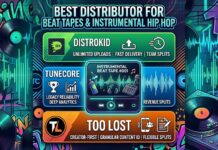
Automated Distributor Flags: When you upload a release through DistroKid, TuneCore, CD Baby, or similar aggregators, your audio files are scanned before or right as they go live. If an un-cleared sample matches a protected master in the database, your track gets flagged immediately.
The result? Your song gets taken down, your streaming revenue is frozen, and you risk getting booted from your distribution platform altogether.
How to Protect Your Music and Career
As a modern hip-hop producer, you don’t have to give up on sampling—you just need to be smart about how you source and release your music.
Here are the best ways to protect yourself:
-
Use Clearance-Ready Libraries: Platforms like Splice, Tracklib, or Kingsway Music Library provide pre-cleared or easy-to-clear royalty-free samples designed specifically for producers.
-
Re-Create the Sample (Interpolation): If you can’t clear the master recording, you can replay or hire musicians to re-record the melody yourself. You will still need to clear the publishing side, but you eliminate master recording infringement.
-
Get Official Clearance: If you have a major record coming together, hire a professional sample clearance agent to contact the rights holders and negotiate a fair deal.
Once your tracks are 100% legal and ready for the world, you can promote them aggressively without the constant fear of a takedown notice destroying your momentum.
To protect your catalog from immediate distributor takedowns, then scale your clear masters using our targeted rap playlist placements (https://itshiphopmusic.com/submit/music-submission/).