Can You Pitch to Spotify Editorial Without Canvas? The Truth for Rap Artists
If you are an independent rap artist getting ready to drop a new single, logging into your Spotify for Artists dashboard can feel overwhelming. Between picking subgenres, writing your track description, and tagging instruments, there is always a lot to manage. But one specific question keeps coming up in group chats and Reddit threads: can you pitch to Spotify editorial without Canvas?
There is a widespread rumor across the indie music community that if you skip uploading an 8-second visual loop, Spotify’s editorial team will automatically throw your pitch in the trash. Some artists delay their entire release schedule just to wait on a graphic designer to finish a video background.
So, is Spotify Canvas actually mandatory for playlist pitching, or is it just another industry myth?
Here is the straightforward truth about how Spotify’s curation process works, what rap editors actually care about when reviewing submissions, and how to structure your release strategy to get real results.
The Short Answer: No, Canvas Is Not Required
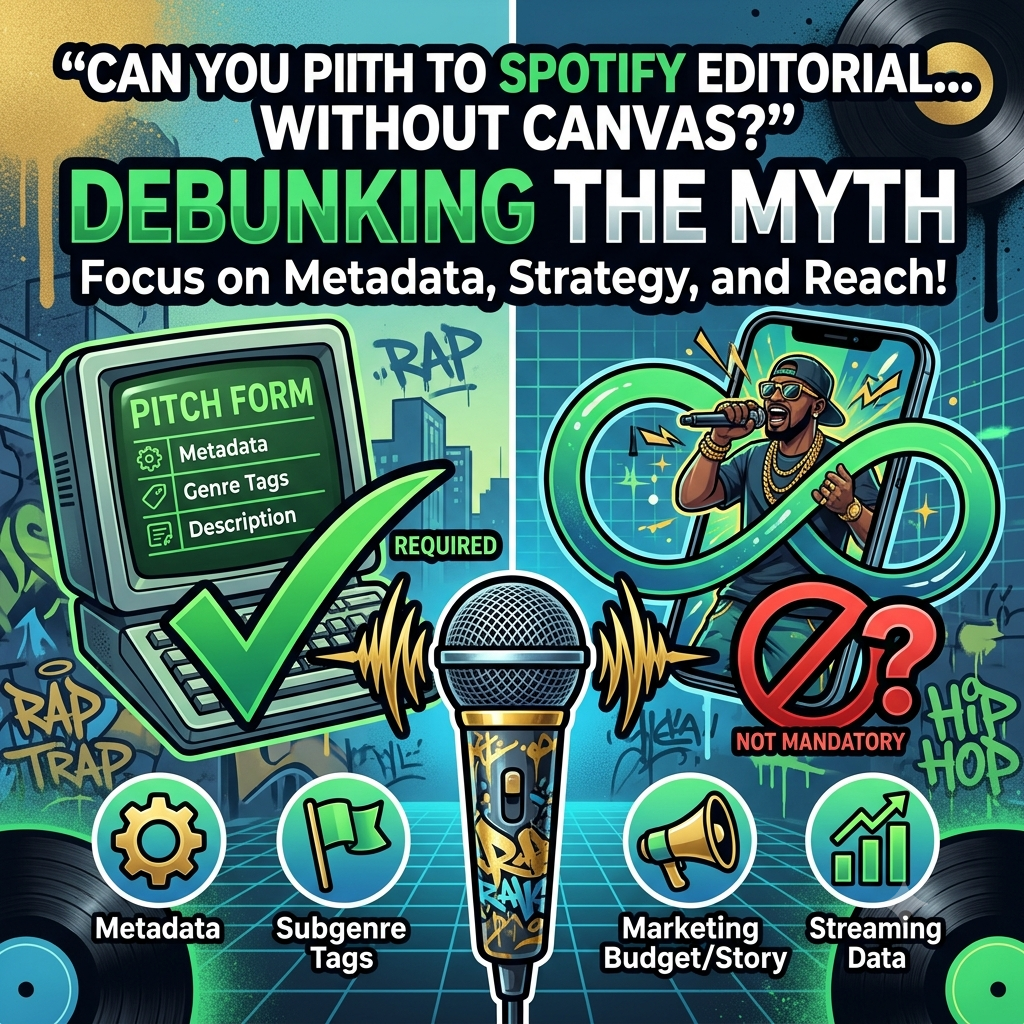
Let’s clear up the confusion right away: Yes, you can pitch to Spotify editorial playlists without a Spotify Canvas.
Spotify’s pitch form does not require a Canvas file to submit your track for consideration. In fact, when you log into Spotify for Artists to pitch an upcoming song, uploading a visual loop is not even part of that submission workflow. The editorial team evaluates your audio, metadata, release context, and promotional plan—not whether you have a looping video attached.
Skipping Canvas will never disqualify your music or prevent a curator from giving your track a listen. Understanding why this myth exists, however, helps highlight what actually makes a pitch successful.
What Spotify Editorial Teams Actually Prioritize
Spotify’s hip-hop curators process thousands of submissions every single week for flagship playlists like RapCaviar, Most Necessary, Get Turnt, and Realest. They do not sit around filtering out tracks based on video files. Instead, they use specific data points to decide where your song fits.
If you want to catch an editor’s attention, focus your energy on these critical factors instead:
1. Pinpoint Accurate Genre and Vibe Tagging
Hip-hop is too broad to label simply as “Rap.” A hard-hitting drill track does not belong on a relaxed, late-night melodic playlist. Curators use your self-selected tags—such as main genre, subgenre, mood, and instruments—to route your song to the right listening queue. If you mislabel a melodic trap song as boom-bap just to stand out, you make it harder for the right curator to find your music.
2. A Solid Marketing Narrative
Your pitch box only gives you a few hundred characters, so make every word count. Avoid using that space to write poetic descriptions of your lyrics or explaining what the song means to you personally. Curators want to see real momentum:
-
Are you going on tour or opening for a notable artist?
-
Do you have an active press push or radio campaign lined up?
-
Are you running targeted social ads or working with creators on TikTok and Instagram?
-
What does your overall promotional strategy look like?
3. Early Data and Third-Party Proof
Both Spotify’s human editors and its recommendation algorithms look closely at off-platform traction. Showing consistent engagement, active pre-save numbers, and a history of listener growth gives curators confidence that adding your song will drive engagement to their playlist. A great way to build this momentum is to back up your editorial pitch with third-party streaming proof generated by our subgenre-specific hip-hop playlisting channels.
4. Adequate Lead Time
Time is one of the most overlooked parts of pitching. Submitting your song at least 7 to 14 days before release gives curators enough time to review it. It also allows Spotify’s algorithmic systems to pick up your track for customized playlists like Release Radar.
Why You Should Still Add a Canvas Before Release Day
Even though Canvas is not needed for your initial pitch, adding one before your song goes live is still a smart move for any serious artist.
1. Better Listener Engagement and Social Shares
According to Spotify’s internal creator metrics, tracks featuring a Canvas see a noticeable bump in performance:
-
An average 145% increase in track shares
-
A 20% increase in playlist adds
-
A 9% bump in overall streams
When fans share your song directly to their Instagram Stories, your Canvas plays smoothly in the background, turning every listener share into a visual advertisement for your brand.
2. Building a Consistent Visual Brand
In modern hip-hop, visual identity is almost as important as the music itself. A strong Canvas loop reinforces your cover art, music video aesthetic, or overall persona, making your artist profile look clean and established to new listeners.
3. You Can Add It Whenever You Want
The pitch and the Canvas live on completely separate timelines. You do not need your video loop finished weeks in advance when you submit your track for playlisting. You can upload or swap out your Canvas file through Spotify for Artists at any point—even long after the song has already dropped.
A Practical Spotify Release Checklist for Rap Artists
Instead of stressing over video loops early in your rollout, follow this straightforward release process:
-
Deliver Audio Early: Send your finalized master files and high-res cover art to your distributor 3 to 4 weeks before your chosen release date.
-
Pitch Immediately: As soon as the unreleased song shows up in your Spotify for Artists account, submit your pitch. Pick accurate mood tags and select your primary subgenre.
-
Write a Business-Focused Pitch: Keep your description short, direct, and focused on marketing facts, press coverage, ad spend, and overall traction.
-
Create Visuals in Parallel: Work on your 8-second Canvas loop during the weeks leading up to release day, then upload it once it’s ready.
-
Drive Fan Engagement: Focus on building real traffic through pre-saves, social media teasers, and targeted independent playlists before your song goes live.
Ready to Take Your Hip-Hop Releases to the Next Level?
Deliver your release to active global rap audiences. Submit your release to the Music Submission Portal.
The Bottom Line
Thinking that Spotify Canvas is a strict requirement for playlist pitching is just a distraction from what actually moves the needle. While a visual loop helps keep listeners engaged once your song is out, your editorial pitch lives or dies on accurate metadata, a solid promo plan, and real streaming traction.
Focus on tagging your song correctly, building early momentum, and giving curators a clear reason to pay attention to your next release.