Every independent rapper has fallen for the same trap at least once. You drop a single you spent months perfecting, scrape together a promo budget, and blow the whole thing trying to land one massive 400,000-follower playlist. You get the screenshot for your Instagram story, watch the stream count jump for forty-eight hours, and then—nothing. Once your slot expires, the streams flatline, you gain maybe twelve real followers, and Spotify’s algorithm leaves your track for dead.
That happens because Spotify doesn’t reward vanity numbers anymore. It rewards relevance and listener behavior.
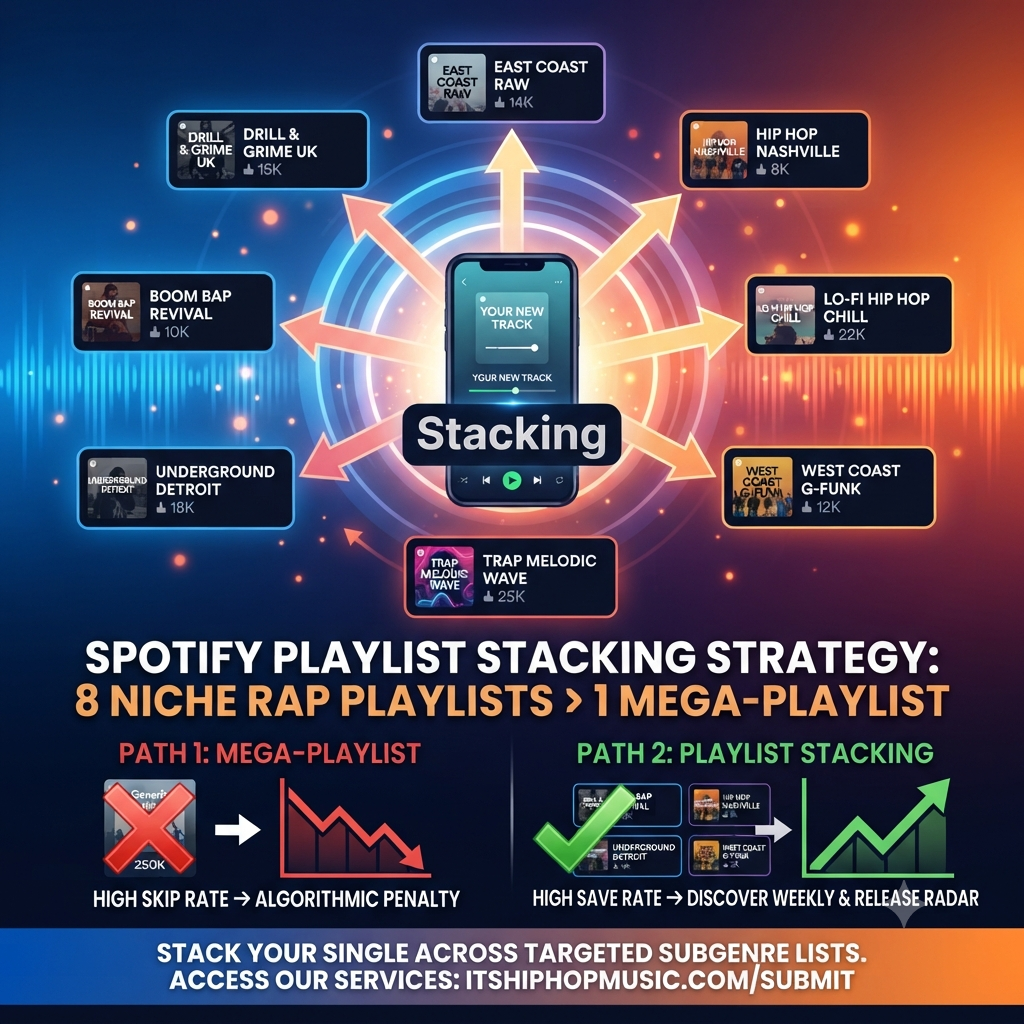
If you want your releases to actually stick and trigger long-term organic growth, you need to stop treating playlisting like a lottery ticket and start using a Spotify playlist stacking strategy for hip hop. Instead of swinging for one massive, generic playlist, you line up 6 to 10 mid-sized, hyper-specific subgenre playlists (1,000 to 25,000 followers) to hit at the exact same time. When you pull that off, you feed Spotify’s recommendation engine the exact data it needs to push your song into Discover Weekly, Release Radar, and Spotify Radio.
Why One Mega-Playlist Can Actually Wreck Your Release
On paper, getting added to a huge “Rap Bangers” or “Hip Hop Central” playlist sounds like the dream. Behind the scenes, it often poisons your track’s data.
Think about who listens to giant, generic playlists. You have college kids playing background music at a pre-game, guys lifting weights, and casual listeners shuffling whatever is popular. They aren’t all looking for the same sound. If a listener is there for bouncy, melodic Atlanta trap and your gritty, sample-heavy East Coast record comes on next, they’re hitting skip within four seconds.
To Spotify’s algorithm, a skip before the 30-second mark is a massive red flag. When thousands of mismatched listeners skip your track on a mega-playlist, your skip-to-save ratio tanks. You essentially pay good money to teach Spotify that people don’t like your song. Once the algorithm tags your track with a high skip rate, it stops recommending you to anyone else.
The Mechanics Behind the Spotify Playlist Stacking Strategy
Playlist stacking flips that entire dynamic on its head. Rather than chasing broad reach, you’re chasing concentrated, high-intent engagement within a tight window—usually the first 7 to 14 days after your song drops.
1. Teaching the Algorithm Who Your Fans Actually Are
Spotify categorizes music by analyzing “taste clusters” and co-occurrence—basically, looking at which songs regularly appear next to each other across thousands of user and curator playlists. If your single lands on eight different Underground Detroit Rap or Late Night Melodic Drill playlists in the same week, Spotify immediately maps your sound to that exact micro-community. That’s how you get placed in the “Fans Also Like” section of established artists in your lane.
2. High Save Rates Over Empty Streams
Curators running mid-sized niche playlists (between 1,000 and 25,000 followers) have usually built their following around a very specific vibe. The people following those lists are real heads who actively hunt for new music in that exact subgenre.
Because the audience already loves your style of hip hop, they listen all the way through. More importantly, they tap the Plus (+) button to save your track to their personal library or add it to their own playlists. Spotify weighs personal saves way heavier than passive streams. A 12% save rate from 5,000 targeted listeners will trigger algorithmic traction ten times faster than a 1% save rate from 50,000 passive listeners.
3. Simultaneous Velocity Fires Algorithmic Filters
Spotify’s discovery feeds look for sudden, concentrated bursts of positive listener signals rather than a slow trickle over six months. When eight niche playlists start driving steady, low-skip streams during your first two weeks of release, that combined momentum pushes your track past Spotify’s internal popularity thresholds, unlocking three major organic engines:
-
Release Radar: Automatically serves your single to your existing followers plus non-followers who heavily stream artists in your subgenre cluster.
-
Discover Weekly: Drops your track into personalized Monday morning playlists for thousands of listeners whose listening history matches your exact sound.
-
Spotify Radio & Autoplay: Keeps your record spinning right after a listener finishes an album or track from a bigger artist in your lane.
Mega-Playlist vs. Niche Playlist Stacking: How They Compare
| Factor | 1 Generic Mega-Playlist (250k+ Followers) | 8 Niche Subgenre Playlists (1k–25k Followers) |
| Type of Listener | Passive background listeners with broad tastes | Dedicated subgenre fans actively discovering music |
| Skip Rate | High (listeners skip tracks outside their vibe) | Low (listeners already like that exact sound) |
| Save-to-Stream Ratio | Usually under 2% | Commonly 8% to 15%+ |
| Algorithmic Signal | Confuses Spotify about who your target audience is | Locks in your micro-genre and triggers Discover Weekly |
| Long-Term Impact | Streams vanish the day you get removed | Builds a sustainable organic tail via algorithmic radio |
How to Build a Hip Hop Playlist Stack Step-by-Step
Running a proper stack takes a little more planning than tossing money at a single playlist broker, but the payoff lasts months instead of days.
Step 1: Get Ruthlessly Specific About Your Subgenre
If your pitch says “I make hip hop,” you’ve already lost. Hip hop has dozens of distinct ecosystems, and listeners rarely cross-pollinate between all of them. Narrow your single down to its exact lane—whether that’s Jazz-Inflected Lo-Fi Rap, Rage Trap, 90s Boom Bap Revival, Melodic Pain Rap, or West Coast G-Funk. Every single playlist in your stack needs to live in that exact sonic world.
Step 2: Line Up Your Placements for a 14-Day Window
Timing is everything with playlist stacking. If you get added to one playlist in January, two in February, and three in March, you never build enough concentrated velocity to wake up the algorithm. Start pitching three to four weeks before your release date so you can coordinate your adds to land within the same two-week window—ideally starting right on release Friday.
Step 3: Vet 6 to 10 Real Mid-Sized Curators
Look for playlists in the 1,000 to 25,000 follower range that show signs of real human curation. Check that the playlist updates regularly, features a cohesive tracklist, and shows steady, organic follower growth rather than suspicious overnight vertical spikes (which usually mean bot farms). To skip weeks of unanswered DMs and dead email threads, you can build concentrated multi-list momentum that fires algorithmic filters using our curated rap playlists.
Step 4: Back It Up With Warm External Traffic
Don’t rely on playlists to do 100% of the heavy lifting. During that same 14-day stacking window, send your own fanbase directly to Spotify via Instagram Reels, TikTok clips, text blasts, or a small, tightly targeted Meta ad campaign. When Spotify sees external traffic converting into saves alongside strong retention from eight niche playlists, your track’s popularity score climbs rapidly—setting you up for a major Discover Weekly push by week three or four.
Ready to Stack Your Next Release?
Stop burning promo money on bloated playlists that tank your skip rate. Stack your single across targeted subgenre lists. Access our Playlist and Music Promotion Services.