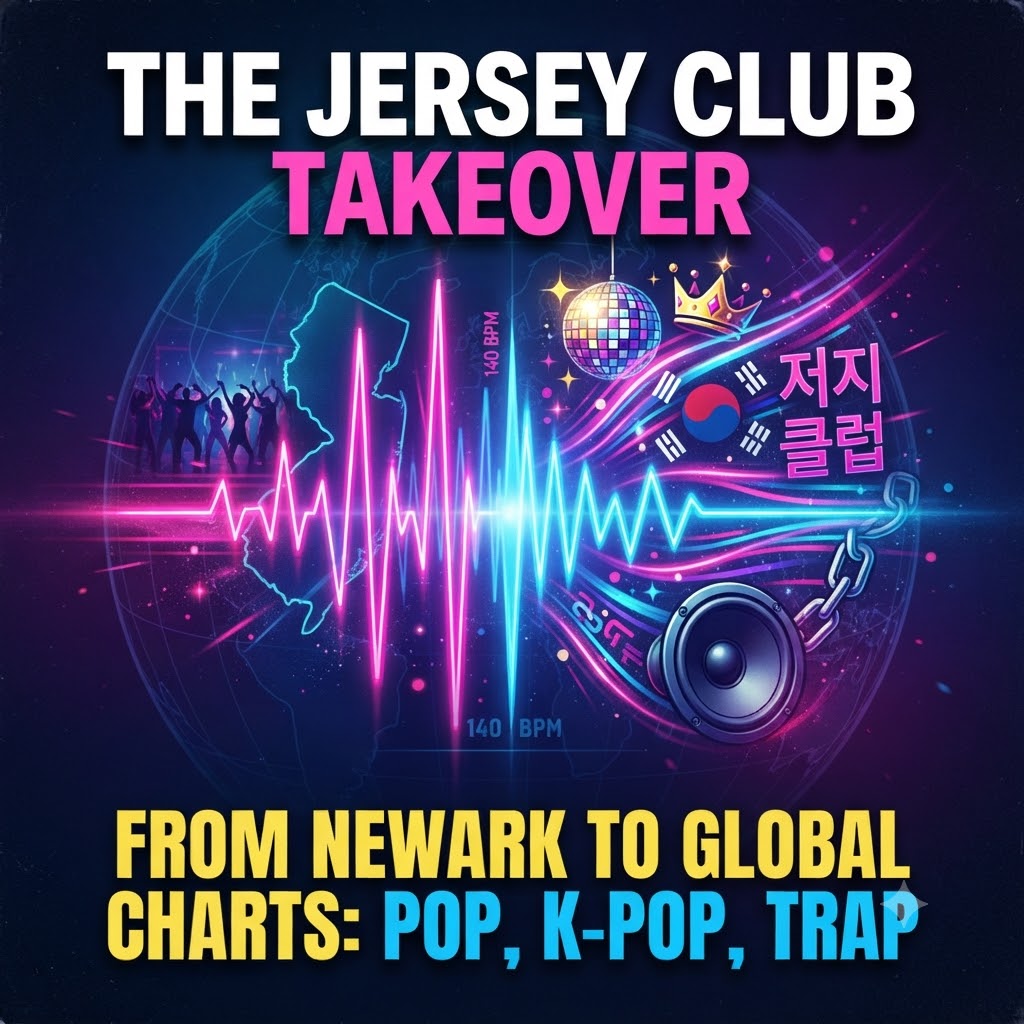
The Jersey Club Takeover: How a Newark Beat Conquered Global Pop, K-Pop, and Trap
If you have spent any time scrolling through TikTok, listening to the latest chart-topping pop albums, or digging into underground electronic playlists over the last couple of years, you have definitely noticed a shift. Music is getting faster, punchier, and intensely rhythmic. Beneath those viral dance challenges, hyper-energetic K-Pop bridges, and festival-ready electronic drops lies one unmistakable rhythmic heartbeat: the Jersey Club kick pattern.
What started as a localized, sweaty underground sound in the high school gyms and basement clubs of Newark, New Jersey, back in the late 1990s and 2000s has officially taken over the world. It is no longer just a regional subgenre kept alive by crate-digging DJs; it is a global pop superpower.
In this deep dive, we are breaking down where Jersey Club came from, what makes that signature tempo tick, and how its frantic, infectious drum programming quietly infiltrated mainstream pop, K-Pop, and modern trap productions across the globe.
1. What Actually Is Jersey Club? (The Sound, The Speed, and The Roots)
Before we talk about how it conquered international charts, we have to look back at its origins. Jersey Club was forged in New Jersey by underground pioneers like DJ Tameil, DJ Sliink, and later carried forward by producers who warped the sound into the digital age.
Musically, Jersey Club is a close cousin—and high-octane offshoot—of Baltimore club music. It usually sits comfortably at around 135 to 140 beats per minute (BPM). But speed is only half the story. The genre is defined by a few unmistakable production pillars:
-
The Triplet Kick Pattern: A rapid-fire, heavily syncopated kick drum pattern (kick-kick-kick-snare) that creates an urgent, bouncing rhythm. If you hear it, your body instantly wants to move.
-
The “Bed Squeak” Sample: Perhaps the most famous sample in modern dance music history, adding a playful, rhythmic punctuation to the mix.
-
Chops and Chants: Heavily repeated vocal snippets and hype-man shouts designed to fire up a crowded room.
When underground rap artists started spitting gritty street verses over these breakneck, 140 BPM instrumental tracks, Jersey Club Rap was born. It married the raw energy of hip-hop with the sweat-drenched endurance test of club music.
2. Why Mainstream Pop Fell in Love with the 140 BPM Bounce
Pop music has always been a sponge, soaking up underground dance cultures whenever it needs a fresh injection of energy. But the mainstream pop adoption of Jersey Club feels different—it feels permanent.
In the era of short-form video content, songs need to capture attention in less than three seconds. The high-octane 140 BPM bounce of Jersey Club is practically tailor-made for viral choreography and instant dopamine hits. Pop producers realized that slipping a Jersey club breakdown into the bridge or chorus of a standard radio track acts like an instant shot of adrenaline.
We saw major artists lean heavily into club heritage—most notably Beyoncé with Renaissance, which opened the floodgates for dance, house, and club rhythms to reclaim real estate on the Billboard charts. Suddenly, major pop and hip-hop writers started working with club producers, speeding up tempos, and layering those signature rapid-fire kicks underneath melodic vocal hooks. The result? Songs that feel both nostalgic and radically futuristic.
3. The K-Pop Phenomenon: Where Speed Meets Precision Choreography
If there is one global market that embraced Jersey Club with open arms and took it to artistic extremes, it is K-Pop.
South Korean idol groups and their powerhouse production teams thrive on dynamic song structures, abrupt genre shifts, and jaw-dropping choreography. For a K-Pop producer, Jersey Club is a dream come true. The 135+ BPM tempo provides the ultimate canvas for complex, lightning-fast, synchronized footwork that lights up dance cover communities across YouTube and TikTok.
Groups like NewJeans, LE SSERAFIM, and NMIXX have frequently experimented with fast-paced club rhythms, garage, and breakbeats. Instead of just using it as a background loop, K-Pop tracks often weaponize the Jersey Club triplet pattern during explosive pre-choruses or dance breaks, completely flipping the energy of the song upside down.
By blending the bouncy cadence of Jersey Club rap with glossy pop melodies and elite production value, the K-Pop industry has played a massive role in exporting the Newark sound to millions of listeners across Asia, Europe, and the Americas.
4. Reshaping Global Trap and Electronic Production
For years, trap music was defined by a very specific formula: heavy, spacious, slow-rolling 808s paired with intricate, rolling hi-hats straight out of Atlanta. But as producers cross-pollinate genres across SoundCloud, Splice, and global studio sessions, trap has undergone a major rhythmic makeover.
Today, you will find producers in London, Atlanta, São Paulo, and Tokyo fusing traditional sub-heavy trap drops with Jersey Club percussion loops. This hybrid approach—sometimes called “Jersey trap” or club-rap fusion—gives producers the best of both worlds:
-
The heavy, chest-rattling low-end and raw swagger of modern hip-hop.
-
The frantic, perpetual motion of Jersey Club percussion.
Because sample packs and drum kits are instantly accessible worldwide, a producer sitting in a bedroom studio can flip a classic 808 beat into a high-speed club hybrid in minutes. This democratization of sound is a huge reason why the rhythm has spread like wildfire.
5. Why the Jersey Club Sound Is Here to Stay
Some musical trends burn out as fast as they appear online, but the global spread of Jersey Club rap feels different. It taps into a fundamental human desire for movement, speed, and unfiltered energy. In an era where digital fatigue is real, the relentless, driving momentum of a 140 BPM Jersey club beat offers an unmatched rush that listeners simply cannot ignore.
As underground producers continue to experiment by blending these rhythms with everything from Afrobeats and Latin urban to hyperpop, the Newark sound has officially cemented its legacy. It is no longer just a localized secret—it is the pulsing rhythm of the modern global music ecosystem.