What BPM Are Trap, Drill, Boom-Bap, and PluggnB Beats? (Complete Tempo Guide)
If you have ever pulled up a beat in FL Studio or Ableton, set your project tempo to 140 BPM, and wondered why the metronome feels twice as fast as the actual head-nod, you are not alone. Tempo in modern hip-hop can be deceptive—especially when you start bouncing between subgenres in the same studio session.
Knowing what BPM are trap, drill, and boom bap beats—along with newer melodic offshoots like PluggnB—is one of the easiest ways to speed up your workflow. It helps producers lock in the right drum pocket without fighting the grid, gives rappers and vocalists a clear lane for their cadence, and prevents your finished song from getting misclassified when you upload it to streaming platforms.
Below is a practical, studio-tested breakdown of where each subgenre sits on the tempo spectrum, how the drum grid actually works under the hood, and why getting your BPM metadata right matters once your track leaves the studio.
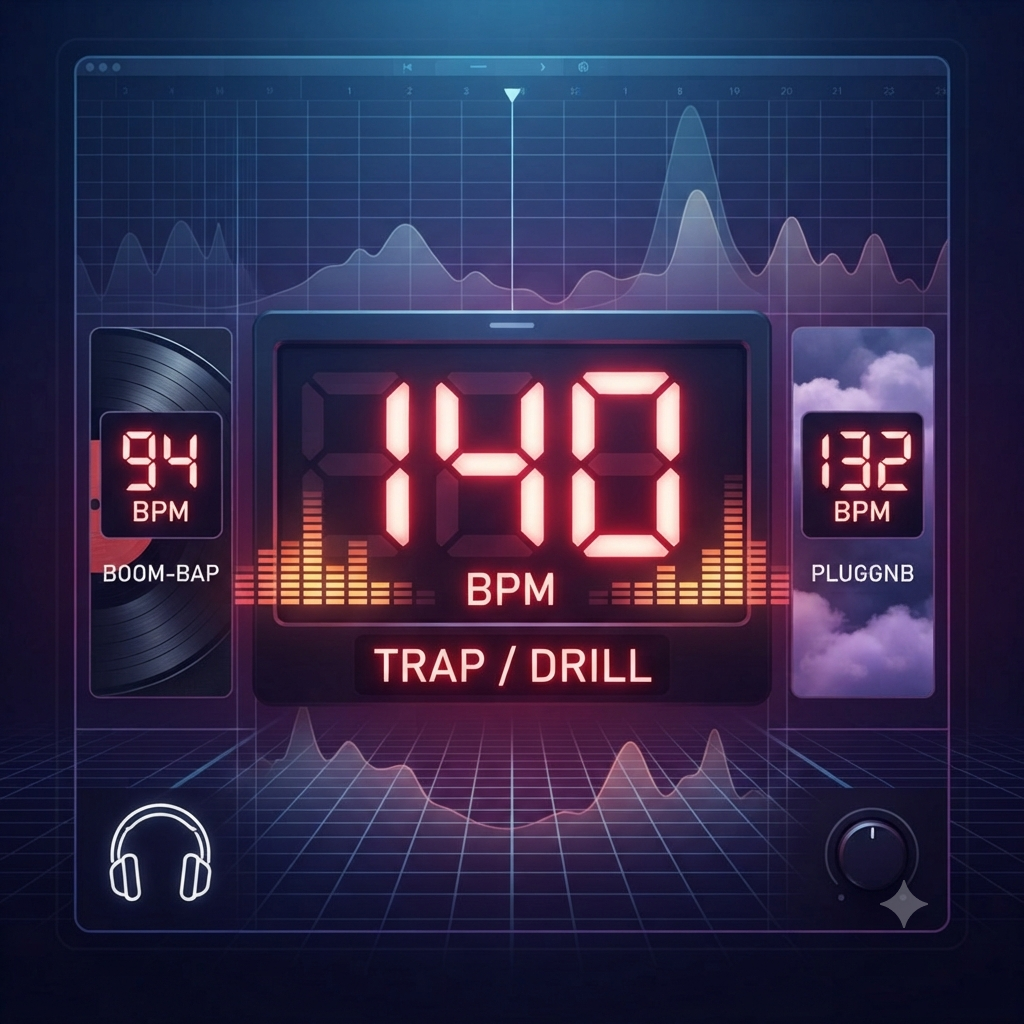
Quick Reference: Hip-Hop Subgenre BPM & Drum-Grid Chart
Before diving into the nuances of each style, keep this cheat sheet handy when you are setting up a new session or organizing beat packs:
1. Boom-Bap Beats: 85 – 98 BPM
Boom-bap is the DNA of 1990s East Coast hip-hop—think DJ Premier, Pete Rock, J Dilla, and Havoc. While modern rap has pushed DAW tempos into the 130s and 140s, classic boom-bap lives comfortably in the 85 to 98 BPM pocket. (You will occasionally hear darker, slower East Coast records dip down to 80 BPM, or high-energy golden-era joints push toward 102 BPM, though 88–94 BPM is the sweet spot.)
How the Drum Grid Works
Unlike trap or drill, boom-bap is programmed in true-time. What you hear is what the metronome clicks:
-
Kick: Anchors beat 1, usually paired with loose, syncopated ghost kicks leading into beat 3.
-
Snare: A thick, acoustic-sounding snare (often layered with vinyl crackle or a rimshot) lands squarely on beats 2 and 4.
-
Swing & Pocket: If you strictly quantize boom-bap drums to a rigid digital grid, the beat immediately loses its soul. Producers either tap the pads live on an MPC or dial in swing percentages around 54% to 62%, nudging the hi-hats and kicks slightly behind the beat to get that unmistakable neck-snapping bounce.
What It Means for Vocalists
At 85–98 BPM, MCs have plenty of breathing room between snares. That extra space is why boom-bap naturally invites dense internal rhyme schemes, storytelling, and intricate wordplay. You do not have to rush your delivery to keep up with the track.
2. Southern Trap Beats: 130 – 150 BPM (Half-Time)
Coming out of Atlanta in the 2000s and dominating global charts ever since, Southern trap completely changed how producers use the DAW timeline. On paper, trap sits between 130 and 150 BPM—with 140 BPM acting as the unofficial industry default.
How the Drum Grid Works
Here is where beginners often get tripped up: even though your DAW is running at 140 BPM, trap is felt in half-time (which sounds like 70 BPM to the listener).
-
Snare / Clap: Instead of hitting on beats 2 and 4, the main snare or sharp clap lands once per bar on beat 3.
-
Why Double the Tempo? Running the session at 140 BPM doubles the resolution of your piano roll. That extra grid detail makes it much easier to program rapid-fire 1/16th-note, 1/32nd-note, and triplet hi-hat rolls without zooming in endlessly.
-
808s: Long, sustained sub-bass 808s carry the low end, usually hitting alongside the kick on beat 1 and bouncing off syncopated off-beats before the snare hits.
What It Means for Vocalists
That half-time 70 BPM feel gives artists the best of both worlds. You can ride the pocket with a slow, laid-back melodic cadence, or effortlessly switch into double-time triplets against the hi-hats whenever you want to raise the intensity of a verse.
3. UK / NY Drill Beats: 140 – 145 BPM (Syncopated Hi-Hats)
Drill started on Chicago’s South Side, mutated in South London with UK producers like 808Melo and AXL Beats, and exploded back across the Atlantic in Brooklyn. On a tempo readout, drill overlaps with trap—sitting in a tight window between 140 and 145 BPM—but the rhythmic bounce is completely different.
How the Drum Grid Works
Like trap, drill operates in half-time, yet it breaks almost every conventional rule of hip-hop drum placement:
-
Shifted Snares: In standard trap, your snares hit on beat 3 of bar one and beat 3 of bar two (beats 3 and 7 in an eight-beat phrase). In UK and NY drill, that second snare gets pushed forward onto beat 4 (or beat 8 of the two-bar loop). That tiny shift creates an urgent, off-balance tension that makes drill sound aggressive before a single melody even plays.
-
Syncopated 3-3-2 Hi-Hats: Forget steady two-step hi-hats. Drill borrows its rhythmic skeleton from grime and dancehall, spacing hats and counter-snares in a 3-3-2 pattern with deliberate empty gaps.
-
Sliding 808s: Those empty gaps leave room for heavy, distorted 808s that glide up and down entire octaves between snare hits.
What It Means for Vocalists
Drill beats do not let you coast. Because the snare hits early on the second bar, MCs have to lock into sharp, percussive cadences and anticipate the off-beat accents.
4. PluggnB Beats: 125 – 140 BPM
PluggnB sits at the crossroads of MexikoDro’s stripped-back “plugg” sound and smooth, late-90s/early-2000s R&B. While trap and drill lean dark and aggressive, PluggnB trades distorted bass for lush electric pianos, airy synth pads, bell leads, and nostalgic chord progressions.
How the Drum Grid Works
PluggnB typically lands between 125 and 140 BPM in half-time, giving it a slightly more relaxed, floating pace than mainstage trap.
-
Snare / Clap: Like trap, the primary clap or rimshot hits on beat 3, though sound selection is noticeably softer and crisp rather than abrasive.
-
Minimalist Bounce: Kicks are punchy and round, 808s stay clean and melodic so they do not clash with complex seventh and ninth chords, and open hi-hats or crash cymbals frequently mark the start of every one or two bars.
-
Hi-Hats: Instead of overwhelming the mix with constant 1/32nd-note rolls, PluggnB keeps the hi-hats relatively sparse with playful, bouncy accents that let the chords breathe.
What It Means for Vocalists
The 125–140 BPM half-time pocket is tailor-made for melodic rap, layered harmonies, and expressive Auto-Tune runs where vocal tone matters just as much as rhythm.
Why Accurate BPM Metadata Matters for Playlist Placement
Understanding what BPM are trap, drill, and boom bap beats is useful inside the studio, but it pays off just as much on release day. When you upload a track through your distributor, tempo metadata and audio analysis play a quiet but major role in where your song ends up.
-
Preventing Algorithmic Mismatches: Streaming platforms scan every uploaded audio file for tempo, energy, and rhythmic density to power automated mixes and radio stations. If you upload a 142 BPM drill record and manually tag it as 71 BPM (its half-time feel), recommendation algorithms can misread the track’s energy—pairing an aggressive street record with slow R&B ballads instead of high-energy workout or late-night drive feeds.
-
Making Life Easier for DJs: Club, radio, and mixshow DJs sort their digital crates by exact BPM ranges so they can mix harmonically on the fly. Clean tempo tags make your record immediately usable in live sets.
-
Hitting the Right Curator Mood Feeds: Human playlist curators build their rosters around specific listener moods—dusty 90 BPM boom-bap for late-night study sessions, 132 BPM PluggnB for melodic chill rotations, or 144 BPM drill for gym playlists. Before you schedule your next release, double-check your master export tempo and ensure your beat tempos align with curator mood feeds, then pitch your finished record through our hip-hop playlist networks.
Ready to get your music in front of the right listeners? Land your track on playlists tailored to your exact tempo and vibe. Submit your release to the Music Submission Portal.