The “Waterfall Single” Release Schedule: How to Compound Your Streams Before an EP Drop
Look, let’s be completely honest about how music promotion used to work versus how it works right now.
A few years ago, the standard playbook for an independent artist looked like this: you spend months locked in a studio crafting four or five incredible songs. You wrap them up into a neat little EP, upload them to your distributor, pick a random Friday, and drop the whole thing on streaming platforms all at once. You cross your fingers, post a few graphics on Instagram, maybe run a couple of modest ad campaigns, and wait for the world to notice.
And what usually happens? Crickets.
Maybe your favorite track gets a little initial love from your core followers on release day. But by week two, the algorithmic momentum completely flatlines. Why? Because streaming platforms like Spotify and Apple Music thrive on consistency, activity, and fresh signals. Dropping a full EP in one go gives you one quick algorithmic spike, and then silence. You’re essentially starving the algorithm of the consistent data it needs to keep pushing your music to new listeners.
That is precisely why smart independent artists, managers, and producers have completely shifted away from traditional drops. Instead, they are using a smarter, calculated approach called the Waterfall Single release schedule.
If you want to stop watching your hard work disappear into the digital void and actually start compounding your streaming numbers, here is how you build, execute, and scale a waterfall rollout from scratch.
What Exactly Is a Waterfall Release Strategy?
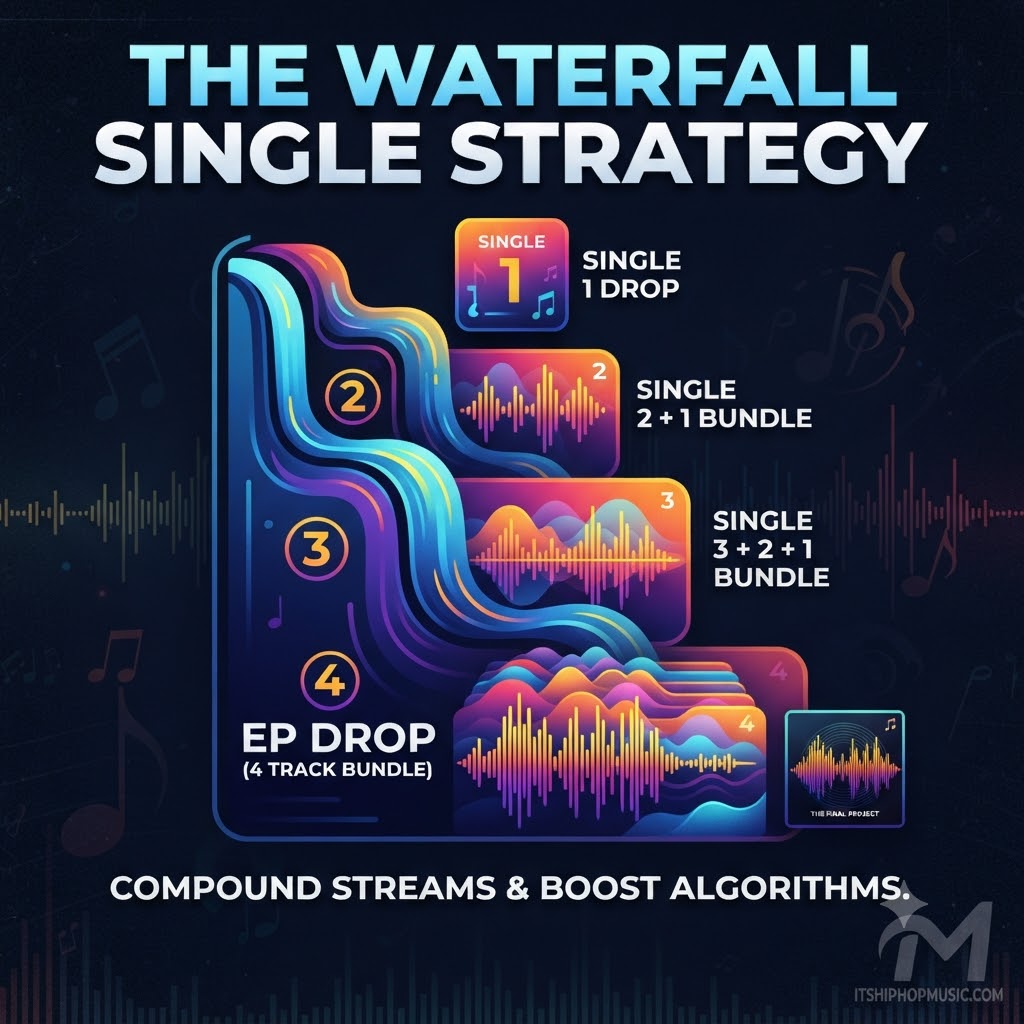
At its core, a waterfall release strategy is a method of dropping your music in installments rather than all at once, while continuously bundling your tracks as you go.
Instead of releasing Single A, then waiting a month to release Single B completely isolated, you release Single B and attach it directly to Single A. When you drop Single C a month later, you bundle it with Single B and Single A. By the time you finally unveil your complete EP, every single track leading up to it has already been living on streaming platforms for weeks or months, steadily accumulating streams, playlist adds, and algorithmic weight.
Crucially, when you do this through your distributor, you use the exact same ISRC code for the previously released tracks when you bundle them. This means any streams, saves, and shares that your first single accumulates continue to build right on top of that original data footprint. You aren’t splitting your audience across multiple different versions of the same song; you are funneling everyone toward a single, growing body of work.
The Blueprint: Step-by-Step Waterfall Execution
To really understand how this works in practice, let’s map out a standard four-track EP rollout. Imagine you have four standout tracks ready to go. Instead of treating them as one project, you are going to treat them as four distinct milestones over a four-to-six-month timeline.
Step 1: Drop Single #1 (The Hook and the Test)
-
The Strategy: This is your opening salvo. Pick the absolute strongest, catchiest, or most commercially viable track from your upcoming project.
-
The Execution: Release this song as a standalone single. For the first four weeks, your entire marketing focus should be on this single track. Pitch it to editorial curators, submit it to music blogs, make short-form video content around its hook, and build up a baseline of data.
-
Why it matters: You get to test how the market reacts to your sound without blowing your entire budget or revealing your whole hand at once.
Step 2: Release Single #2 (The First Cascade)
-
The Strategy: Four to six weeks after your first drop, it’s time for your second release.
-
The Execution: You drop a brand-new track (Single #2), but on streaming services, it gets packaged as a 2-track release alongside Single #1.
-
The Result: Anyone who comes across your profile because of your second single is now just one click away from discovering your first single. The streaming momentum from your new release naturally spills over, lifting the playback numbers of your older track right when its initial hype might have otherwise started to fade.
Step 3: Release Single #3 (The Mid-Rollout Momentum)
-
The Strategy: Keep the machine moving. By month three or four, your audience is actively looking out for your next move.
-
The Execution: Drop your third track, bundled together with Single #2 and Single #1, creating a 3-track release.
-
The Result: At this stage, your very first single has been accumulating passive streams for months. The streaming algorithms notice that people are continuously returning to your catalog, signaling that you are an active artist with high listener retention.
Step 4: The Final EP Drop (The Grand Finale)
-
The Strategy: Unveil the final piece of the puzzle and complete the official EP package.
-
The Execution: Drop your final track (or an intro/outro piece) and bundle the entire collection into your official 4-track EP.
-
The Result: Because your first three tracks have already built a massive foundation of streams, saves, and algorithmic placement (like Spotify’s Release Radar and Discover Weekly), the full EP debut doesn’t start from zero. It launches with built-in velocity, maximizing your chances of making a real splash.
Why the Waterfall Method Dominates Modern Music Marketing
When you break down the economics and psychology of modern music consumption, the waterfall method solves almost every major pain point independent artists face today.
1. Feeding the Algorithm What It Craves
Streaming algorithms don’t care how hard you worked on a song; they care about engagement velocity. They want to know: Are people listening all the way through? Are they saving it? Are they coming back next week? Dropping music every four to six weeks keeps your artist profile flagged as “active” in the system. Instead of disappearing for a year to make an album, you stay perpetually top-of-mind.
2. Maximizing Your Marketing Budget
Let’s be real—most independent creators don’t have major-label advertising budgets. Splitting your marketing dollars across ten different standalone singles or trying to push a whole album at once is exhausting and expensive. With a waterfall release, you focus your promotional energy on a single campaign anchor every month, knowing that every dollar spent is also retroactively lifting your previous releases.
3. Smarter Playlist and Editorial Pitching
Playlists are notoriously difficult to crack if you’re an unknown artist. But when you pitch a waterfall release, you give curators a track record. A song that already has 10,000 or 50,000 organic streams from its previous life as a single looks a lot more attractive to playlist curators than a completely dead, unproven track.
Putting the Strategy into Action
Executing a waterfall schedule takes patience, discipline, and a clear organizational timeline. You have to map out your distribution dates, line up your content creation, and make sure your visual assets match the cadence of your releases.
More importantly, you need to make sure that every single time you drop a new installment, your music is actually landing in front of people who care about independent music, culture, and fresh sounds.
If you are ready to put this blueprint into action and want to ensure your music reaches real tastemakers, blogs, and curators, funnel fresh audience traffic directly to your owned channels using our artist submission portal (https://itshiphopmusic.com/submit/artist-submission/?utm_source=gemini).
🚀 Ready to Amplify Your Next Release?
Maintain consistent marketing velocity across every drop. Whether you are launching Single #1 or pushing your final EP package, we have promotional options designed to scale your reach. Explore our packages and submit your tracks today via our Full Artist Submission Form.