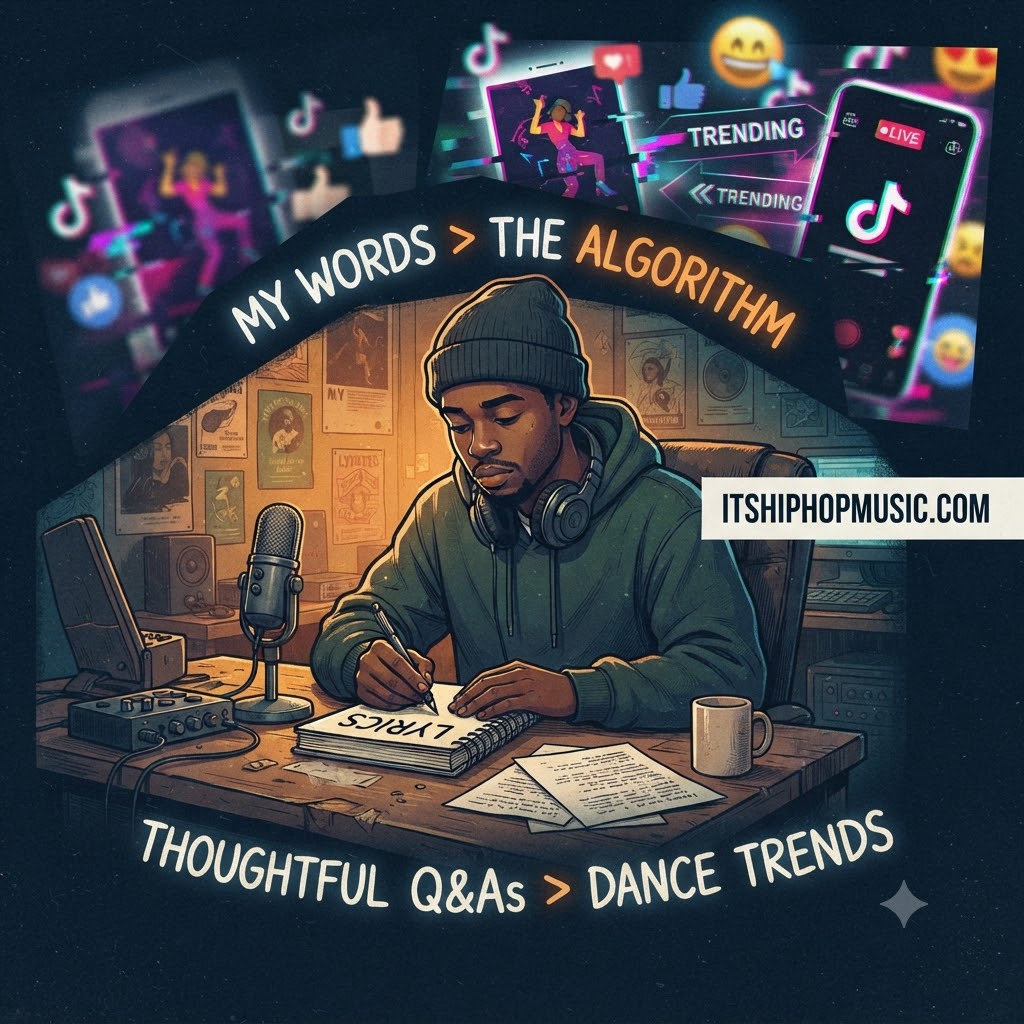
The Introvert’s Guide to Hip-Hop Marketing: Why Written Blog Q&As Beat Dancing on Short-Form Video Apps
If you spend even ten minutes scrolling through music marketing Twitter or Reddit threads right now, you’d think that becoming a successful independent rapper requires a degree in choreography. Open up TikTok, Instagram Reels, or YouTube Shorts, and the playbook looks identical: hop on the latest hyperactive dance trend, prank your producer in the studio, lip-sync frantically to a 10-second snippet of your unreleased hook, or aggressively point at floating text on a green screen.
For extroverted artists who thrive on high-energy performance, maybe that comes naturally. But if you’re an introverted rapper—someone who processes the world internally, spends hours alone perfecting a multi-syllabic rhyme scheme, and prefers to let the music do the heavy lifting—that advice feels less like marketing and more like a special kind of torture.
You didn’t spend weeks writing, mixing, and mastering a cohesive project just to watch it get flattened into a 7-second background track for someone else’s viral meme.
Fortunately, you don’t have to play that game. For reserved artists, in-depth written blog Q&As, email interviews, and text-based features offer a much more comfortable, authentic, and ultimately effective way to articulate your vision. Let’s look at why stepping away from the short-form video treadmill and leaning into the power of the written word might just be the best career move an introverted hip-hop artist can make.
The Exhaustion of the Short-Form Video Treadmill
Let’s be honest for a second: short-form video algorithms are exhausting. They are engineered to demand constant attention, continuous output, and an endless stream of visual novelty. For an introverted rapper, trying to keep pace with these platforms usually triggers a very specific kind of creative burnout.
1. The Social Battery Drain
Introverts pull their energy from within. When you spend all day forcing yourself to act bubbly, perform for a camera lens, and chase fleeting internet trends, your social and creative battery gets completely fried. By the time you actually sit down to write bars or record vocals, the well is dry. Performance fatigue creeps in, and the music suffers as a result.
2. Stripping Away Nuance and Depth
Hip-hop is arguably the most literary genre in modern music. It relies on internal rhyme schemes, double entendres, historical references, and deeply personal storytelling. How are you supposed to convey the emotional weight of a 16-bar verse about your upbringing or mental health in a 15-second video while a text overlay flashes neon emojis? Short-form video forces you to dumb down your art just to hook a scrolling audience with an attention span shorter than a goldfish’s.
3. The Algorithm Doesn’t Care About Your Art
The worst part about the short-form grind is its transient nature. You can spend four hours editing a clever video, and if the algorithm decides it doesn’t like it within the first hour, it goes straight to the digital graveyard. To stay relevant, you have to wake up the next morning and do it all over again. It’s an endless treadmill where the platform wins, the tech companies win, and the artist is left feeling like a jester rather than a creator.
Why Written Q&As Are a Safe Haven for Introverted Artists
When you pivot toward written media—like blog interviews, email Q&As, and written features—the entire dynamic shifts. Instead of demanding a fast, loud, knee-jerk reaction, the written medium rewards patience, thoughtfulness, and depth.
Here is why this format works so much better for reserved, detail-oriented creators:
The Power of the Pause
When a music journalist sends you a list of interview questions, you aren’t put on the spot under hot studio lights or staring awkwardly into a selfie camera. You have time. You can close your laptop, go for a walk, sleep on it, and carefully construct your answers over a cup of coffee.
This buffer gives introverts the space they need to articulate their thoughts clearly. You don’t have to worry about stumbling over your words or saying something awkward. You can edit, refine, and polish your narrative until it accurately reflects who you are as an artist. You let your thoughts and story shine in text.
Attracting True Listeners, Not Casual Scrollers
Think about how you consume music yourself. Do you find your favorite underground lyricists by watching them dance on an app, or do you find them because you read a compelling interview, dove down a rabbit hole of music blogs, and connected with their worldview?
Short-form video builds temporary hype based on visual gimmicks. Written interviews build real fans. People who take the time to read a 1,500-word Q&A are the ones who buy physical vinyl, show up to your local shows, and actually listen to the transitions between tracks on your album. They aren’t looking for a quick laugh; they are looking for a connection with the artist behind the music.
Permanent SEO Value That Works While You Sleep
Social media posts have a shelf life of about 24 to 48 hours before they are buried forever beneath an avalanche of fresh content. Conversely, a well-optimized written feature on a reputable music blog lives on the internet indefinitely.
Years from now, when a new fan, a playlist curator, or a music supervisor Googles your artist name or your latest album title, that written interview will pop up in search results. It builds immediate digital authority and professionalism. It says, “This artist isn’t just a flash-in-the-pan meme; they are a serious creator with a documented body of work.”
Reclaiming the Narrative on Your Own Terms
Hip-hop culture was built by writers, poets, and observers of society. The greatest MCs in history didn’t win over their audiences with slick choreography; they did it by painting vivid pictures with words.
You do not have to compromise your personality to build a fanbase. If you are naturally reserved, quiet, or fiercely private, lean into it. Let your lyricism do the heavy lifting in your songs, and let your written words do the heavy lifting in your interviews.