The Mechanical Licensing Collective (The MLC): How Independent Rap Artists Can Claim Hidden Royalties
If you are an independent hip-hop artist, producer, or self-published songwriter, you probably check your distro dashboard every single Friday. You watch the numbers tick up, calculate your streaming revenue, and figure out your next move. But if you are only looking at your primary distribution payout—whether that’s DistroKid, TuneCore, or CD Baby—you are likely missing out on a massive piece of your financial pie.
For years, millions of dollars generated by rap and hip-hop streams have sat trapped in the music industry’s infamous “black box.”
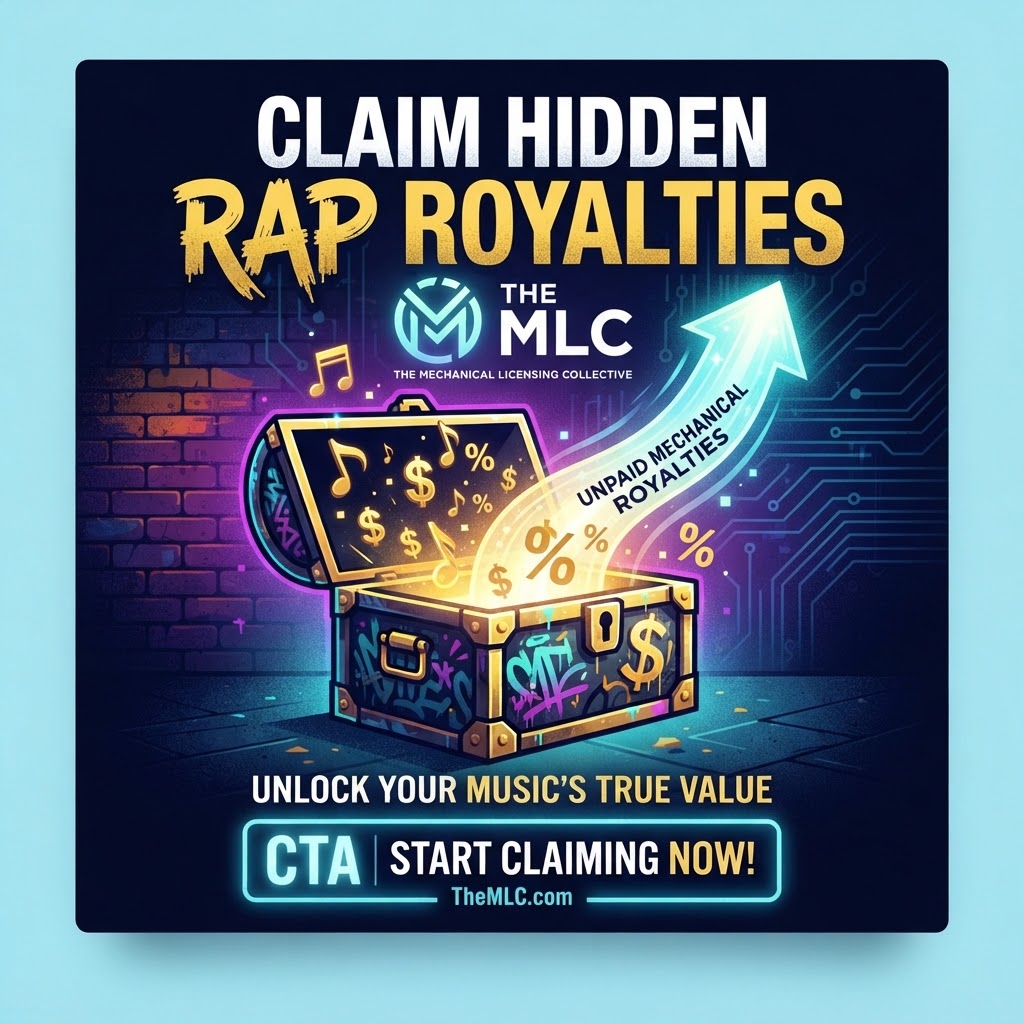
If you haven’t claimed what’s rightfully yours through The Mechanical Licensing Collective (The MLC), you could be leaving thousands of uncollected dollars on the table. Let’s pull back the curtain on digital mechanical royalties, look at how this mysterious black box actually operates, and walk through the exact steps independent creators need to take to secure their funds.
What Is the “Black Box” of Digital Mechanical Royalties?
To understand where your money is hiding, it helps to break down the two distinct types of royalties generated every single time a rap track gets streamed on platforms like Spotify, Apple Music, or Amazon Music:
-
Performance Royalties: These are paid to songwriters, composers, and publishers whenever a composition is streamed publicly, played on terrestrial or satellite radio, or performed live at a venue. These are collected by Performance Rights Organizations (PROs) like ASCAP, BMI, or SESAC.
-
Mechanical Royalties: These are paid to songwriters and publishers for the reproduction of a musical composition. Every single time a digital audio file is streamed, cached, or downloaded, a mechanical royalty is triggered.
For a long time, the infrastructure governing digital streaming wasn’t built to handle the sheer volume of independent music entering the ecosystem. Streaming services struggled to match millions of daily streams to the correct songwriters and publishers. This issue hit hip-hop and rap especially hard. Uncredited features, alias producer names, alternate spellings, and messy split sheets that were never officially filed caused massive data mismatches across DSP databases.
When digital service providers couldn’t figure out who owned a specific composition, those mechanical royalties didn’t just vanish into thin air. Instead, they went into a massive, unclaimed holding account referred to throughout the industry as the “black box.”
The MLC and the $424 Million Historical Pool
The landscape shifted dramatically with the passage of the Music Modernization Act (MMA). This federal legislation fundamentally changed how digital mechanical licensing works in the United States by establishing The Mechanical Licensing Collective (The MLC).
The MLC is a non-profit organization created to administer a blanket mechanical license for digital streaming services. When the doors officially opened, major streaming platforms transferred over $424 million in historical, unmatched “black box” royalties that had piled up between 2007 and 2020. On top of that massive lump sum, ongoing unmatched streaming funds continue to flow into the collective every single month.
However, there is a catch that catches a lot of independent artists off guard: The MLC doesn’t hunt you down.
They hold the money in trust, but the burden of proof is entirely on you. It is up to independent songwriters, self-published artists, and producers to register, clean up their catalog data, match their works, and actively claim their funds.
Why Independent Rap Artists Miss Out on Their Royalties
Hip-hop is arguably the most collaborative genre on earth. Between beat swaps, multiple co-producers, uncredited vocal hooks, samples, and changing artist monikers, the metadata often gets messy. Independent creators are disproportionately affected by unclaimed mechanical royalties for a few key reasons:
-
You handle your own publishing: If you aren’t signed to a major publishing administrator or haven’t registered your catalog directly, your mechanical royalties have no designated home. They default straight into the unclaimed pool.
-
Inaccurate or conflicting metadata: If your distributor lists your producer as “John Doe” on one track, but your split sheet or PRO registration lists “J. Doe,” automated matching systems fail. Computers don’t guess; if the names don’t match identically, the money gets flagged as unmatched.
-
The PRO misconception: A lot of artists assume that because they joined ASCAP, BMI, or SESAC, every single dollar generated by their music is accounted for. That is a costly mistake. PROs collect performance royalties—they do not collect digital mechanical royalties from DSPs. That job belongs exclusively to mechanical collection entities like The MLC.
If you have released rap tracks that have accumulated tens of thousands—or millions—of streams over the years, a portion of that $424 million+ historical pool and ongoing mechanical royalties belong to your name.
Step-by-Step: How to Claim Your Hidden Royalties
Claiming your money won’t cost you a dime, but it does require some organization. Here is how you can check if you have money waiting for you:
-
Audit Your Catalog: Pull together a master list of every song you’ve ever released. Make sure you have your International Standard Musical Work Codes (ISWC), track lengths, official release dates, and exact collaborator split percentages documented.
-
Set Up an Account with The MLC: Head to their official portal and register as a creator. Membership is entirely free for songwriters, composers, lyricists, and self-published music publishers.
-
Search the Unclaimed Portals: Use The MLC’s public database to look for unmatched historical royalties or works associated with your writer, artist, or producer name variants. Check for misspelled titles or old project aliases.
-
Link Your Sound Recordings: Once you claim your compositions, map your sound recordings (your audio files distributed via DistroKid, TuneCore, etc.) directly to those musical works. This bridges the gap between the master recording and the underlying composition.
Once your claims are verified, your accumulated royalties—along with your share of historical interest—will be cleared for payout directly to your bank account.
Final Thoughts
The music business has always favored those who understand the backend. For independent rap artists, staying on top of publishing administration and mechanical licensing is just as important as dropping fire visuals and securing playlist placement. Stop letting your hard-earned money sit in a corporate black box. Claim your royalties, clean up your metadata, and put those funds right back into building your hip-hop empire.