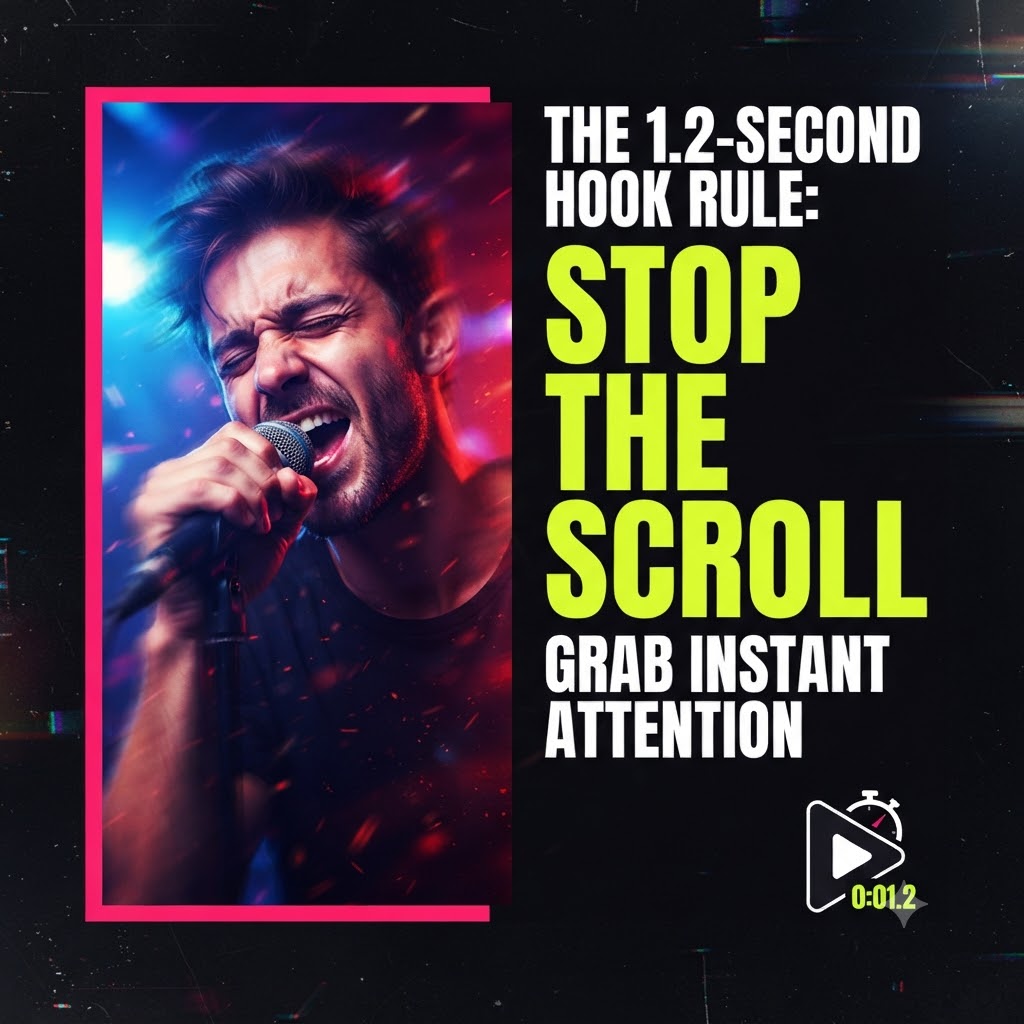
The “1.2-Second Hook” Rule: How to Edit the First Frame of Your YouTube Music Video
Let’s be honest: attention spans are completely shot right now. When someone clicks on your music video on YouTube, you aren’t just competing against the other artists in your genre—you’re fighting short-form feeds, text notifications, and that tempting little back button.
The battle for audience retention is won or lost in the blink of an eye. If your opening doesn’t instantly scream that something cool is about to happen, viewers are going to bounce before your track even hits the first verse. That’s why you need to master the 1.2-Second Hook Rule.
Fixing your intro isn’t about selling out; it’s about respecting how people actually consume video today. Here is how to rethink your edit and lock in your audience from frame one.
Why the First Frame Makes or Breaks Your Release
When a new video drops, the algorithm watches closely to see how early viewers react. If a ton of people bail in the first thirty seconds, YouTube assumes the content is a dud and cuts off your organic reach before the track even has a chance to catch fire.
As music video creators, we love a slow burn. We want that cinematic fade-in, a moody drone shot of a city skyline, or an atmospheric, static intro of an artist standing still. It looks artistic on paper, but it’s absolute death for watch time. If frame one looks stagnant, the viewer’s brain registers it as dead air. To stop the scroll, your edit needs movement, context, or visual friction right out of the gate.
Three Ways to Nail a 1.2-Second Open
You don’t need a Hollywood budget to engineer a high-retention opening. You just have to weaponize your footage during the assembly cut. Try throwing these editing techniques into your timeline’s first few seconds:
1. High-Contrast Text Overlays
Don’t make people guess what they’re looking at. Drop some bold, high-contrast kinetic typography right onto the very first frame. Keep it sharp and punchy—think song title, artist name, or a cryptic lyrical teaser that sets the vibe. By giving the viewer’s brain a visual and textual anchor all at once, you cut down the urge to click away.
2. The Mid-Action “Cold Open” Drop
Instead of starting chronologically, dive straight into the most visually arresting moment of the entire video. Take a high-energy clip from the bridge or chorus—a wild lighting shift, a dynamic dance movement, or a close-up performance shot—and drop it at frame zero. Let it run for a quick 1.2 seconds as a teaser, then hard-cut into the actual start of the song. You’ve just created an open loop in the viewer’s head: now they have to stay tuned just to see how the video gets to that explosive moment.
3. Rapid Transition Edits & Kinetic Pacing
Never let the first frame sit completely still. If your opening shot features a slower camera movement, give it some teeth in post-production. Add a subtle, aggressive punch-in zoom, a swift whip-pan, or a chromatic aberration glitch matched to the first transient of your audio. Movement tells the subconscious mind that something is happening right now, buying you the crucial seconds needed to pull people into your visual world.
Keeping the Momentum Going
Getting a viewer to stick around for the initial 1.2 seconds is only half the battle. Once you’ve mastered the first few frames, back up your retention metrics with an official release strategy to kickstart your watch time.
Treating your intro like a movie trailer instead of a digital placeholder isn’t changing your art—it’s just making sure people actually stick around to hear it.