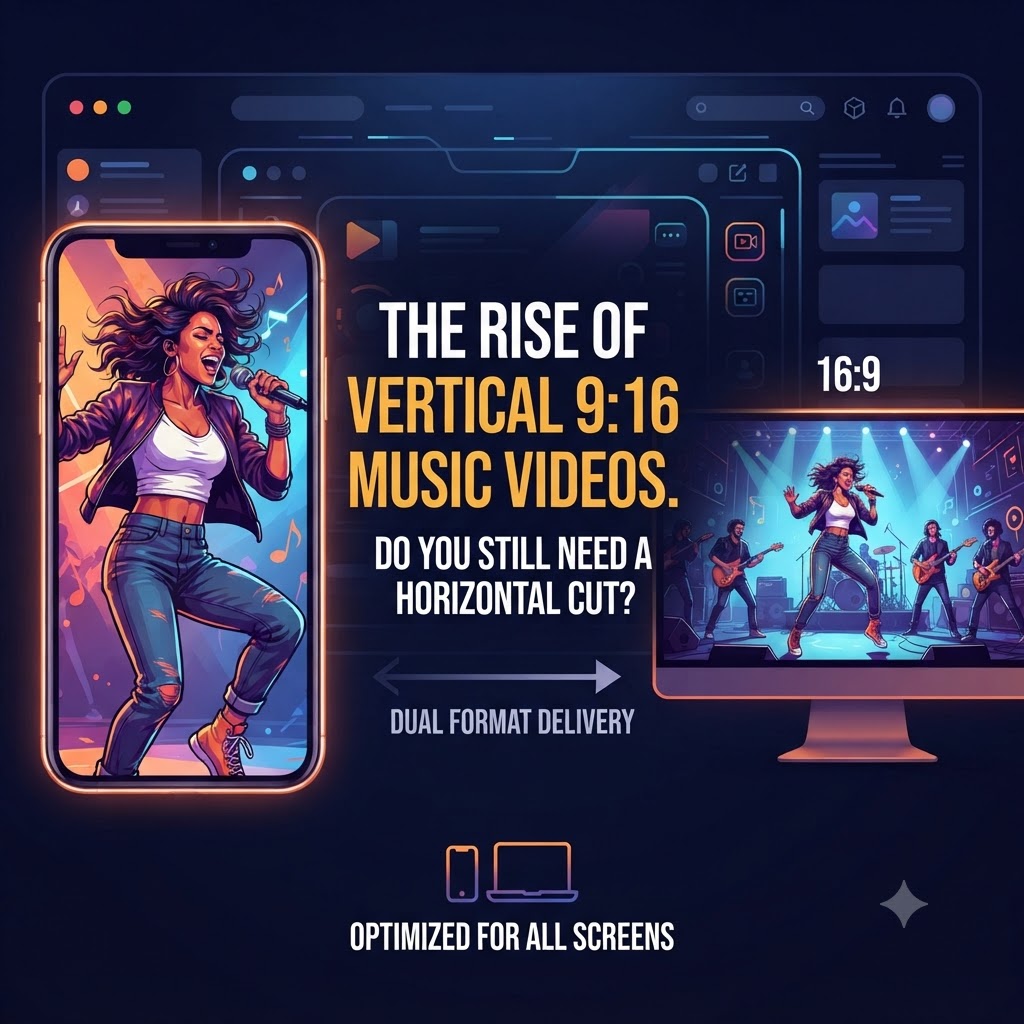
The Rise of Vertical 9:16 Music Videos: Do You Still Need a Horizontal Cut?
Remember when turning your phone sideways was just the default way to watch a video? Today, that instinct feels almost ancient. With TikTok, Instagram Reels, and YouTube Shorts dictating how we consume media, our phones live vertically—and our viewing habits have completely flipped right along with them.
For artists, directors, and independent labels, the game has shifted overnight. Native vertical 9:16 music videos aren’t just a fun extra anymore; they’re often the main engine behind a track’s viral momentum. But that leaves a nagging question for anyone planning a shoot: In a world dominated by vertical screens, do you actually still need a traditional horizontal cut?
Let’s break down why vertical rules the mobile feed, how to plan your shoots so you don’t lose your mind (or your budget), and whether widescreen is officially dead.
Why 9:16 Owns the Screen
If you’ve ever tried watching a classic 16:9 widescreen video on TikTok, you already know the frustration. It shrinks down into a tiny horizontal box trapped between massive black bars, eating up most of the screen and completely losing its punch.
Native vertical videos do the exact opposite. They take over the whole display, creating an upfront, intimate experience that feels like the artist is right there in the room with you. Algorithms naturally favor this format because people stay hooked longer without having to tilt their devices. For a music video, that means closer eye contact, punchier choreography, and an immediate connection with the viewer.
But Do You Still Need a Horizontal Cut?
The short answer is yes. Even though vertical is king on social media, horizontal (16:9) is still the gold standard for YouTube long-form, desktop browsing, press features, and TV syncs.
If an artist wants their video pitched to major music sites, added to editorial playlists, or showcased on a proper TV screen, a widescreen master is non-negotiable. Walking away from 16:9 entirely means shutting the door on traditional curation.
So, how do you solve this formatting headache without doubling your production budget or driving your DP crazy?
How to Shoot for Both Worlds Without Going Crazy
Trying to awkwardly crop a horizontal video down the middle for a vertical reel usually cuts off band members, ruins the composition, and tanks your video quality. Instead, smart production teams are using a few simple workarounds:
1. Shoot Wider and Higher Resolution (4K or Open Gate)
If your camera setup allows for it, shooting in high-res or open-gate gives you a massive canvas. By capturing a wider frame than you initially think you need, you leave yourself plenty of room in post-production to punch in for a clean vertical crop without sacrificing image clarity.
2. Dual-Framing on Set
Stop guessing where the edges are. Modern monitors let you overlay 9:16 guide lines right over your 16:9 feed. This lets your director and camera operator keep all the important action locked dead center, ensuring the primary focal point works for both formats on the fly.
3. Coordinate Your Visual Rollouts
Maximizing your release means planning your distribution timeline ahead of time so your content hits every platform right when it needs to. Vertical formats excel at capturing mobile attention. Keep your channels supplied with professional content by coordinating your visual rollouts with our .
The Bottom Line
The boom of 9:16 music videos doesn’t mean widescreen is dead; it just means we’re in a multi-format era. By thinking ahead on set, you don’t have to choose between a vertical clip that pops on feeds and a cinematic widescreen master—you can easily build both into a single shoot.