Every independent MC is dealing with the exact same bottleneck right now: you spent real money on studio time, mixing, and a video shoot, only to watch your release fight against a feed where listeners swipe past in two seconds. When you look closely at TikTok vs YouTube Shorts for rappers, you quickly realize these two apps aren’t doing the same job. They run on completely different engines, reward different types of hip-hop content, and create two very different kinds of fans.
Treat them like identical vertical video feeds and you will burn through your promotional budget with little to show for it. Treat them as separate stages of a rollout, and you can actually turn random scrollers into people who care about your catalog.
The Numbers Behind TikTok vs. YouTube Shorts for Independent MCs
Before getting into content strategy, it helps to look at how the two algorithms actually distribute underground music when you don’t have a label pushing your records.
Why TikTok Still Wins at Fast, Viral Audio Challenges
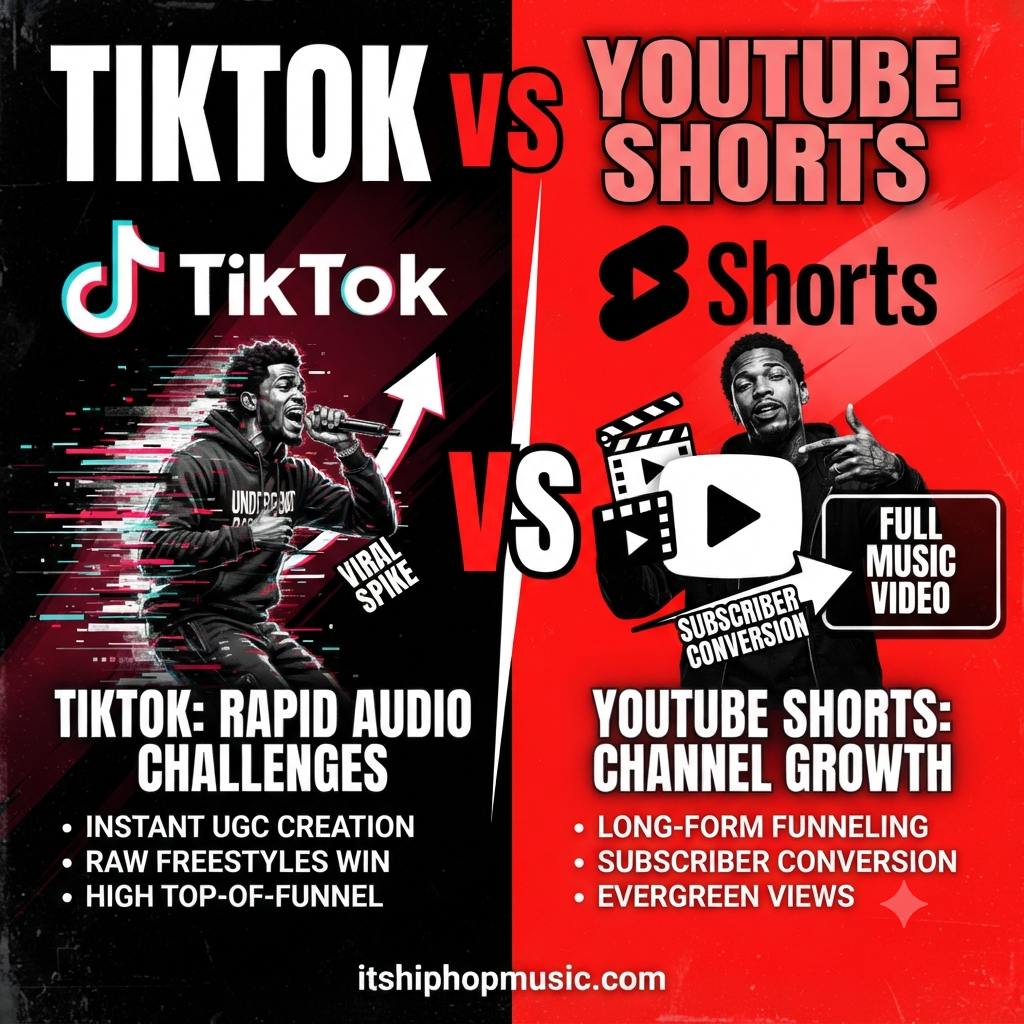
If your goal is raw speed—getting an unreleased verse in front of 50,000 strangers before Friday—TikTok is still the fastest ignition switch in hip-hop.
TikTok’s recommendation system does not care how many followers you had yesterday. Every clip gets dropped into an initial test batch (usually around 200 to 500 viewers). If people replay the bar, leave a comment arguing about a punchline, or tap the audio disc in the bottom corner, the system pushes it into a larger pool within hours.
For underground rappers, TikTok’s real superpower is user-generated audio:
-
Low-barrier participation: Features like Duet, Stitch, and native sound-linking make it effortless for regular users to take a 15-second bounce from your track and put it behind a gym video, a car cruise, or a comedy skit.
-
Raw beats polished: On TikTok, a $3,000 RED camera music video clip often gets swiped past faster than a raw iPhone video of you rapping the verse into a handheld mic in your bedroom. Fans on the app connect with immediacy and personality over glossy production.
-
Immediate DSP spikes: Independent distribution data consistently shows that when an unsigned artist hits micro-virality on TikTok (between 100K and 500K views on a sound), Spotify and Apple Music streams typically jump by 15,000 to 45,000 plays within a week.
The problem is what happens after the spike. TikTok listeners are notoriously passive about following artists. A kid might replay your 15-second hook twenty times on their For You Page and never once tap your profile, check your bio link, or learn your stage name. You get temporary reach, not an audience you actually own.
How YouTube Shorts Turns Scrollers into Official Music Video Viewers
YouTube Shorts plays a slower, heavier game—and for rappers who take their visuals and catalog seriously, it usually pays off better over time.
Instead of relying on dance trends or lip-syncs, the Shorts algorithm watches viewer retention and session behavior. It wants to know if someone watched your 35-second clip all the way through, let it loop twice, and then clicked deeper into your channel.
That changes everything for how hip-hop artists should use it:
-
The Related Video Bridge: YouTube lets you attach a clickable “Related Video” link directly onto the bottom of any Short. If a viewer gets hooked by a 30-second performance clip from your latest single, one tap takes them straight into the full, four-minute official music video—no hunting through a link-in-bio page required.
-
Real Subscriber Conversion: Because YouTube users are already logged in to watch long-form videos, they subscribe at a much higher rate than TikTok users follow. Channels that post consistent Shorts alongside their main uploads see an average 80% lift in overall channel watch time over a 90-day stretch.
-
Search Traffic That Doesn’t Die in 48 Hours: YouTube is the world’s second-largest search engine, and Shorts show up directly in both YouTube and Google results. A clean freestyle over an industry beat, a studio breakdown, or a lyric clip can sit quietly for three weeks and suddenly start pulling thousands of views a day months after you uploaded it.
Once your Shorts start pulling consistent attention, you can convert short-form discovery into permanent long-form channel views via our hip-hop music video promotion packages so that momentum actually sticks to your main release.
The Best Way to Use Both in Your Next Rollout
Stop arguing over TikTok vs YouTube Shorts for rappers as if you can only pick one. The smartest independent artists treat them like a two-step filter:
-
Test your records on TikTok first. Before you lock in a final single or spend money shooting visuals, post three or four raw clips of different verses on TikTok. Watch the completion rate and comments. You will find out within 48 hours which bar actually makes people stop scrolling.
-
Move the winners to YouTube Shorts. Once you know which section of the song connects, cut a clean 30-to-45-second vertical version—without a TikTok watermark, which YouTube’s algorithm actively downranks—and upload it to Shorts with the Related Video link pointed straight at your full official video.
-
Keep the framing tight. On both platforms, your first two seconds decide everything. Start right on the vocal entry or the hardest visual cut, keep captions clean and readable in the center of the screen, and don’t waste five seconds on a slow beat intro.
TikTok gets your name in the room; YouTube gives people a reason to stay once they walk in.
Put your video shoot in front of active fans. Submit your link on our Video Submission Platform.