How to Write Rap Punchlines and Metaphors Like Lil Wayne and Benny The Butcher
Most rappers spend hours obsessing over rhyme schemes, yet their verses still bounce right off the listener’s ears. Why? Because multi-syllable rhyming without a sharp payoff is just rhythmic tongue-twisters. If you want people to actually hit the rewind button—or screw up their faces in that unmistakable “stank face” reaction—you have to master how to write rap punchlines that hit with genuine surprise and weight.
When you look at the Mount Rushmore of modern lyricism, two names stand out for completely different reasons: Lil Wayne and Benny The Butcher.
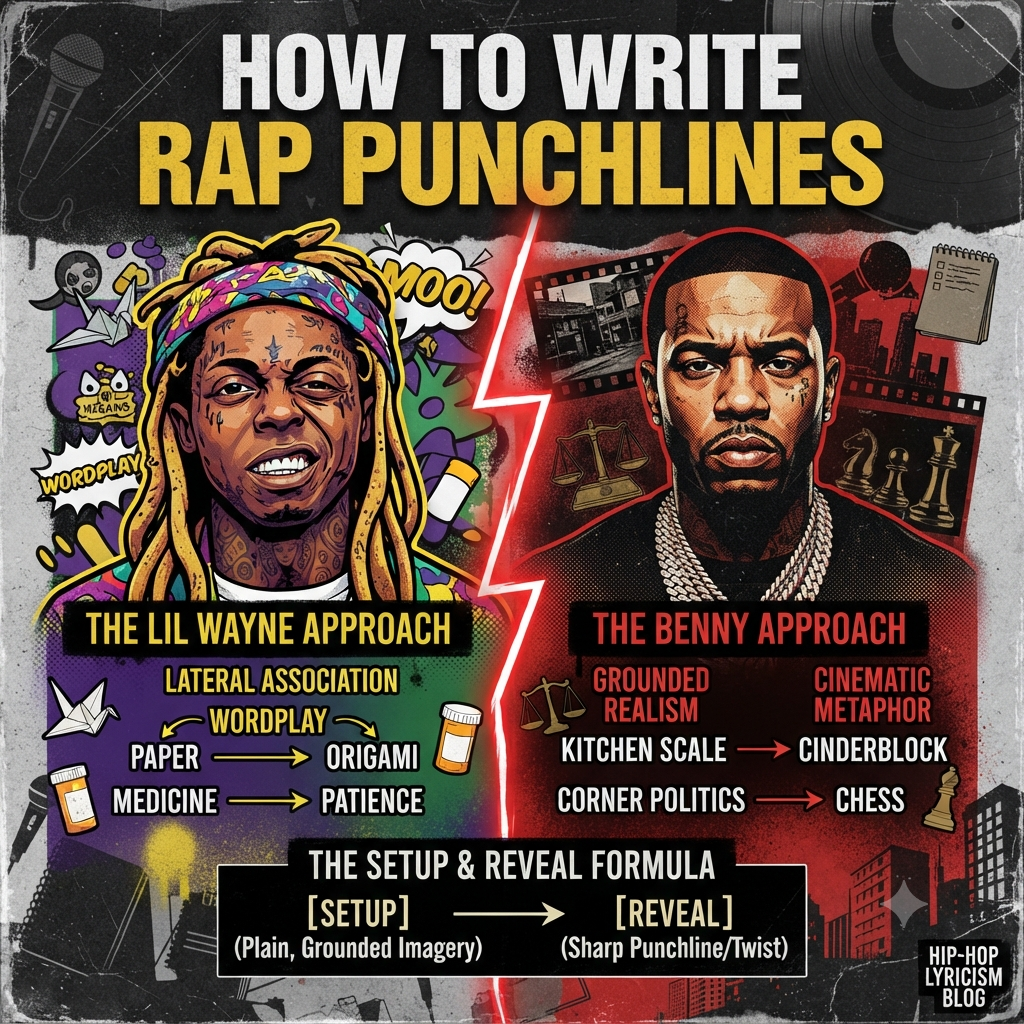
Wayne is the undisputed king of surrealist wordplay, treating the English language like silly putty and flipping double entendres at breakneck speed. Benny, on the other hand, writes like a Martin Scorsese screenwriter—cold, hyper-specific, and heavy, setting up vivid crime-drama scenes before dropping a metaphor that lands like a cinderblock. They come from opposite sides of the hip-hop map, yet if you strip away their vocal tones and beat selections, they are using the exact same songwriting mechanics.
If you are ready to move past surface-level similes and build verses that actually stick, here is a real-world breakdown of how punchline construction works—and how you can apply Wayne and Benny’s techniques to your own catalog.
1. The Setup-and-Reveal Formula: Treat Your Bars Like Stand-Up Comedy
Great punchline writing borrows heavily from stand-up comedy. A comedian never gives away the joke in the first sentence; they paint an ordinary picture, get the audience nodding along in agreement, and then pull the rug out at the last second. In a two-bar rap couplet, Bar 1 is your setup, and Bar 2 is your reveal. If the listener can guess your punchline halfway through the first bar, you have already lost them.
How Lil Wayne Builds a Setup: Lateral Association
During his historic mixtape run, Lil Wayne perfected a specific kind of mental gymnastics. He makes a bold, seemingly straightforward boast in the setup, then pivots on a secondary meaning of a word in the reveal.
Think about how Wayne connects two unrelated worlds using a single bridge word. Instead of saying “I have a lot of money and I’m dangerous,” he looks at the word paper and immediately connects it to origami, cuts, or notebooks. He looks at medicine and links patients with patience.
To write like Wayne, stop trying to think of cool things to say and start playing word association:
-
Pick a standard rap topic—wealth, loyalty, or outworking your competition.
-
Write down five physical objects tied to that topic (e.g., for wealth: safe, wire, scale, receipt, vault).
-
List three verbs or slang terms attached to each object. When you find a word that works in two completely different sentences, you have found your bridge.
How Benny The Butcher Builds a Setup: Grounded Realism
Benny The Butcher rarely messes around with cartoonish puns. His setups work because they feel uncomfortably real. Before Benny ever hits you with a metaphor, he anchors the verse in concrete, cinematic details—kitchen scales, specific watch references, winter coats, corner politics, and exact dollar amounts.
Because the setup feels like a documentary, the listener drops their guard. They aren’t expecting a punchline; they are just listening to a story. Then, right at the end of the bar, Benny drops a cold comparison that reframes the entire situation.
Try this in your next writing session: write a two-bar couplet where the first bar contains zero metaphors—only concrete nouns and plain actions. Save your figurative language exclusively for the second bar. When the metaphor finally arrives, that grounded setup will make it hit twice as hard.
2. Flipping Pop-Culture, Sports, and Homophones Without Sounding Cheesy
One of the fastest ways to level up how to write rap punchlines is to tap into shared cultural memory. Both Wayne and Benny pull constantly from sports, classic movies, and pop culture because those references come pre-loaded with imagery. When you mention a championship game, a famous movie villain, or a notorious scandal, the listener already knows the backstory—which saves you valuable syllables.
The trick is avoiding the obvious, played-out comparisons (“balling like Michael Jordan” should stay retired permanently). Instead, look at the mechanics, terminology, and obscure moments inside those worlds.
| Wordplay Element | The Lil Wayne Approach | The Benny The Butcher Approach |
| Sports Angles | Targets rulebook jargon, referee calls, jersey numbers, and injury reports (traveling, technical foul, sixth man, torn ACL). | Focuses on championship grit, underdog comebacks, draft-day snubs, and heavyweight boxing wars. |
| Homophone Flips | Exploits identical-sounding words with wildly different definitions (sole/soul, reign/rain, board/bored, stationery/stationary). | Leans on double meanings rooted in street economics and hustle (work, brick, weight, plate, scale, plug). |
| Pop-Culture Pulls | Mixes cartoons, horror franchises, and viral news into surreal, unexpected jokes. | Pulls from 90s crime cinema, mafia lore, and classic hip-hop history to project authority. |
A Simple Blueprint for Engineering a Flip
If you want to build a clean homophone or sports flip from scratch, work backward:
-
Isolate the Punchword: Start with a word that carries two or three distinct meanings. Words like draft (NBA draft, cold breeze, rough draft), check (Nike swoosh, bank check, chess move), or ring (championship ring, boxing ring, burner phone) are goldmines.
-
Write Two Unrelated Sentences: Write one sentence using the word in a sports or pop-culture context, and a second sentence using it in a real-life or street context.
-
Splice Them Together: Put the first context in Bar 1 and the second context in Bar 2, trimming out any filler words until the transition feels effortless.
3. Subverting Expectations on the Fourth Beat
You can write the cleverest double entendre on paper, yet if your rhythmic placement is sloppy, nobody in the room will catch it. In standard 4/4 hip-hop production, the snare drum lands on beats 2 and 4. That fourth beat—especially at the end of a second or fourth bar—is where the listener’s brain naturally expects a thought to resolve.
Great punchline rappers treat beat four like a trapdoor.
The “Garden Path” Technique
In linguistics, a “garden path” sentence leads your brain down one obvious grammatical road before the final word forces you to re-read the whole sentence from scratch. Wayne uses this constantly. He will spend beats one, two, and three making you think a line is about a relationship, only to drop a single word on beat four that reveals he was talking about his studio grind the entire time.
Let the Pocket Breathe
Benny The Butcher is a master of space. Instead of cramming sixteen syllables into every bar, he will often leave a split-second pause right before the fourth-beat snare, dropping his punchline deadpan into the empty pocket. When you stop rapping for a fraction of a second before the reveal, the listener’s ear leans forward automatically.
Watch Your Diction on the Landing
A common mistake younger rappers make is accelerating their flow right through the punchline to show off speed. Resist that urge. Stack your internal rhymes across beats one, two, and three to build momentum, then lock into a clean, unmistakable cadence on beat four. If people have to squint to understand what you just said, the punchline loses its visceral impact.
4. A Daily 15-Minute Drill to Sharpen Your Pen
Punchline writing isn’t a mystical gift you are born with; it is lateral thinking, and like any muscle, it responds to reps. Before you record your next verse, run through this quick routine:
-
Lock in One Micro-Topic: Don’t try to write about your whole life in eight bars. Pick one narrow angle—surviving a bad business deal, outworking lazy peers, or enjoying the payoff after a long drought.
-
Build a Word Web: Write fifteen plain words related to that topic down the left side of your notebook. Next to each word, scribble down every homophone, idiom, athlete, or movie character it reminds you of.
-
Write Bar 2 First: Pick your strongest connection from the list and write the punchline bar before you write anything else. Knowing your exact destination makes it ten times easier to build a deceptive setup.
-
Do the Acapella Check: Read the finished couplet out loud at a normal speaking pace with the beat muted. If the bar doesn’t make someone smirk or nod without drums and 808s backing it up, rewrite the setup until the twist hits cleanly on its own.
Once you have put in the work to tighten your metaphors and record a track where every bar pulls its weight, the next step is getting your music heard by people who actually care about lyricism. Algorithms reward noise, but real hip-hop fans and tastemakers still pay attention to penmanship. When you are ready to step outside your immediate circle, put your sharpest punchlines and intricate wordplay in front of seasoned culture critics on our hip-hop music review blog.