The Spotify -14 LUFS Myth: Why Your 808s Lose Punch and How to Fix Your Low-End
If you spend any time on producer forums, YouTube tutorials, or mixing subreddits, you’ve almost certainly run into this piece of advice:
“Bro, you gotta master your beats to -14 LUFS. Otherwise, Spotify’s loudness penalty is going to crush your dynamics and turn your mix down to mush!”
It sounds smart. It sounds technical. And because it comes wrapped in numbers and platform specs, thousands of producers take it as gospel. Every single day, bedroom beatmakers and emerging mix engineers throw away massive amounts of low-end energy, squeeze the life out of their 808s, and sacrifice commercial weight—all because they are terrified of Spotify’s volume normalization.
Here is the honest, unfiltered truth: Obsessing over the -14 LUFS target is one of the fastest ways to ruin your modern hip-hop, trap, or electronic mix.
Let’s pull back the curtain on how streaming normalization actually works, why the term “loudness penalty” is completely misleading, and how you can stop stressing over numbers and start making your 808s hit as hard as your favorite reference tracks.
1. Where Did the -14 LUFS Rule Come From (And Why Is It Wrong)?
To understand why the -14 LUFS myth refuses to die, we have to look at why streaming platforms introduced loudness normalization in the first place.
Back in the peak of the “Loudness Wars” of the 2000s, commercial music was being slammed against digital brickwall limiters. CDs and early digital downloads were mastered hotter and hotter—often pushing past -5 or -4 LUFS—just to sound louder than the track before them. The result? Total auditory fatigue. Listening to an uncompressed acoustic ballad followed immediately by a hyper-compressed heavy metal track or a blasting trap beat meant constantly reaching for the volume knob.
To fix this, streaming services like Spotify, Apple Music, YouTube, and Tidal introduced loudness normalization.
How Normalization Actually Works
Think of normalization as an automated volume knob that sits on the platform’s playback engine:
-
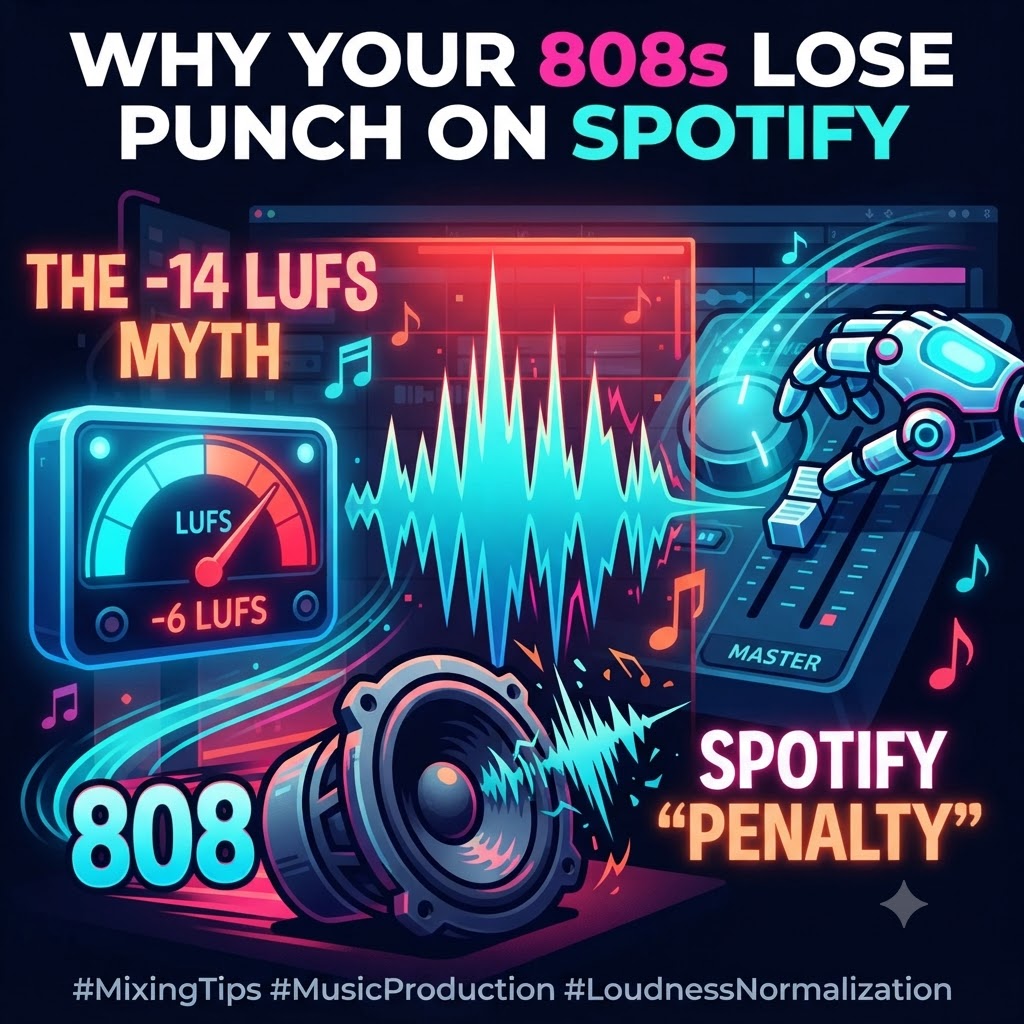
If a track measures louder than the platform’s target (Spotify uses -14 LUFS, YouTube uses around -13 LUFS, and Apple Music targets -16 LUFS), the algorithm gently turns the master volume down so it matches a comfortable listening level.
-
If a track is quieter than the target, Spotify may turn it up—up to a point. But if boosting it would cause digital clipping, the platform applies a hidden limiter to protect your audio, which can distort your mix.
The Misinterpretation
Here is where producers got confused. Logic dictates: “If Spotify is going to turn down anything louder than -14 LUFS, I should just master my tracks right at -14 LUFS. That way, the algorithm won’t touch my music, and my dynamics will stay completely intact!”
It sounds foolproof on paper, but it completely ignores the reality of modern commercial music consumption. If you pull up a chart-topping hip-hop or pop track right now and drop it into a metering plugin, you will rarely see it sitting at -14 LUFS. Professional commercial mixes across urban, pop, and electronic genres routinely average between -9 LUFS and -6 LUFS.
If you master your beat at -14 LUFS to “trick” Spotify, and play it right next to a professional Travis Scott or Drake record, your track is going to sound noticeably weaker, thinner, and less impactful when listeners are flipping through playlists. Normalization doesn’t care what your integrated LUFS target is—it balances tracks based on psychoacoustic loudness. If your mix lacks energy out of the gate, normalization isn’t going to magically give it punch.
2. The Real Victim: Why Over-Compressing 808s Kills Your Low-End
When producers realize that -14 LUFS leaves their beats sounding quiet compared to commercial heavyweights, they often panic. They try to bridge the gap by squeezing every last drop of loudness out of their master buss, or they over-compress their individual 808 and kick channels to force them to “compete.”
This is where things go completely off the rails for low-heavy genres. Sub-bass and 808s behave completely differently than mid-range instruments like guitars or vocals. Low frequencies carry massive amounts of energy, and treating them with heavy-handed compression creates a cascade of mixing disasters:
A. Sucked-Out Transients and Dead Punch
An 808 isn’t just a sustained sine wave; its magic lives in the initial transient—the knock, the click, and the sharp slide that hits your chest the moment the note triggers. When you slap a fast compressor with an aggressive ratio onto your 808 to squeeze it into a narrow dynamic window, you chop off that initial strike. What you are left with is a tubby, muddy low-end drone that lacks any cutting power. It takes up a ton of headroom, but it doesn’t actually hit.
B. Inter-Sample Peaks and Transcoding Distortion
Sub-frequencies contain immense energy. When you push a heavy-handed limiter on a master buss filled with massive, unmanaged 808s, you generate intense inter-sample peaks (ISPs).
When you upload your pristine WAV file to Spotify, the platform doesn’t stream that raw file to your listeners. It runs your audio through lossy compression codecs like Ogg Vorbis or AAC to save bandwidth. If your track is plagued by harsh inter-sample peaks, those lossy compression algorithms will mangle your low end. Instead of a clean, booming sub, your listeners hear digital crackling, pumping, or a weird “choking” sound every time the 808 drops.
C. The Dreaded “Pumping” Effect
Have you ever listened to a beat where the entire mix seems to duck or breathe every time the kick drum or 808 hits? That is the sound of an overworked master limiter. When a massive, untamed sub-frequency slams into your compressor, the plugin grabs the entire frequency spectrum to pull the volume down, dragging your hi-hats, melodies, and vocals down with it. It completely destroys the groove and professional polish of your production.
3. How to Master Loudly Without Sacrificing Your Low-End
So, what is the alternative? Should you just give up on modern loudness and accept quiet mixes? Absolutely not. You can achieve commercial weight and loudness while keeping your 808s chest-pounding and dynamic. You just need to change how you approach your mixing chain.
Here is a practical workflow to get your beats sounding massive, whether they are played on a club system, Apple AirPods, or laptop speakers:
-
Distribute Your Gain Staging: Do not rely on your master bus limiter to do 100% of the heavy lifting. Build your mix from the ground up. Use clipping or saturation on individual 808 and drum buses to shave off unpredictable peaks before they ever reach the master fader. Saturation adds pleasant harmonics, making your 808s sound louder and clearer on small speakers without actually eating up extra dynamic headroom.
-
Keep an Eye on True Peaks: Set a ceiling on your final limiter. Aim for a True Peak maximum of -1.0 dBTP (Decibels True Peak). This safety margin gives streaming algorithms breathing room when they transcode your audio, ensuring your low-end survives the compression process without digital clipping.
-
Target Commercial Loudness Confidently: Stop worrying about the -14 LUFS boogeyman. If your hip-hop, trap, or electronic track feels best and retains its emotional punch at -8 LUFS or -9 LUFS, master it there. Spotify will simply turn it down a few decibels, and because your transients are clean and your low-end is managed, your mix will retain its clarity, weight, and competitive edge.
-
Reference Relentlessly: Drop a track from your favorite producer into your DAW. Match its volume to yours using a gain plugin, bypass your master chain, and critically listen to how their sub-bass moves. Notice that professional 808s often leave room to breathe, utilizing space and saturation rather than mindless compression to feel heavy.
Final Thoughts: Let Go of the Numbers
At the end of the day, music listeners don’t check LUFS meters on their phones before adding a song to their playlist. They care about how a track makes them feel.
The -14 LUFS standard is a normalization target for the playback system, not a creative constraint for the studio. Chasing it blindly will only leave your beats sounding weak, and over-compressing your 808s to compensate will strip away the very energy that makes your music exciting.
Focus on great sound selection, clean gain staging, smart saturation, and proper headroom. Let Spotify worry about the volume knob—your job is simply to make the music hit as hard as possible.