SoundCloud Pro vs. DistroKid: Building a Hybrid Distribution Stack for Underground Rap
If you talk to ten underground rap artists in 2026, you will get ten different opinions on how to drop music. Some swear by the grassroots, chaotic energy of SoundCloud. Others treat aggregators like DistroKid as the absolute law of the land, focusing purely on Spotify algorithm game and Apple Music pre-saves.
For a long time, the indie music industry tried to frame this as a massive either/or decision. People acted like you had to choose a side: either you’re an underground SoundCloud purist dropping loose MP3s into the void, or you’re a structured, buttoned-up streaming artist optimizing metadata for algorithmic playlists.
The truth? The smartest underground rappers aren’t picking a side at all. They are combining both platforms into a hybrid distribution stack.
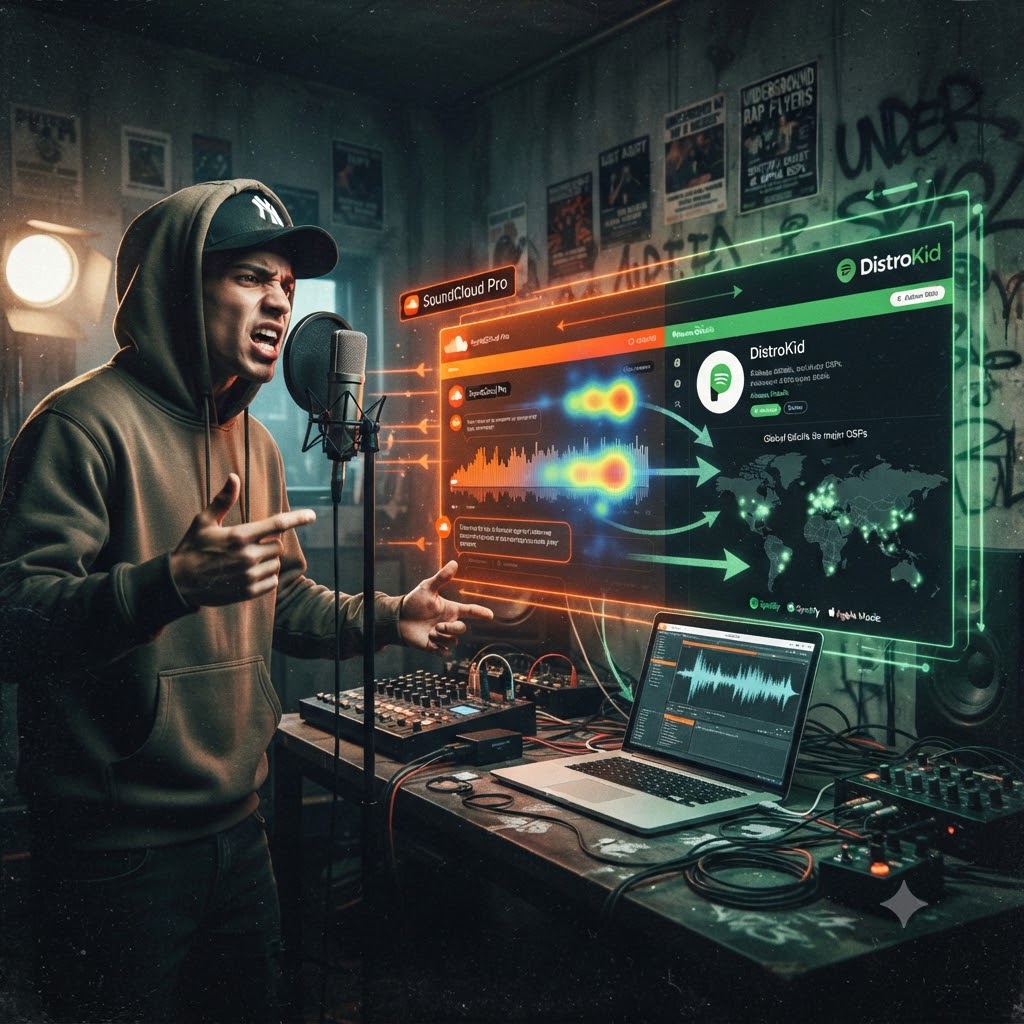
By using SoundCloud Pro (Next Pro) as an underground laboratory and testing ground, and then using DistroKid as the heavy-duty engine to push polished tracks to global DSPs (Digital Service Providers), you can stop guessing what your fans want to hear. Instead, you let the streets tell you what works before you spend a dime on official distribution or broad marketing campaigns.
Let’s break down how this hybrid setup works, why traditional release models are failing underground acts, and how you can build a pipeline that turns raw internet hype into certified, monetizable streaming data.
The Death of the Blind Drop: Why Underground Rap Needs a Two-Step Launch
Let’s paint a picture that every independent artist knows too well. You spend three weeks tweaking an 808 pattern, stacking vocal layers, and paying an engineer to get that dark, distorted mix sitting right. You are convinced it’s a hit.
Without testing it, you upload it to DistroKid, set a release date for three weeks out, and wait. When it finally drops on Spotify, it lands with a quiet thud. The algorithm doesn’t know what to do with it, your followers stream it once because you posted a link on your story, and the momentum dies in 48 hours. You just burned a legitimate release on a track that wasn’t fully ready for prime time.
In underground rap—whether you’re pushing pluggnb, aggressive rage beats, melodic trap, or lo-fi underground phonk—momentum is fragile. Major labels can afford to throw money at the wall until something sticks. As an independent artist, you don’t have that luxury. Every drop has to count.
This is where the hybrid mindset changes the game. Instead of treating every platform the same, you divide and conquer:
-
SoundCloud is your laboratory: Fast, highly reactive, conversational, and completely raw. It’s where you test the structural integrity of your songs.
-
DistroKid is your storefront: Formal, structured, royalty-generating, and global. It’s where you lock in permanent stats once a song has already proven it has a pulse.
Phase 1: SoundCloud Pro as the Ultimate Underground Sandbox
Before a track ever smells a major DSP, it needs to survive the gauntlet of the underground internet. SoundCloud Pro gives you the precise tools needed to run these diagnostics without ruining your official streaming footprint.
1. Real-Time Feedback and Timestamped Diagnostics
When you upload a private or unlisted link to SoundCloud, you aren’t just sharing a song; you are opening up a live focus group. Underground rap fans are notoriously vocal. If your intro is too long, someone will leave a timestamped comment at 0:15 saying “skip to the beat drop.”
SoundCloud’s playback stats also show you listener retention curves. If you notice a massive drop-off at the second verse every single time people play the track, you know instantly that your second verse needs a rewrite or a faster flow. You can’t get that kind of granular, structural feedback on Spotify on release day—by then, it’s already too late.
2. Testing the “Loosies” Culture
The underground rap scene was built on loosies. Think about how many legendary careers were kickstarted by throwaway SoundCloud drops that caught fire organically. SoundCloud Pro gives you unlimited uploads, meaning you can drop rough demos, alternate mixes, or snippet packs without polluting your primary Spotify profile with half-baked ideas.
If a rough SoundCloud upload starts pulling organic reposts, word-of-mouth traction, and high play counts within 72 hours, you have just found your next official single.
3. Fan-Powered Royalties and Direct Community Support
SoundCloud’s Fan-Powered Royalties (FPR) system means that even during your testing phase, your most dedicated supporters aren’t just giving you empty hype—they are sending actual revenue your way based on their listening habits. It turns your core fanbase into micro-investors who feel a real sense of ownership over your journey.
Phase 3: Moving to DistroKid to Lock in the Global Rollout
Once a track passes the SoundCloud stress test—meaning the comment section is active, the repost chains are moving, and the retention stats look healthy—it’s time to take off the training wheels and send the master file to DistroKid.
1. Speed and Low Friction
DistroKid remains a favorite for independent artists because of its flat annual fee and fast turnaround times. Once you’ve dialed in your mix based on your SoundCloud audience’s reactions, you can upload the final file to DistroKid, lock in your primary and featured artists, add your producers to the liner notes, and push it out to Spotify, Apple Music, Tidal, and Amazon Music.
2. Protecting Your Brand Equity
One crucial rule of the hybrid stack: Keep your metadata clean. When you move a track from SoundCloud to DistroKid, make sure the title, feature formatting, and cover art match what your underground audience fell in love with. You want listeners who discovered you on SoundCloud to instantly recognize the track when it pops up in their Release Radar on Spotify.
Step-by-Step Blueprint: Building Your Hybrid Release Pipeline
If you want to put this system into practice for your next rollout, follow this four-step weekly framework:
-
The Private Stress-Test (Week 1): Upload your mastered or near-mastered track to SoundCloud Pro as a private link. Drop it into private Discord servers, send it to trusted producer friends, and gauge their initial reactions. Fix any glaring mix issues or structural bloat.
-
The Public Warm-Up (Week 2): Make the track public on SoundCloud. Push it across your socials, encourage your core supporters to repost, and watch the comment section closely. Treat this period as live market research.
-
The Official DSP Trigger (Week 3): Take the validated, crowd-tested version of the track and upload it through DistroKid. Give yourself a 2-to-3-week lead time before the release date so you can pitch directly to Spotify Editorial and independent playlist curators.
-
The Cross-Platform Bridge: Use the organic view counts, screenshots of high engagement, and fan reactions from your SoundCloud run to prove to independent curators that the track already has momentum.
From Internet Hype to Verified Streaming Metrics
Building a hybrid distribution stack is all about cutting out the guesswork. Instead of hoping the internet likes what you made, you let the underground community vet your music first, and then you scale it globally with DistroKid.
Of course, once your track is live across all DSPs, the next challenge is getting it into the right ears. If you want to convert underground warm-up hype into official streaming data with our curated rap playlists, make sure your tracks are locked in, polished, and ready to make some noise.