The 1-Minute, 45-Second Hit: How Short Songs Are Rewriting Music Payout Math
If you’ve spent any time on TikTok or Spotify lately, you’ve probably noticed that popular songs are shrinking. The sprawling, 5-minute rock epics and leisurely 4-minute pop ballads of the past have largely taken a back seat. Today, tracks routinely clock in under three minutes—and a growing wave of independent artists, beatmakers, and savvy producers are trimming them down even further to around 1 minute and 45 seconds.
At first glance, it feels like a symptom of our collective goldfish attention spans. But if you look under the hood, there is a much bigger financial engine driving this trend. It’s a brilliant, slightly chaotic masterclass in modern music economics known as streaming payout math.
When you break down how digital streaming platforms (DSPs) actually pay out royalties, shrinking your tracks isn’t just an artistic choice. For the right genre, it is a legitimate strategy to double your streaming revenue within the exact same amount of listener time.
Let’s pull back the curtain on how the math works, why the algorithm loves it, and whether you should consider cutting your next track in half.
The Golden Rule of Streaming: The 30-Second Threshold
To understand why short songs are suddenly a massive financial cheat code, we have to look at how major services like Spotify, Apple Music, and Amazon Music define a “stream.”
It’s a simple binary rule that every indie artist needs to memorize: A stream—and a corresponding royalty—is only triggered when a listener stays on a track for at least 30 seconds.
-
If someone listens to your song for 29 seconds and skips, you earn $0.00.
-
If they listen for 31 seconds, that counts as one full, completed stream, triggering a payout.
Here is where the traditional music business model collides with digital math: royalties are paid out per stream, not per minute.
With very few exceptions regarding song length penalties on specific platforms (usually only applying if a track is under 30 seconds total), a 4-minute track pays out roughly the exact same per stream as a 2-minute track.
Once a song crosses that 30-second finish line, its length no longer matters to the ledger. A stream is a stream is a stream.
The 30-Minute Listening Session: A Real-World Math Breakdown
Let’s see what happens when we take this rule out of theory and put it into practice. Imagine an average music fan going about their day—say, a 30-minute morning commute or a gym session where they put on a playlist and let it ride.
Scenario A: The Traditional 3.5-Minute Track
Let’s look at a standard, radio-friendly pop or indie song.
-
Song Length: 3 minutes and 30 seconds (or 210 seconds)
-
Total Session Window: 30 minutes (or 1,800 seconds)
-
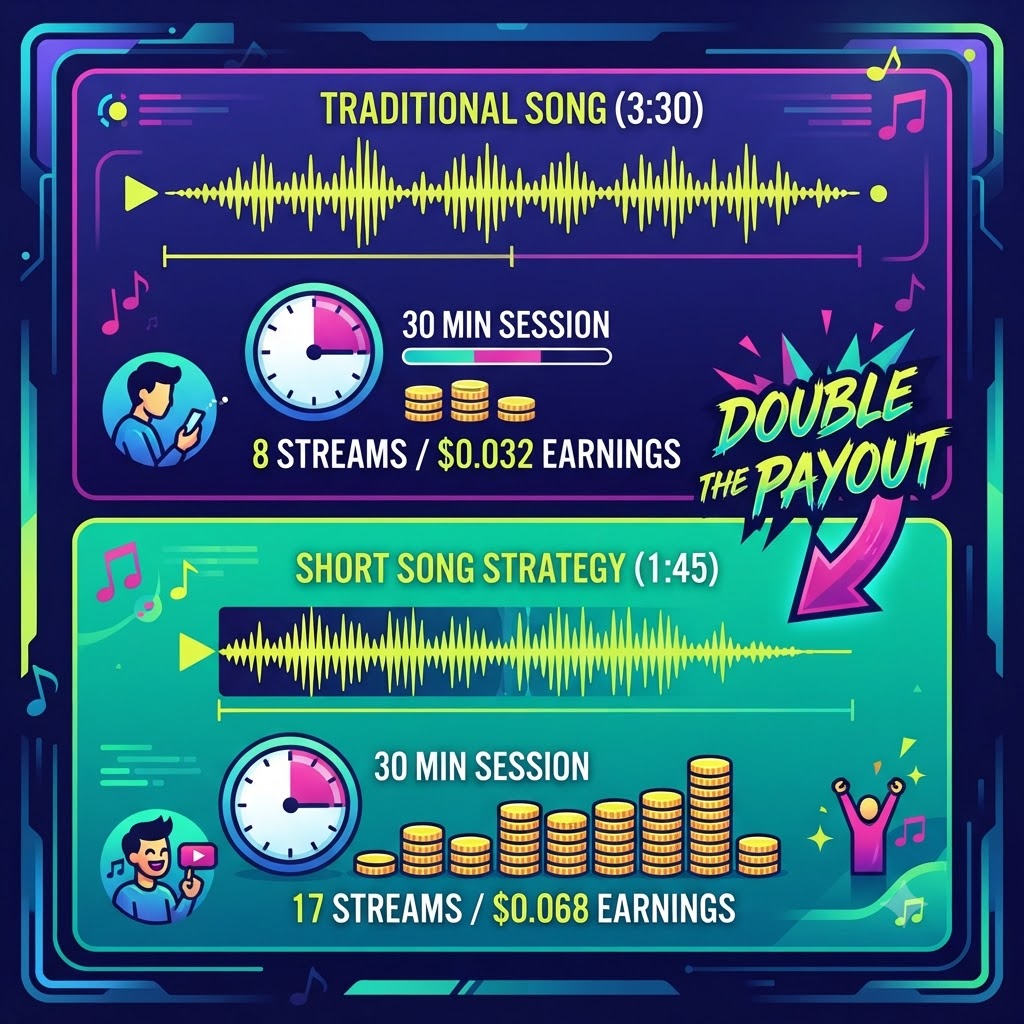
Plays per Session: 1,800 divided by 210 equals roughly 8.5 streams.
-
Royalty Count: Rounded down or logged as 8 completed streams.
In that 30-minute block of background listening, your listener cycles through about 8 traditional songs. If you’re an independent artist earning roughly $0.004 per stream on Spotify (the standard industry average ballpark), those 8 streams earn you:
Scenario B: The “Short-Song” Strategy (1 Minute 45 Seconds)
Now, let’s look at what happens when an artist builds a track specifically optimized for modern listening habits—clocking in at a tight 1 minute and 45 seconds (105 seconds).
-
Song Length: 1 minute and 45 seconds (or 105 seconds)
-
Total Session Window: 30 minutes (or 1,800 seconds)
-
Plays per Session: 1,800 divided by 105 equals roughly 17.1 streams.
-
Royalty Count: Rounded down or logged as 17 completed streams.
In that exact same 30-minute time window, because the tracks are half as long, the listener has streamed your song 17 times instead of just 8.
Let’s run the financial math on that session again:
By simply cutting the song length in half—while keeping the listener engaged for the exact same amount of time—you have more than doubled your royalty earnings for that session.
Beyond the Payouts: Why the Algorithm Rewards Short Songs
If the raw math isn’t enough to convince you, consider how streaming algorithms actually decide who gets discovered. Platforms like Spotify and Apple Music aren’t run by human music critics; they are run by cold, hard data algorithms that heavily prioritize user engagement signals.
Short tracks naturally stack the deck in your favor for several reasons:
-
Massive Replay Value: A great 105-second track leaves people wanting more. Instead of experiencing listener fatigue around the 3-minute mark, a listener is far more likely to hit the repeat button immediately. Every single repeat loop counts as a brand new stream.
-
Sky-High Completion Rates: One of the biggest metrics algorithms track is whether listeners finish a song or skip it halfway through. With a sub-2-minute track, the song is essentially over before the listener even gets a chance to think about skipping. High completion rates scream to the algorithm: “This is a sticky track!”
-
Algorithmic Momentum: Because completion rates and instant replays are high, automated systems push the track outward into algorithmic life rafts like Release Radar, Discover Weekly, and endless mood-based radio stations.
The Catch: Is the 1:45 Strategy Right for You?
Of course, hacking the streaming economy with hyper-short tracks isn’t a universal magic wand. There are definite trade-offs to consider before you head back into your DAW to chop up your entire catalog.
Artistic Compromise
If you write sprawling progressive rock, intricate jazz fusion, or emotional, cinematic folk music that takes two minutes just to build an atmosphere, a 1-minute 45-second structure is going to feel like a straightjacket. You shouldn’t butcher your artistic vision just to appease an algorithm if it strips the soul entirely out of the music.
Genre Constraints
This strategy doesn’t work equally for everyone. If you make ambient drone music or classical pieces, short songs are a non-starter. But if you operate in genres like hyperpop, modern hip-hop, indie-pop, electronic dance music (EDM), or lo-fi beats, the 1:45 sweet spot is proving to be a revolutionary commercial playbook.
Final Thoughts: Adapt, Evolve, or Leave Money on the Table
Music history has always been shaped by the physical and technological constraints of its era. In the 1950s, the 3-minute 7-inch vinyl single was born because radio DJs and jukeboxes demanded it. In the 90s, CDs bloated album runtimes because artists suddenly had 74 minutes of digital space to fill.
Today, streaming economics dictate the canvas.
If you want to build a sustainable independent music career in a system that pays a flat rate per stream regardless of duration, ignoring how the math works is essentially leaving money on the table. By tightening up your arrangements, cutting out the fat, and aiming for that magic 1:45 mark, you can give modern listeners the fast-paced fix they crave while quietly doubling your streaming payout potential.