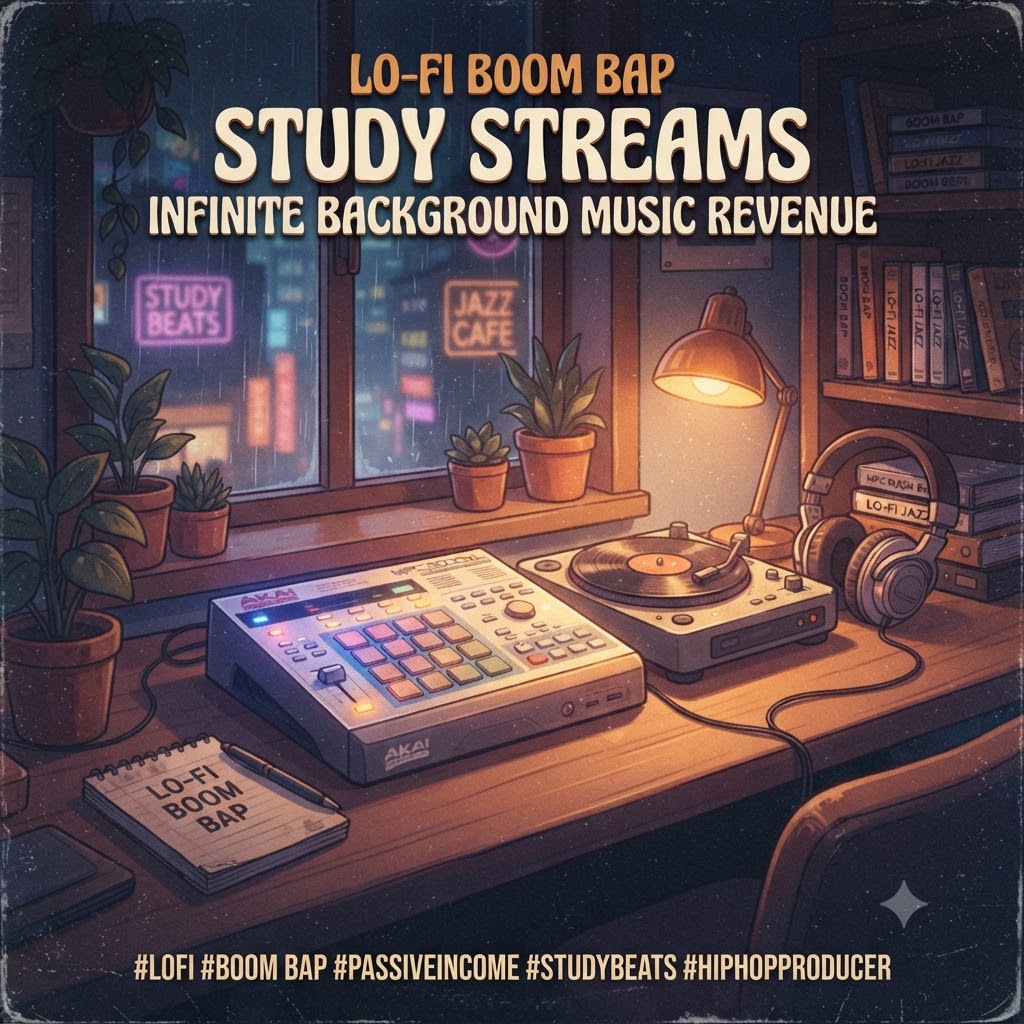
Lo-Fi Boom Bap Study Streams: The Infinite Background Music Revenue Stream
If you’re a hip-hop producer staring at a hard drive full of unreleased instrumentals, chances are you’ve spent a lot of time stressing over the traditional music industry game. You’ve probably chased major artist placements, tried to crack the code on viral TikTok audio snippets, or burned cash on social media ads that didn’t go anywhere. It’s exhausting, unpredictable, and honestly, a fast track to burnout.
But what if you shifted your focus entirely?
What if, instead of trying to make the next big club banger or radio single, you started making music designed to be played in the background while people code, study, and drink coffee at 2:00 AM?
Welcome to the world of Lo-Fi Boom Bap study streams. This corner of the internet isn’t flashy, but it quietly generates some of the most reliable, long-term passive income in the modern music business. If you want to turn your beatmaking habit into an infinite background music revenue stream, this is the blueprint.
Why the Traditional Beat-Selling Model is Burning Producers Out
Let’s be honest about how the beat-selling landscape usually works. You spend hours meticulously crafting an intricate beat with complex arrangement shifts, multi-layered melodies, and hard-hitting 808 slides. Then, you upload it to YouTube or Beatstars, slap a cool anime graphic or a moody street photo on it, and wait.
And wait.
The reality is that traditional rap beats require active consumer engagement. A rapper has to find your beat, visualize themselves writing a 16-bar verse over it, clear the budget, buy a lease or exclusive license, and record. That’s a massive friction point.
Background music, on the other hand, removes all that friction.
When someone puts on a 24/7 lo-fi study stream, they aren’t listening for punchlines or aggressive mixdowns. They are looking for a vibe. They want consistency, warmth, and just enough rhythm to keep their brain focused while they power through a work shift or an organic chemistry textbook.
By pivoting toward background music, you stop selling individual beats to picky artists and start licensing moods to a global, always-on audience.
The Anatomy of a Perfect 2-Minute Lo-Fi Jazz-Rap Beat
You might think that making background music means lowering your standards or churning out lazy, boring loops. Far from it. Producing high-retention lo-fi boom bap requires a specific kind of craftsmanship—one that balances technical polish with raw, analog imperfection.
1. The Power of the Short Loop (Yes, Really)
In standard song structures, a 2-minute track feels short. But in the world of study streams, 2 to 2.5 minutes is the absolute sweet spot.
-
The Loop Factor: Listeners often leave these streams playing for hours. If a track is too long or has too many jarring arrangement shifts, it breaks the listener’s focus.
-
Algorithmic Advantage: A tight, deeply grooving 2-minute beat that loops seamlessly without a jarring transition encourages passive re-listens. Every time the track cycles back around, it counts as a fresh stream, stacking up your royalties organically.
2. Infusing the Jazz-Rap Flavor
Standard lo-fi hip-hop has a tendency to get oversaturated. If you listen to a generic lo-fi playlist for an hour, you’ll hear the exact same muffled piano chords, low-pass filters, and generic vinyl crackle repeated ad nauseam.
This is where your unique edge comes in: Jazz-Rap.
-
Layer in sophisticated Rhodes chord extensions, muted jazz trumpet samples, or smooth saxophone licks.
-
Pair those lush, sophisticated harmonies with authentic, swinging boom-bap drum breaks—think heavy acoustic kicks, snappy wooden snares, and slightly unquantized hi-hats that give the beat a human, breathing feel.
This hybrid approach gives your music immediate character. It stands out against the sea of robotic, template-driven lo-fi tracks while keeping that cozy, nostalgic aesthetic intact.
The Secret Weapon: Continuous 24/7 Background Placements
Here is where a lot of independent producers drop the ball: they spend 90% of their time making incredible music and 10% of their time figuring out how people are actually going to hear it.
Getting your tracks into the rotation of continuous, around-the-clock streaming channels isn’t about spamming random playlist links on social media. It requires plugging your music directly into existing ecosystems where thousands of listeners are already tuned in.
Think about how people consume study music. They rarely search for individual artists. Instead, they hit “play” on a massive 24/7 livestream or a curated mood playlist and let it run for the entire afternoon.
If you want your music to live inside those high-traffic channels and generate steady, compounding royalties, you need to get your tracks in front of the right curators. You can secure placements on continuous 24/7 background listening channels using our targeted rap playlist placements to fast-track your catalog into active rotation.
How to Build Your Passive Income Catalog Step-by-Step
You don’t need a million-dollar studio setup to start building a lo-fi boom bap catalog. In fact, most of this can be done right from your bedroom laptop. Here is a practical roadmap to get rolling this week:
-
Batch Your Production: Don’t try to release tracks one by one. Spend a week producing five to ten instrumental loops centered around a cohesive theme (e.g., late-night rainy city vibes, cozy autumn coffee shops, or dusty cassette tape aesthetics).
-
Master for Warmth, Not Loudness: Stop trying to smash your masters into a modern commercial limiter. Lo-fi music thrives on dynamics, warmth, and saturation. Use tape emulation plugins, tube saturation, and gentle filtering to roll off harsh high frequencies.
-
Smart Metadata and Titling: People searching for study music connect deeply with imagery. Give your instrumentals evocative, mood-driven titles like Midnight Studying, Cold Windowpanes, or Old Vinyl Memories. It helps algorithmic recommendation engines understand the vibe of your track instantly.
-
Distribute and Pitch Consistently: Once your tracks are distributed to major streaming platforms via your aggregator of choice, immediately start pitching them to playlist curators who specialize in chill beats, jazz-hop, and instrumental focus music.