For decades, the ultimate dream for a rapper coming out of the trenches was sitting in a downtown high-rise, signing a thick stack of paperwork, and posing next to an A&R executive with a giant novelty check. That image was sold to an entire generation as the finish line. Today, if you talk to any seasoned artist manager or entertainment lawyer in Atlanta, New York, or L.A., they will tell you that signing that traditional contract without leverage is often the fastest way to go broke while looking famous.
As streaming platforms, TikTok, and direct-to-fan marketing have completely rewritten the music business, understanding the difference between a distribution deal vs record deal hip hop structure is the most important financial education an emerging artist can get. When your records start catching real traction and labels begin calling your phone, two primary paths will land on the table: signing a traditional 360 record deal or partnering with a modern music company for an 80/20 distribution deal. One turns you into an employee paying off a massive loan, while the other sets you up to own your catalog and build real generational wealth.
What Is a Traditional 360 Record Deal?
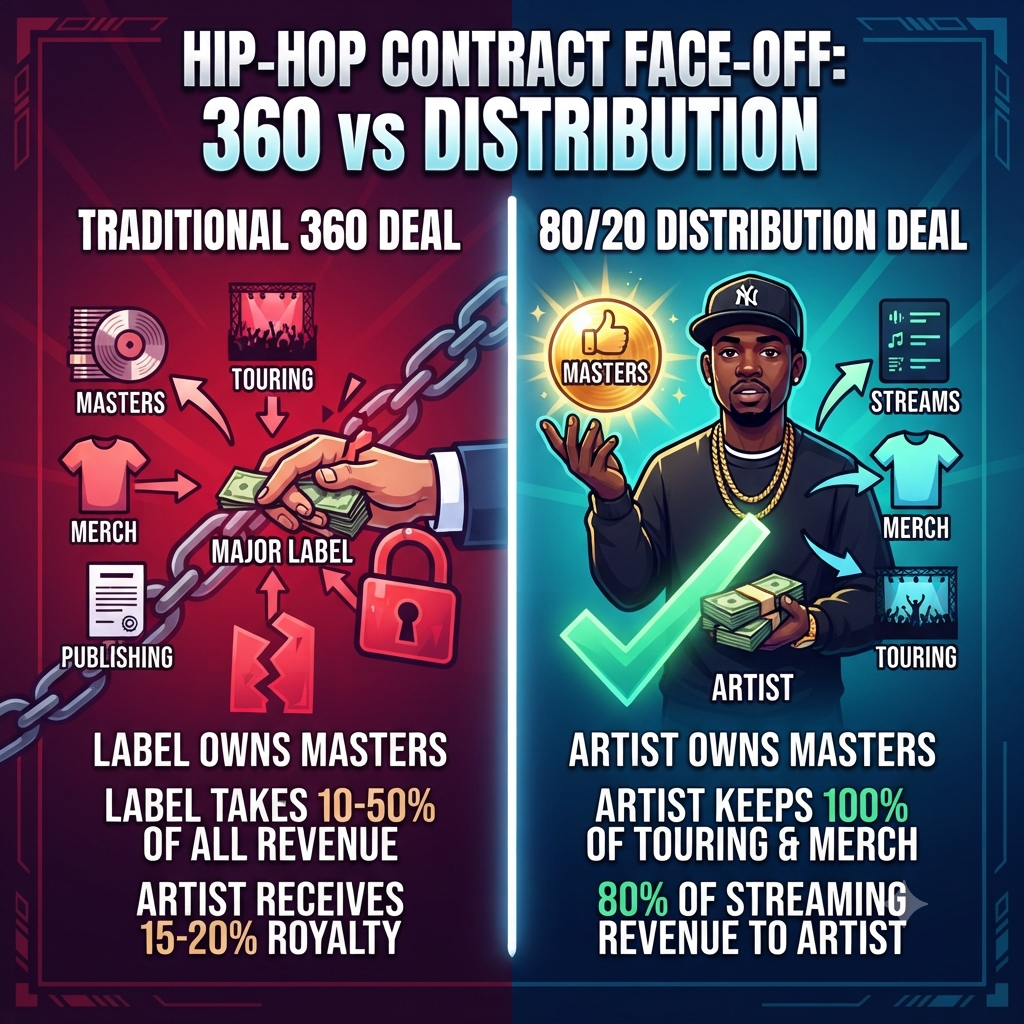
A 360 deal—officially called a multiple rights deal—became the standard major-label contract back in the late 2000s when physical CD sales collapsed and labels needed new ways to make money. In a 360 deal, the record label acts like an aggressive venture capital firm. They hand you an upfront cash advance, pay for studio time, cover video shoots, and put their massive promotional machine behind your single. In return, they do not just take a cut of your streaming numbers. They take a percentage of virtually every dollar you earn across your entire entertainment career.
When you sign a standard 360 contract, the label reaches into every single pocket you have:
Master Recordings: The label typically keeps 80% to 85% of your streaming and sales revenue, leaving you with an artist royalty rate of just 15% to 20%. Touring and Live Shows: The label takes 10% to 30% of your net touring income, festival guarantees, and club walk-throughs. Merchandise: They claim 20% to 50% of all hoodies, t-shirts, and physical gear you sell online or at the merch table after a show. Brand Deals and Endorsements: If a sneaker company, liquor brand, or gaming platform pays you for a sponsorship, the label takes 15% to 30% off the top. Publishing: Many labels also push for a co-publishing split on the actual songwriting copyrights, taking a piece of your backend writer royalties.
The real danger of a 360 deal is how the math works behind the scenes. Say a label gives you a $500,000 advance so you can buy a chain, upgrade your studio, and shoot visuals. Then, they spend another $500,000 on radio promotion, billboard ads, and playlist marketing. You are now $1,000,000 in the red—known in the industry as being unrecouped. Because your royalty rate is only 15% to 20%, you do not start earning royalty checks after your songs generate $1 million on Spotify. Your catalog actually has to generate around $5 million to $6 million in gross streaming revenue just to pay back your original $1 million budget. Worse yet, even after you pay every penny back, the record label usually owns your master recordings forever.
What Is an 80/20 Distribution Deal?
An 80/20 distribution deal, often structured as an artist services or label services agreement, flips the old industry power dynamic on its head. Instead of acting as your boss and owning your intellectual property, the distributor operates as a high-level infrastructure partner.
Under an 80/20 split, you keep 80% of your net streaming and download revenue, while the distributor takes a 20% fee for their services. That 20% covers delivering your music globally to Spotify, Apple Music, Tidal, and YouTube, pitching your singles to editorial playlist curators, collecting international performance royalties, and sometimes providing a modest, fast-recouping marketing budget or advance.
What separates an 80/20 distribution deal from a traditional record contract is everything the distributor does not touch. A clean distribution agreement stays strictly in its lane:
100% Master Ownership: You remain the sole legal owner of your sound recordings from day one, or your rights revert back to you after a short licensing window of three to five years. 100% Touring Revenue: When you sell out a 500-cap venue or get booked for a college show, every dollar goes straight to you and your team. 100% Merch Revenue: Your clothing line and tour merchandise belong entirely to your brand. 100% Brand Partnerships: Any endorsement deal, sync placement, or acting check stays completely out of the distributor’s reach.
How the Money Actually Plays Out for Rising Rappers
In modern hip-hop, master recordings are digital real estate. Every time an old mixtape track goes viral on social media three years after release, or a catalog song gets licensed for a video game or movie trailer, the person who owns the master gets paid. When you sign away your masters in a 360 deal, you are essentially renting an apartment instead of buying the building. You might get to live flashy for a year or two off the advance, but you are building equity for a corporation, not your family.
On top of that, independent rappers make their real day-to-day living on the road and through lifestyle branding. Streaming fractions of a penny take time to stack up, whereas selling 300 hoodies at $60 apiece on a regional tour puts $18,000 in your hands over a single weekend. Giving away 30% of that hustle to a record label that never helped you design your brand or build your local fanbase is a tough pill to swallow once the initial excitement of signing wears off. With an 80/20 distribution deal, you also recoup any upfront marketing funds four times faster because you are earning eighty cents on the dollar instead of fifteen cents.
Years ago, artists felt forced to sign 360 deals because major labels were the only gatekeepers with access to radio programmers, press outlets, and real marketing power. That monopoly is dead. Today, you can maintain sovereign ownership of your masters while accessing major-level marketing through our independent artist campaign services (https://itshiphopmusic.com/submit/artist-submission/). By pairing an 80/20 distribution setup with targeted, independent promotional campaigns, rising artists get the visibility, press coverage, and audience growth of a major label rollout without surrendering their equity or creative freedom.
When Does a 360 Deal Actually Make Sense?
To be completely fair, a 360 deal is not automatically a scam—it is simply a high-interest loan that only makes sense when you have massive leverage or very specific goals. If you are an artist aiming for global pop-rap crossover status, need $2 million upfront to build an international arena tour, and have zero infrastructure of your own, a major label system can open doors that are hard to kick down solo. However, if you already have streaming momentum, a loyal fanbase buying your merch, and a strong work ethic, signing a 360 deal usually means giving away half your company right before it becomes profitable.
Making the Right Move for Your Career
Before you ever put a pen to paper, spend a few thousand dollars on an experienced music attorney—never use the lawyer the label recommends. Look closely at who owns the masters, how long the term lasts, and whether the company is asking for a piece of your touring and merchandise. If you want to build a career where you control your release schedule, keep 100% of your touring and merch money, and own your catalog for the rest of your life, an 80/20 distribution deal is almost always the smarter play.