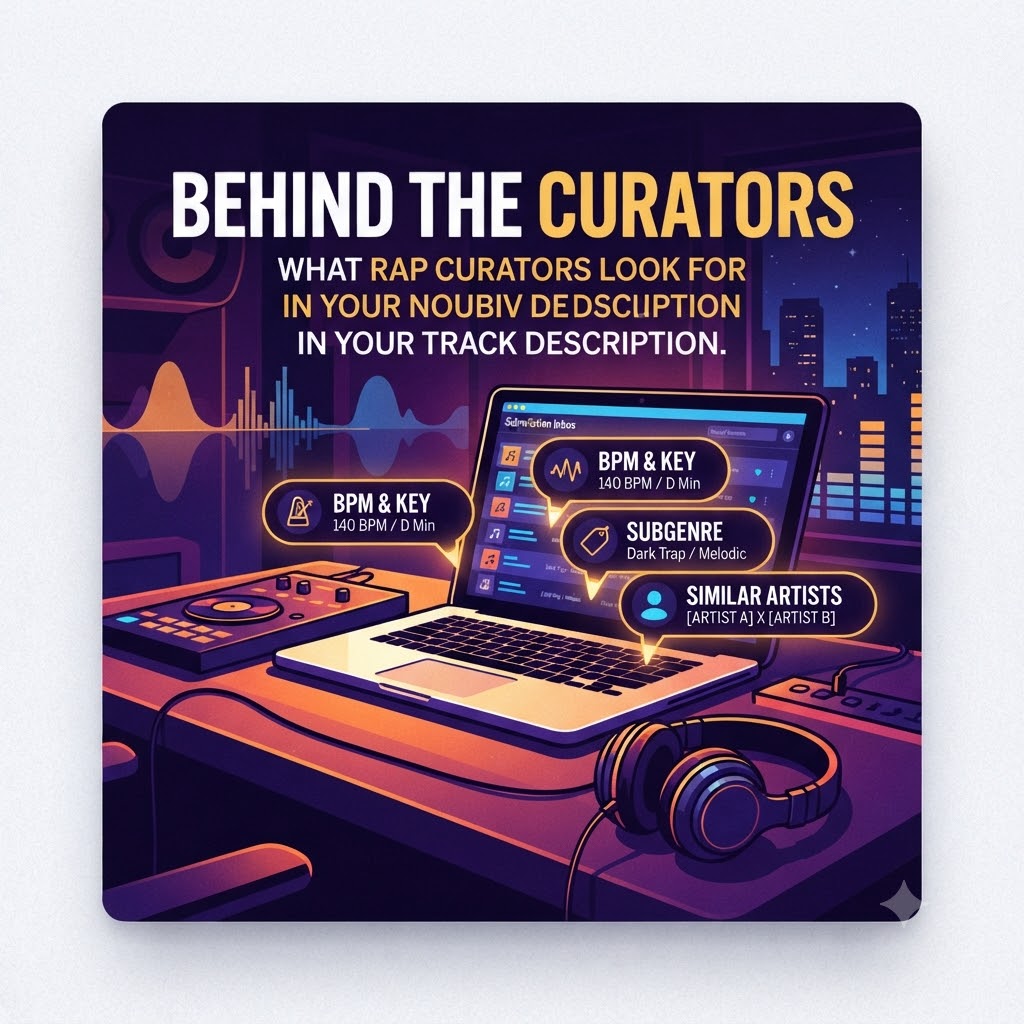
Behind the Curators: What Independent Rap Curators Look For in Your Track Description
If you’re grinding as an independent hip-hop artist or producer, you already know the drill. You spend weeks dialing in your 808s, stressing over the mix, and rewriting verses until they hit just right. Finally, the track is ready. You fire off emails or form submissions to independent rap curators, crossing your fingers for a playlist add or a blog feature.
Then… crickets.
Why do so many hard tracks get left on read? Honestly, most of the time it’s not even the music—it’s how you set up the track description.
Independent rap curators and playlist editors open up hundreds of pitches every single week. They don’t have the time or patience to decode vague messages or hunt around for basic details. If you want to grab their attention instantly, your pitch has to get straight to the point.
Let’s pull back the curtain on what’s actually happening in that inbox and look at what curators care about most.
1. Drop the Vital Stats: BPM and Key
Curators are usually building very specific vibes—whether it’s a late-night melodic trap playlist, a high-BPM gym mix, or a heavy boom-bap throwback.
If they have to guess your tempo or listen for 30 seconds just to figure out where your song fits, they’re just going to skip to the next email. Do yourself a favor and put the numbers right up front:
-
Drop your BPM immediately.
-
Pro tip: If it helps, include the key too (e.g., 145 BPM – G Minor).
It takes two seconds to type, but it helps DJs and curators instantly picture where your track slots into a set or rotation.
2. Be Specific About Your Subgenre
Calling your song just “rap” or “hip-hop” doesn’t give anyone anything to work with. The scene is way too vast for broad labels.
Help curators figure out what your song actually sounds like before they even hit play. Are you doing gritty underground boom-bap, dark cinematic trap, melodic emo-rap, or aggressive drill? Using precise subgenres shows you actually know the landscape and respect the curator’s time.
3. Name-Drop Relevant Similar Artists
One of the fastest ways to give someone context is through smart comparisons. When you tell a curator, “This has the atmospheric production of Metro Boomin with the aggressive flow of 21 Savage,” you instantly paint a picture in their head.
Keep it real, though. Don’t drop massive superstar names unless the production and delivery genuinely match that level. Stick to reference artists who fit the specific indie lane the curator is actually pushing.
4. Call Out Features, Producers, or Accolades
Did you land a killer guest verse from an underground heavyweight? Did a respected engineer handle the mix? Put it in the notes.
Curators are always keeping an eye out for momentum and co-signs. If there’s a recognizable name attached to the track in any capacity, it adds instant credibility. Keep it punchy: “Produced by [Name], featuring a verse by [Name].”
Streamline Your Pitch and Get Heard
Writing a solid track description is half the battle, but getting it in front of the right people the right way seals the deal. If you want to skip the chaotic inbox clutter and improve your pitch by formatting your submission professionally, send your details through our streamlined, multi-platform for direct access.
When your metadata is clean, your subgenres are clear, and your delivery is sharp, curators actually take notice. Stop guessing what happens behind closed doors and start pitching like you’ve been doing this for years.