Best Audio Interface for Recording Rap Vocals at Home Under $250 (Focusrite vs. SSL vs. Volt)
If you record your own music in a bedroom or spare closet, you already know the biggest frustration in hip-hop production: you write a crazy verse, catch the right pocket, and play it back only to hear thin, harsh, or muffled vocals sitting awkwardly on top of the beat.
Most independent rappers immediately blame their microphone or start buying expensive vocal chain plugins to fix the recording. In reality, the bottleneck is usually the box sitting between your mic cable and your laptop. Finding the best audio interface for recording rap vocals at home comes down to three practical things: how clean and loud the preamps get without hissing, whether the onboard analog saturation actually flatters a rap vocal, and how fast you can track yourself without headphone delay throwing off your cadence.
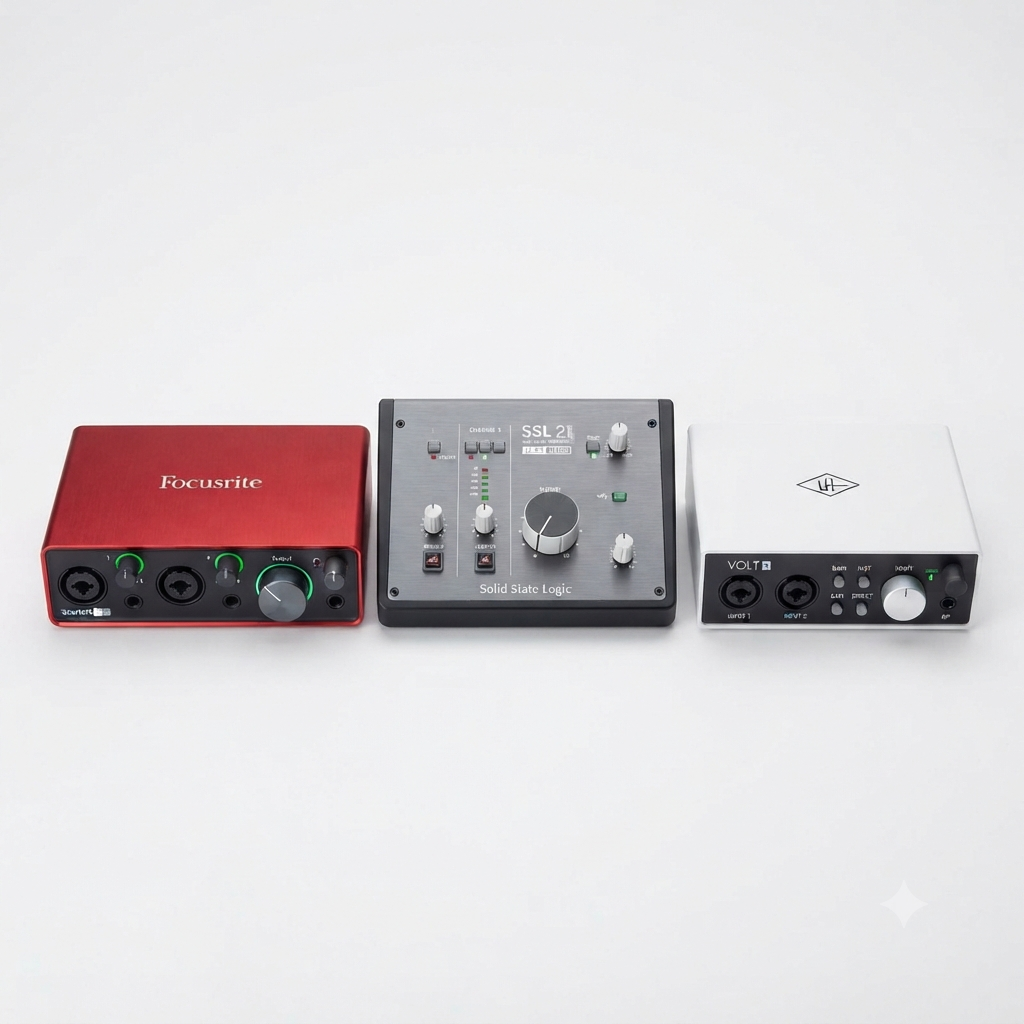
You don’t need a $2,000 rackmount unit to get commercial-ready takes anymore. Right now, three desktop interfaces under $250 dominate the home studio space: the Focusrite Scarlett 2i2 (4th Gen), the Solid State Logic SSL 2 MKII, and the Universal Audio Volt 2.
We put these three boxes head-to-head to see how they actually hold up when you’re tracking aggressive verses, layered ad-libs, and melodic hooks at home.
Quick Spec Breakdown: Focusrite vs. SSL vs. Volt
1. Preamp Cleanliness & Gain Headroom: Handling Quiet Flows to Loud Ad-Libs
Rap vocals are dynamic nightmares for cheap gear. Within a single sixteen-bar verse, you might go from a laid-back, close-mic whisper to yelling an emphatic punchline or stacking high-energy ad-libs. If your interface has weak preamps, you end up cranking the gain knob to 95%, which introduces an ugly layer of electronic hiss underneath your voice.
-
Focusrite Scarlett 2i2 (4th Gen): Focusrite completely overhauled the preamps on the 4th Generation Scarlett, pushing the gain range all the way up to 69 dB with a 120 dB dynamic range. To put that in perspective, that is more than enough clean power to drive notoriously quiet dynamic microphones like the Shure SM7B without needing an external Cloudlifter or inline preamp booster. Even when pushed hard, the noise floor stays remarkably quiet.
-
Solid State Logic SSL 2 MKII: SSL brings serious console pedigree to the table with a two-stage preamp design offering 64 dB of gain and an ultra-low noise floor (-130.5 dBu EIN). On top of that, the MKII upgrade introduced 32-bit / 192 kHz converters. When you are spitting fast, double-time triplets with sharp “T” and “K” consonants, those converters capture crisp transient detail without sounding brittle.
-
Universal Audio Volt 2: The Volt 2 tops out at 55 dB of gain. If you are using a standard large-diaphragm condenser microphone (like an Audio-Technica AT2020, Rode NT1, or Neumann TLM 102), 55 dB is plenty of clean headroom and sounds transparent and punchy. However, if you prefer tracking rap vocals on a low-output dynamic mic, you will find yourself maxing out that gain knob pretty quickly.
The Takeaway: If you use a dynamic broadcast mic or record quieter, melodic deliveries, the Scarlett 2i2 4th Gen and SSL 2 MKII give you noticeably more breathing room than the Volt 2.
2. Built-In Analog Saturation: SSL 4K vs. UA Vintage vs. Focusrite Air
Modern hip-hop mixes rely heavily on vocal presence and harmonic grit. A completely flat, sterile vocal often gets swallowed alive by distorted 808s and dense trap hi-hats. All three of these interfaces include a hardware button designed to add analog flavor on the way into your DAW, but they color your voice in very different ways.
SSL Legacy 4K Button
On the SSL 2 MKII, pressing the “4K” button engages an analog circuit modeled after Solid State Logic’s legendary 4000-series consoles—the same boards used to mix countless classic hip-hop records. Practically speaking, the 4K switch does two things: it adds a subtle touch of harmonic distortion and lifts the high-end frequencies. On a rap vocal, it immediately pushes the voice forward, adding crisp “air” and midrange bite so your lyrics cut right through a dense two-track beat before you even touch an EQ plugin.
Universal Audio Vintage Mode
The Volt 2 goes in the opposite direction. Its “Vintage” button activates a solid-state tube emulation circuit inspired by Universal Audio’s classic 610 tube preamp. Instead of hyping the top end, Vintage mode thickens the low-midrange and gently rounds off harsh high frequencies. If you are recording in an untreated bedroom with a bright, budget condenser mic that normally sounds sibilant or piercing on “S” sounds, the Volt’s Vintage button smooths out the edges and gives your voice a warm, weighty chest tone.
Focusrite Air Mode
Focusrite upgraded its signature Air Mode on the 4th Gen Scarlett 2i2 so you actually get two flavors instead of one: Presence and Harmonic Drive. Presence gives your vocal a clean top-end lift modeled after Focusrite’s classic ISA transformers, while Harmonic Drive adds rich midrange saturation that helps thin vocals feel thicker and more aggressive.
3. Low-Latency Monitoring & The Solo Home Studio Workflow
When you are engineering yourself—hitting record on the keyboard, spinning around to the mic, and laying down a take—workflow friction kills creativity. Nothing ruins a good take faster than hearing a slight slapback delay in your headphones because your computer’s buffer size is lagging, or realizing after a fiery verse that your loudest bar clipped and ruined the audio file.
-
Focusrite’s Solo Engineer Safety Net: Focusrite clearly designed the 4th Gen 2i2 with self-recording artists in mind. Its Auto Gain feature lets you rap into the mic for ten seconds while the interface automatically sets your optimal input level. Even better is Clip Safe, which monitors your signal 96,000 times per second and automatically turns down the preamp gain if you suddenly scream an ad-lib or get too close to the capsule. Combined with zero-latency direct monitoring, it takes the technical guesswork out of solo sessions.
-
SSL’s Tactile Control & Dual Headphone Jacks: The SSL 2 MKII feels like a mini mixing console on your desk. It features a dedicated Monitor Mix knob so you can smoothly blend your live mic signal with the beat in your DAW. It also includes a physical high-pass filter button right on the front panel—super useful for cutting out low-end rumble from air conditioners, traffic outside your window, or footsteps before it ever hits your recording. Plus, having two independent headphone outputs on the front makes it effortless to bring a producer or feature artist into your room without needing a separate headphone splitter.
-
UA’s Zero-Fuss Simplicity: The Volt 2 keeps things stripped back and intuitive. You get a simple Direct Monitor button (which lets you monitor in mono or stereo) and a surprisingly loud, punchy headphone amplifier that easily drives high-impedance studio headphones like the Beyerdynamic DT 770 Pro (250 Ohm) without struggling for volume.
Final Verdict: Which One Belongs on Your Desk?
Every interface in this shootout is capable of recording release-ready music, so the right choice comes down to your microphone and how you work:
-
Get the Focusrite Scarlett 2i2 (4th Gen) if you record yourself alone and want foolproof reliability. Between the massive 69 dB of clean gain, Auto Gain, and Clip Safe, it practically eliminates ruined takes while handling any mic you throw at it.
-
Get the Solid State Logic SSL 2 MKII if you want the best raw conversion (32-bit), two separate headphone jacks for collaborations, and that unmistakable 4K console sheen that makes vocals sit right on top of modern hip-hop beats.
-
Get the Universal Audio Volt 2 if you use a condenser microphone and want instant, one-button 610 tube warmth to tame harsh room acoustics and give your voice analog weight right out of the box.
Once you dial in your front-end hardware, you can capture studio-clean vocals at home, then launch your finished singles through our artist submission portal.
Ready to Push Your Next Release?
Maintain consistent marketing velocity across every drop. Options available on our Full Artist Submission Form.