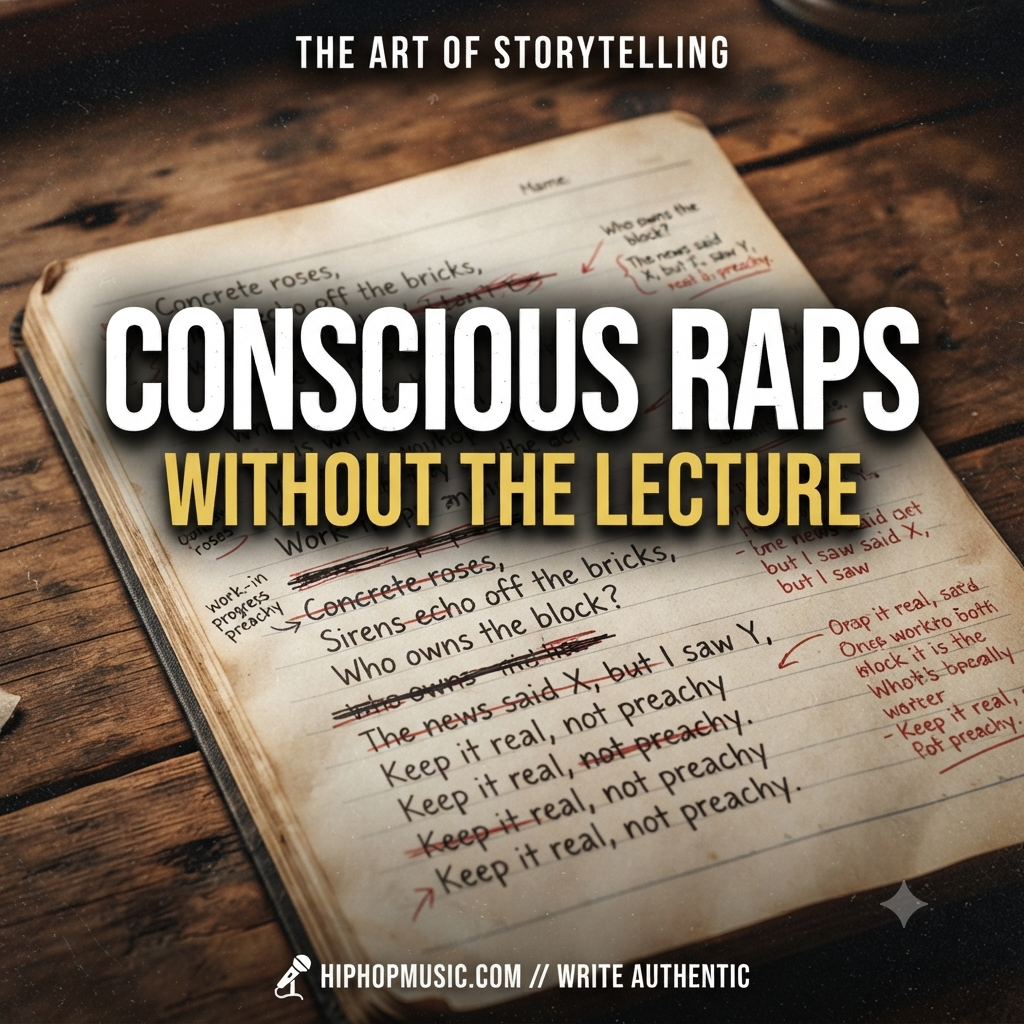
How to Write Conscious Rap Lyrics That Hit Hard Without Sounding Preachy
Everybody loves a good message until it starts feeling like homework.
If you’ve spent any real time around hip-hop, you’ve heard that one local rapper—or even a major-label vet—who hops on a dusty boom-bap loop and immediately starts lecturing the listener like a tenured sociology professor. The vocabulary is heavy, the tone is finger-wagging, and by bar twelve, you’re reaching for the skip button. Not because the message is wrong, but because nobody turns on music to get scolded.
Figuring out how to write conscious rap lyrics that actually stick is a tough needle to thread. You want to speak on real issues—police pressure, gentrification, generational poverty, the trap of the streets—without losing the folks living through those exact conditions. At the same time, you want music critics and playlist editors to recognize the craft behind the pen.
The secret isn’t watering down what you have to say. It’s changing how you deliver it. The best political and conscious MCs don’t preach from a podium; they report from the sidewalk. Here is how to balance heavy subject matter with raw, undeniable songwriting so both the block and the press pay attention.
Zoom In on the Block, Not the Textbook
The fastest way to make your verses sound stiff is leaning on big, abstract buzzwords. Terms like systemic oppression, late-stage capitalism, mass incarceration, and propaganda are real concepts, sure. In a rap verse, though, they often land like wet cardboard. They tell the listener what to think instead of letting them feel what’s actually happening.
Think about the difference between reading a news headline and watching something unfold outside your front window. When you anchor big political ideas in small, hyper-specific neighborhood details, the listener connects the dots on their own—and it hits ten times harder because they arrived at the conclusion themselves.
Look at the difference in how these two approaches land:
-
The Lecture: “The systemic underfunding of urban infrastructure is destroying our youth and limiting economic mobility.”
-
The Street Report: “Half the streetlights dead on 4th, glass crunching under fresh Jordans / Rec center locked since ’22, now the corner store is where the shorties board in.”
Notice how the second version never once uses a political buzzword, yet it says everything about redlining, city neglect, and why kids end up on the block. Smell the corner store. Mention the specific bus line that runs late. Name the liquor store across from the elementary school. Concrete details do the heavy lifting so you don’t have to explain the thesis.
Put the Pocket and the Beat First (The Trojan Horse)
A conscious rap song is still a rap song. Before anybody breaks down your double entendres on Genius or praises your social commentary in a blog write-up, their neck has to move. Street listeners and music critics alike judge an MC on rhythm, pocket, breath control, and charisma before they ever care about the moral of the story.
Too many message-driven artists treat the beat like background music for a spoken-word poem. They cram forty syllables into a single bar just to squeeze an entire political argument into a sixteen, completely sacrificing groove and replay value.
Flip that mindset. Treat your sonics and delivery like a Trojan horse:
-
Ride the Beat Like a Battle Rapper: Bring the same hunger, vocal grit, and rhythmic bounce to a song about housing inequality that you would bring to a track about out-rapping the competition.
-
Give Your Bars Room to Breathe: Silence is part of the rhythm. A crisp pause right after a heavy line lets the punch land in the listener’s chest.
-
Make the Hook Undeniable: Think about why records like Kendrick Lamar’s “Alright” or OutKast’s “B.O.B.” became timeless. You can chant them at a protest, play them in a whip, or spin them at a party. When the hook is infectious, people invite the message into their daily rotation willingly.
Live in the Gray Areas Instead of Acting Like a Saint
Preachy music almost always suffers from a superiority complex. The unspoken vibe is: “I’ve got all the answers, you’re sleepwalking through life, and here’s how you need to fix yourself.” Nobody—especially core hip-hop fans—wants to be talked down to by somebody acting holier-than-thou.
Real life on the block isn’t black and white, and your pen shouldn’t pretend it is. Audiences trust MCs who admit their own contradictions. You can rap about how predatory luxury brands drain money out of poor neighborhoods while still admitting you love how a fresh pair of kicks feels when you step out the door. You can call out street violence while still being honest about the paranoia and survival instincts that keep people armed.
When you place yourself inside the struggle rather than above it, listeners don’t feel judged—they feel seen.
A Good Rule for the Notebook: Never point a finger at the listener unless you’re also pointing one in the mirror. Vulnerability disarms people faster than righteousness ever will.
Tell Stories Through Characters Instead of Opinions
When you stay in first-person opinion mode for three straight verses, it’s easy to slip into ranting. One of the sharpest tricks in conscious songwriting is stepping out of your own shoes and telling a story through a third-person character—or even writing from an unexpected perspective.
Think back to Nas rapping from the perspective of a firearm on “I Gave You Power,” or Lupe Fiasco painting the picture of a struggling independent artist and his family on “Hip-Hop Saved My Life.” Neither track stops the music to deliver a speech. Instead, they follow a human being through a real set of circumstances and let the stakes play out naturally.
Write a verse from the perspective of:
-
A night-shift nurse riding the train home at 5:00 AM watching the neighborhood change.
-
A corner-store owner watching developers buy up every building on the block.
-
A young kid weighing a minimum-wage gig against fast money on the strip.
Music critics eat character studies up because they show genuine literary range and empathy. Meanwhile, everyday listeners recognize their own cousins, neighbors, and parents in the bars. Everybody wins, and nobody feels lectured.
Cut the “Moral of the Story” Bar at the End of Your Quatrains
If you want an instant upgrade to your writing, go back through your notebook and read the fourth bar of every four-bar sequence.
A super common habit among developing conscious rappers is writing three killer, visual bars that set up a vivid scene, and then ruining the tension on bar four by summarizing what the listener is supposed to take away from it. It’s the lyrical equivalent of explaining a joke right after you tell it.
Trust your audience’s ears. Hip-hop fans are some of the sharpest listeners on the planet—they catch subtleties, double meanings, and subtext without needing a footnote. If your fourth bar is just restating the point, cut it. Replace it with another sharp image, an ironic twist, or a transition that pushes the story forward. Making the listener lean in just a little bit to catch the full weight of a bar is what turns a casual stream into a lifelong fan.
Getting Your Message-Driven Music Heard by the Right Ears
When you master that balance—gritty, street-level storytelling paired with sharp political awareness—you put yourself in a lane that stands out immediately in a flooded release schedule. Journalists, tastemakers, and playlist curators are constantly hunting for MCs who can say something meaningful without sacrificing sonics or replay value.
Still, great songwriting needs the right framing when you take it to market. Once your mix is tight and your narrative is dialed in, give your message-driven projects the thoughtful critique they warrant on our music review portal. Solid, well-written press coverage helps translate the layers in your lyrics to new listeners and gives your catalog the credibility it deserves.
Make your music catalog attractive to media outlets. Order a feature via our Music Review Page.