Handling Album Release Date Delay in Hip Hop: How Offset Turned a GMFU Setback Into Pre-Save Hype
Every independent rapper knows that sinking feeling in the pit of your stomach when a rollout hits a wall. Maybe a sample clearance fell through at the eleventh hour, the final master still isn’t hitting right in the car, or your distributor flagged a metadata issue forty-eight hours before midnight. Whatever the reason, pushing a project back feels like admitting defeat.
Yet when you look at how major artists navigate these exact roadblocks, a delay doesn’t have to kill your momentum. In fact, mastering handling album release date delay hip hop rollouts can actually build stronger anticipation than sticking to an original date.
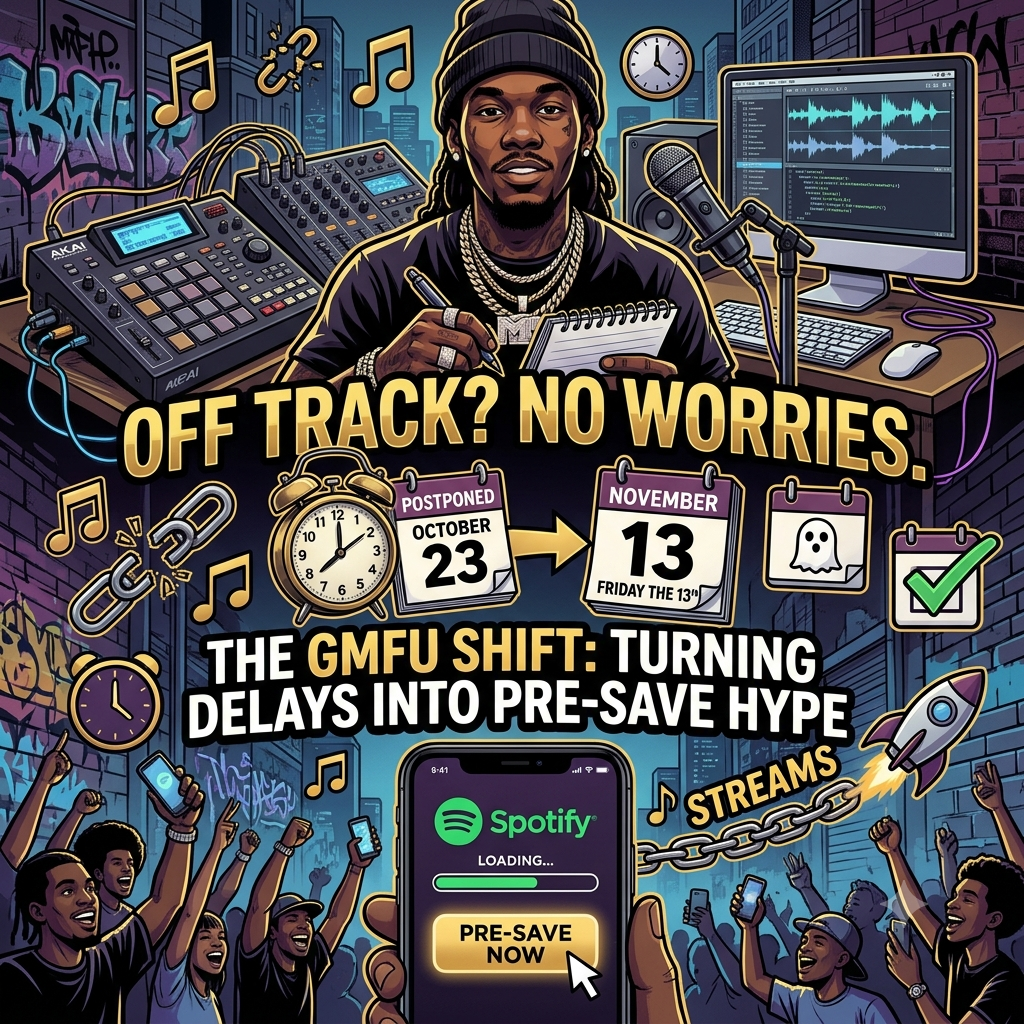
Take Offset’s fourth solo album, GMFU. Originally slated to drop on October 23, 2026, the project missed its midnight window, leaving fans refreshing Spotify and Apple Music in confusion. Within hours, comment sections were flooded with theories about label politics and uncleared samples. Instead of letting the silence drag on and sour the mood, Offset pivoted. He moved the album three weeks back to Friday, November 13, 2026—and turned what could have been a messy postponement into a sharp, high-converting three-week campaign.
For independent artists trying to keep their fanbase locked in without a major-label safety net, there is a lot to unpack from how that three-week window played out.
Why Going Quiet Is the Real Career Killer
In hip-hop, release dates have always been a little fluid. Fans understand that perfecting a tape takes time, especially when you are dealing with last-minute features, sample clearances, or distributor ingestion queues. What listeners don’t forgive is radio silence.
When midnight passes and there is no music, no tweet, and no Instagram Story explaining what happened, fans stop feeling excited and start feeling played. That frustration quickly turns into apathy, and once a listener checks out mentally, getting them back two weeks later is twice as hard.
Offset avoided that trap by stepping in before the narrative spun out of control. By Friday evening on October 23, he hopped on Instagram with raw studio footage, letting people see him still locked in with collaborators, and laid down a hard new date: November 13. Notice what he didn’t do. He didn’t post a long, defensive notes-app apology blaming engineers, managers, or distributors. He didn’t act defeated. He simply reset the clock, showed the work happening in real time, and gave his core audience a specific new target to circle on their calendars.
5 Ways to Handle an Album Release Date Delay Without Losing Your Fanbase
If you are an indie artist staring down a schedule shift, panic is your worst enemy. Use those extra weeks to tighten your funnel and turn frustrated fans into verified pre-saves.
1. Break the Silence Within 24 Hours With Studio Proof
If your project isn’t dropping at midnight, your audience needs to hear from you before the next evening. Don’t just post a text graphic saying “new date coming soon”—that sounds like the project is stuck in limbo. Instead, post a fifteen-second clip from the studio, a snippet of a verse being reworked, or footage of you listening back to mixes. Showing active progress reframes the delay. In the eyes of your listeners, you aren’t disorganized; you are obsessing over quality control so they get the best possible record.
2. Pick a New Date That Carries Built-In Weight
Moving GMFU to Friday, November 13 wasn’t a random dart throw. A Friday the 13th release instantly gives a hip-hop project an eerie, high-stakes aesthetic that fits naturally into social media promo and visual teasers. When you reschedule your own drop, avoid picking a forgettable Tuesday or a random week with zero context. Anchor your new date to something memorable—a holiday weekend, the kickoff of a local tour run, a music video premiere, or a culturally recognizable date like Friday the 13th. When the new date feels intentional, fans buy into the narrative.
3. Route All That Frustrated Traffic to One Pre-Save Link
Here is a secret most indie artists miss: the twenty-four hours right after a missed release date are when curiosity around your name is at its absolute peak. People are actively checking your profile to see what happened. If your bio link still points to an old single or a dead landing page, you are wasting free traffic.
During the GMFU shift, every update pushed fans straight to a clean, dedicated Linkfire pre-save hub (offset.lnk.to/GMFU). When you announce your new date, give impatient fans something immediate to do with their energy. Tell them to lock in the pre-save right then and there. Not only does that capture their intent while they are paying attention, it also guarantees they get an automatic library add and notification the second your delayed project finally goes live.
4. Pace Your Rollout Assets Across the Extra Weeks
One of the biggest silver linings of a two- or three-week delay is breathing room. Most independent rappers rush their rollouts anyway, dumping the cover art, tracklist, and lead single in the same forty-eight-hour span and leaving nothing left to talk about by release week.
Treat your delay like a second act by spacing out your visual assets:
-
Week 1 (The Reset): Confirm the new date with raw behind-the-scenes studio clips and push the pre-save link heavily across Instagram Reels, TikTok, and X.
-
Week 2 (The Visual Reveal): Drop the official cover art alongside a short, honest caption about why this project matters to you. Cover art gives blogs, fan pages, and curators a fresh reason to post about your album without needing a new song.
-
Week 3 (The Tracklist & Features): Hold your tracklist and guest features until 24 to 48 hours before midnight. Debates over feature matchups and song titles are undefeated when it comes to sparking last-minute social buzz right before drop day.
5. Reward the Fans Who Stuck Around
If people waited an extra three weeks for your tape, acknowledge them when the clock finally hits zero. Whether it is dropping an unlisted bonus track on SoundCloud, hosting an IG Live listening session at 11:45 PM, or replying directly to fans who screenshot their pre-save confirmation, small personal touches turn casual listeners into die-hard supporters who will show up for every release after this one.
Turning Those Pre-Saves Into Day-One Streaming Momentum
Getting fans to click a pre-save button during a delay is a great start, but the real test happens in the first twenty-four hours after your music hits DSPs. Spotify and Apple Music pay close attention to early listener behavior. If your delayed album drops and immediately sees strong save-to-stream ratios, repeat listens, and low skip rates, the algorithm starts pushing your tracks into Release Radar, Radio, and algorithmic mixes. If those pre-saves don’t translate into real engagement on day one, the momentum dries up fast.
That is why combining smart rollout communication with real promotional muscle matters so much for independent artists. While you focus on keeping your fanbase engaged through the schedule change, you also want trusted curators putting your record in front of active listeners the moment it goes live. To keep fan anticipation high and convert pre-saves into active streams with our Spotify playlist submission services, make sure your track is pitched and ready ahead of your new release window.
Delays happen to artists at every level of the game—from bedroom producers uploading through DistroKid to platinum-selling veterans like Offset. What separates a stalled project from a breakthrough moment isn’t whether everything went according to plan; it is how clearly you communicate, how smartly you capture fan attention during the wait, and how hard you hit when the new date finally arrives.
Ready to turn your next release date into real numbers? Deliver high-retention tracks to genuine hip-hop fans on drop day. Apply via our Music Promo and Playlisting Services.