Spotify Discovery Mode: The 30% Commission Breakdown & Net Royalty Calculator for Independent Artists
If you’ve spent any time looking at your Spotify for Artists dashboard over the past few years, you’ve almost certainly run across Spotify Discovery Mode. The pitch sounds incredibly enticing on paper: give Spotify’s algorithm a green light to push your track into contextually relevant Radio and Autoplay queues, and watch your monthly listeners climb.
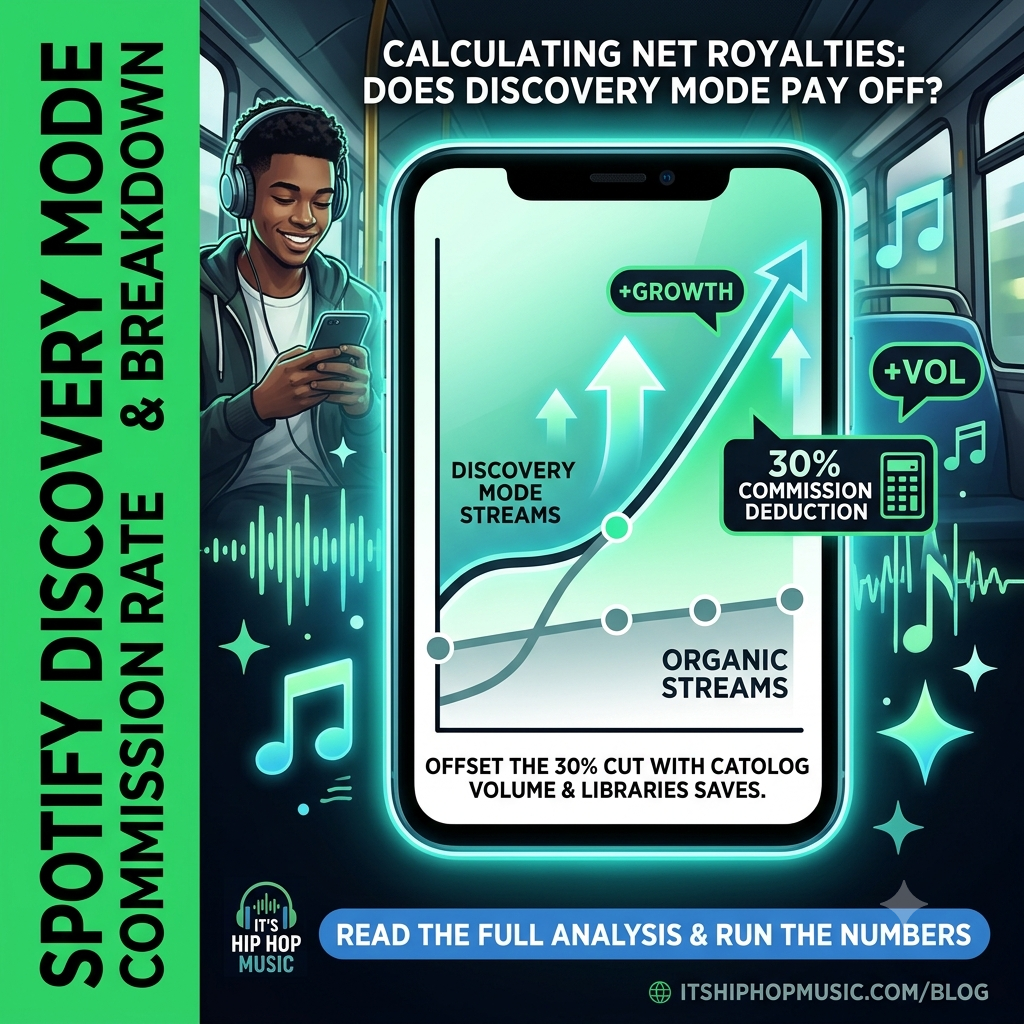
The catch? Spotify takes a 30% commission deduction on every single recording royalty generated from those algorithmic placements.
That trade-off leaves a lot of independent artists and boutique record labels asking the same question: Is giving up nearly a third of my streaming revenue actually worth the added exposure?
To answer that properly, you can’t just rely on gut feeling or vanity stream counts. You need a realistic mathematical model. Whether you’re searching for a spotify discovery mode commission rate calculator to run your own numbers or trying to understand the long-term economics of algorithmic promotion, this guide breaks down the math, the operational trade-offs, and how to evaluate if Discovery Mode makes financial sense for your catalog.
What Is Spotify Discovery Mode (And How Does the 30% Commission Work)?
Launched as an open-beta tool for distributors and labels, Discovery Mode is designed to boost a song’s reach without requiring an upfront financial marketing budget. Instead of paying cash to run ads, you pay with a percentage of your backend stream revenue.
Here is how the mechanics function behind the scenes:
-
Targeted Placements: Discovery Mode specifically targets non-interactive streaming environments—namely Spotify Radio and Autoplay (what plays automatically after an album, playlist, or single finishes).
-
The Royalty Cut: Spotify applies a 30% commission to the master recording royalties on streams generated through those specific Discovery Mode queues.
-
Protected Streams: Your standard stream revenue remains completely untouched. If a fan searches for your song directly, streams it from their saved library, or listens to it on an editorial or user-curated playlist, you receive your full, un-deducted royalty payout.
Because your payout per stream drops on Discovery-driven plays, success comes down to a simple reality: volume and conversion. For Discovery Mode to generate a net positive financial outcome, the sheer volume of new streams—and the long-term fans they turn into—must outweigh the revenue lost to Spotify’s 30% cut.
Building the Math Model: The Discovery Mode Formula
To understand whether opting a track into the program will put more money in your pocket, you need to look at your Blended Effective Payout Rate.
A standard Spotify stream generates an average master royalty payout of roughly $0.003 to $0.004 (though this fluctuates significantly depending on listener country, tier, and pool dynamics). When Discovery Mode triggers, that specific payout drops by 30%.
The Core Revenue Formula
To make this practical, let’s test this equation across three realistic artist scenarios over a 30-day billing window, assuming a baseline payout rate of $0.0035 per stream.
Scenario Analyses: Does the Math Work in Your Favor?
Scenario 1: The Underperforming Push (A Net Loss)
In this scenario, a track receives an initial push from Spotify’s algorithm, but listeners skip the song quickly. Because Spotify’s algorithm detects low engagement, it stops prioritizing the track after a few days.
-
Baseline (Pre-Discovery): 10,000 organic streams/month = $35.00
-
Opt-In Results:
-
Organic streams drop slightly to 6,000 = $21.00
-
Discovery Mode adds 3,000 streams at the discounted rate ($0.00245) = $7.35
-
-
Total Net Revenue: $21.00 + $7.35 = $28.35
The Outcome: You lost $6.65 compared to your baseline. The algorithm failed to find a receptive audience, and the low volume boost couldn’t cover the 30% cut taken on those extra plays.
Scenario 2: The Moderate Incremental Gain (A Slight Win)
Here, the song performs reasonably well in Radio queues. Listener completion rates are average, leading to steady algorithmic rotation.
-
Baseline (Pre-Discovery): 10,000 organic streams/month = $35.00
-
Opt-In Results:
-
Organic streams hold steady at 10,000 = $35.00
-
Discovery Mode generates 6,000 new streams at the discounted rate ($0.00245) = $14.70
-
-
Total Net Revenue: $35.00 + $14.70 = $49.70
The Outcome: A net gain of $14.70 (+42%). Because your baseline organic streams didn’t drop, every discounted stream added incremental value to your bottom line.
Scenario 3: The Algorithmic Breakout (A Clear Success)
In a breakout scenario, high listener retention and low skip rates prompt Spotify’s system to aggressively push the track across thousands of Autoplay queues.
-
Baseline (Pre-Discovery): 10,000 organic streams/month = $35.00
-
Opt-In Results:
-
Organic streams grow to 12,000 (driven by new listener saves) = $42.00
-
Discovery Mode drives 25,000 algorithmic streams ($0.00245) = $61.25
-
-
Total Net Revenue: $42.00 + $61.25 = $103.25
| Financial Metric | Baseline Performance | Scenario 1 (Low Reach) | Scenario 2 (Moderate Reach) | Scenario 3 (Breakout) |
| Organic Streams | 10,000 | 6,000 | 10,000 | 12,000 |
| Discovery Streams | 0 | 3,000 | 6,000 | 25,000 |
| Total Stream Count | 10,000 | 9,000 | 16,000 | 37,000 |
| Blended Rate / Stream | $0.00350 | $0.00315 | $0.00311 | $0.00279 |
| Total Net Payout | $35.00 | $28.35 | $49.70 | $103.25 |
The Hidden Variables: Saves, Shares, and Long-Term Value
Evaluating Discovery Mode strictly on immediate payout checks ignores how modern streaming ecosystems actually work. The 30% commission is essentially a user acquisition cost.
When an Autoplay stream leads a listener to hit the “Like” button or add your track to a personal playlist, that listener leaves the 30% commission ecosystem for all future plays. Every time they replay that song from their personal collection next week or next month, you collect your full 100% standard royalty payout.
To figure out if Discovery Mode is working for your catalog over time, track these three core metrics in your dashboard:
-
Save Rate: Aim for a save rate above 4–6% on Discovery streams. High save rates convert temporary radio listeners into long-term catalog streams.
-
Playlist Addition Rate: Listeners adding your track to personal playlists creates a compounding effect that continues long after a Discovery Mode campaign ends.
-
Spillover to Un-Commissioned Algorithmic Vectors: High engagement signals inside Discovery Mode can positively influence your organic reach on Discover Weekly and Release Radar, where Spotify takes no extra commission cut.
How to Strategically Integrate Discovery Mode into Your Marketing
Opting your entire catalog into Discovery Mode without a clear strategy is rarely effective. Instead, consider using it selectively within a broader promotional strategy:
-
Focus on Back-Catalog Tracks: Instead of opting in brand-new releases right out of the gate (when organic momentum and initial release push are highest), test Discovery Mode on older catalog tracks that have plateaued in organic growth.
-
Monitor Skip Rates: If a song has a high skip rate on standard streams, Discovery Mode will likely fail and drag down your blended royalty rate. Only enroll tracks with proven listener retention.
-
Combine Algorithmic and Organic Campaigns: Relying exclusively on Spotify’s internal algorithm puts your audience growth in someone else’s hands. Successful independent teams evaluate algorithmic trade-offs, then build healthy organic listener numbers via our independent rap playlist campaigns.
By feeding your profile with verified organic playlist placement and targeted promotion, you create a baseline of strong engagement signals. That external activity tells Spotify’s algorithm that your music is worth recommending, maximizing your chances of achieving a high-volume breakout when you do test Discovery Mode.
🚀 Keep Your Streaming Counts Growing
Don’t rely on algorithms alone to build your fanbase. Keep your streaming counts climbing with verified promotion. Schedule your push on the Music Submission Portal.