


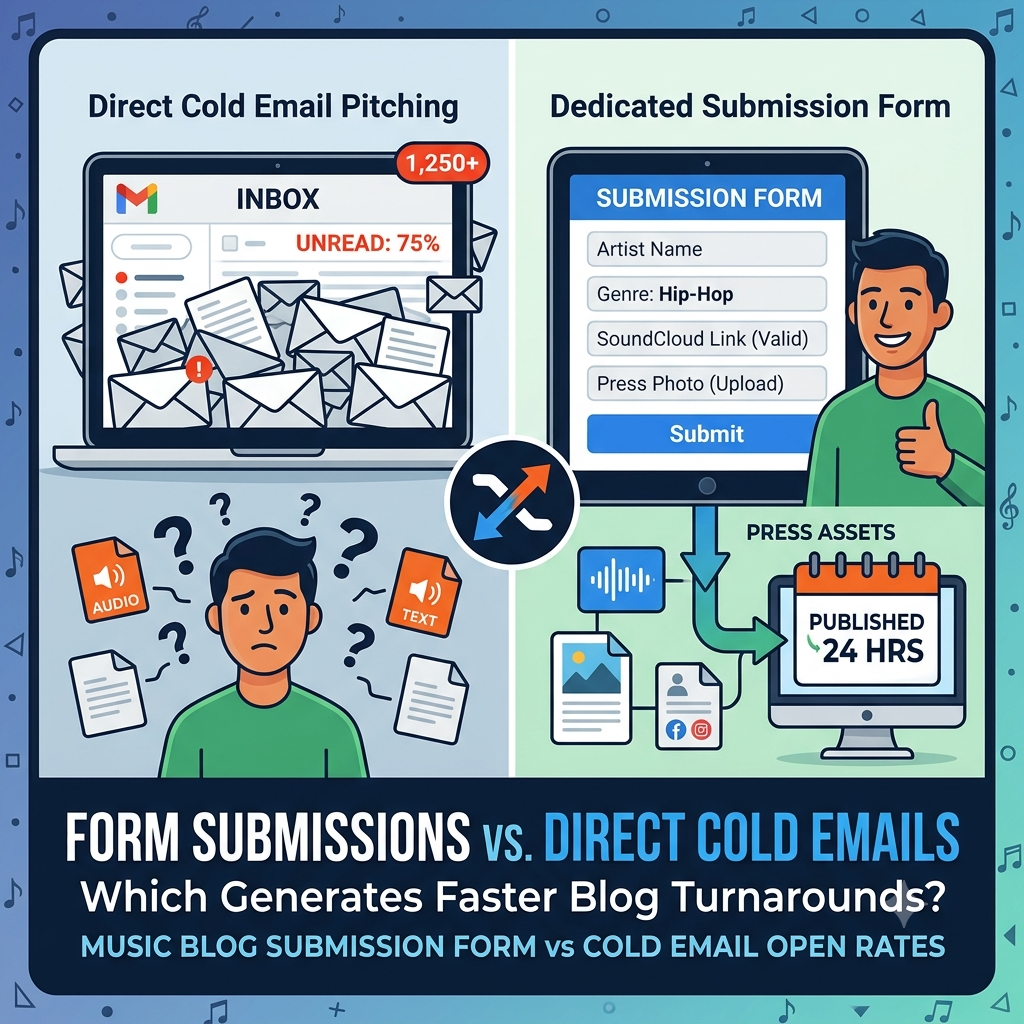
Music Blog Submission Form vs Cold Email Open Rates: Which Delivers Faster Turnarounds?
If you are an independent artist, manager, or boutique PR rep gearing up for release day, you already know the brutal reality of music promotion: timing is everything. You can have the most immaculate mix, a bulletproof marketing roll-out, and stunning visual artwork, but if your press coverage drops three weeks after your single hits DSPs, you miss the initial momentum window entirely.
When it comes to pitching music journalists, playlist curators, and digital publication editors, the industry remains split on strategy. On one side, you have traditionalists pushing direct cold outreach. On the other, modern digital publications encourage artists to use structured intake forms.
When you evaluate music blog submission form vs cold email open rates, cold emailing might feel like the more personal touch on the surface. But look under the hood at how modern music magazines actually operate, and you will find that cold emails routinely stall out. Web submission portals consistently deliver faster publication turnarounds, higher intake rates, and far fewer headaches for independent creators.
The Cold Email Trap: Why Staff Inboxes Are Where Pitches Go to Die
To understand why cold emailing yields such painfully slow turnaround times, you have to look at what the inside of a music blog editor’s inbox actually looks like on a Monday morning.
An editor at a mid-to-high-traffic music publication easily receives anywhere from 200 to 500 pitches a day. That inbox is not a tidy, organized workstation. It is a chaotic dump of unread press releases, administrative internal emails, automated newsletter subscriptions, follow-ups from major record label reps, and literal spam.
Incoming Cold Email Inbox (Unfiltered Chaos)
  ├── Major Label Priority Pitch
  ├── Unsolicited Press Release (No Streaming Link)
  ├── Spam / Phishing Message
  ├── Artist Follow-Up #4
  └── Underground Hip-Hop Pitch (Buried at position #342)
When you send a cold email to a staff writer or generic press email address, your pitch faces several immediate operational hurdles:
1. The Open Rate Reality Check
Across the music and entertainment industry, open rates for unsolicited cold emails sit at an abysmal 15% to 25%. That means before an editor even hears a single note of your track, there is a 75% chance your email will be deleted, marked as spam, or simply pushed to page three of an inbox before anyone looks at it.
2. The Missing Asset Headache
Even when an editor opens a cold email, the pitch often lacks critical assets. Maybe the Private SoundCloud link requires a password that wasn’t included. Maybe the Google Drive folder for the press photos is locked to private access. Or maybe the pitch is just a block of plain text with no press release or Spotify embed code.
When an editor has to spend three minutes emailing an artist back just to ask for a high-res JPG or playable audio stream, they usually just close the email and move to the next one.
3. The Manual Forwarding Bottleneck
Music publications usually run on specialized desks—one writer handles underground trap, another focuses on alternative R&B, and someone else writes album reviews. When a cold email lands in a general inbox, someone on staff has to manually read it, recognize the genre, figure out who handles that beat, and forward it along. If that staff member is busy, sick, or on deadline, your pitch sits in limbo for weeks.
Behind the Curtain: How Submission Portals Speed Up Publishing
Switching from a chaotic Gmail inbox to an automated backend submission system changes the entire dynamic. For high-traffic blogs, submission forms act like a digital traffic controller, organizing incoming content so editorial teams can make split-second decisions without administrative drag.
Submitting via Dedicated Web Portal
                 │
                 ▼
[Automated Intake & Field Validation]
 (Validates Audio Links, Press Kit, Bio, Artwork)
                 │
                 ▼
[Smart Tagging & Editorial Queueing]
 (Directly routes Hip-Hop pitches to Hip-Hop Lead)
                 │
                 ▼
[Instant Editorial Review & Publication Scheduling]
Instead of digging through a messy inbox, an editor logs into a clean administrative dashboard. Every pitch arrives pre-formatted, pre-sorted, and ready for immediate listening and writing.
Side-by-Side Breakdown: Inbox Pitching vs. Intake Portals
The Three Reasons Web Forms Turn Pitches Into Posts Faster
If you want your music reviewed while your campaign is still fresh, here is why submitting through a web portal beats rolling the dice on a cold email every single time:
1. Enforced Press Kits End Back-and-Forth Emails
Submission forms use required fields. You cannot hit “Submit” unless you have provided your streaming link, high-resolution cover art, artist bio, social handles, and track credits. For an editor, this is a dream setup. When they find a track they love, they do not need to ask for permission to view your Google Drive or wait on a reply for producer credits—they can draft the article on the spot.
2. Direct-to-Writer Routing
Modern CMS backends use intelligent routing logic. If you tag your submission under “Underground Hip-Hop,” the system skips the main site editor and drops your pitch straight into the queue of the dedicated Hip-Hop reviewer. That single automated step cuts out days of manual inbox shuffling.
3. Clear Queue Management & Guaranteed Placement Tiers
Email inboxes sort messages by time received, meaning older pitches quickly get buried under new arrivals. Intake dashboards, however, let editors sort pitches by release date, coverage tier, and verified artist profiles. This ensures time-sensitive releases get reviewed quickly rather than sliding off the first page of an inbox.
How to Work Press Submissions Into Your Release Strategy
To get maximum coverage without wasting hours on dead-end pitches, adjust your PR approach:
-
Stop Blasting Cold Inboxes: Save cold email pitching exclusively for writers you already have a personal, working relationship with.
-
Double-Check Your Links: If you use private streaming links or Drive folders, make sure public permissions are turned on so editors can listen without requesting access.
-
Use Dedicated Outlets: Stop guessing whether your email fell into a spam folder. Instead, skip the uncertainty of unread inboxes by locking in guaranteed placement through our online music review platform.
Build Your Verifiable Media Source History
Stop letting your music get buried in cluttered Gmail folders. Establish consistent press coverage, boost your online credibility, and get your music featured by active industry professionals.














Good shit hmu