What Is DistroKid Upstream Record Label Matchmaking? (How A&R Actually Scouts Now)
If you have spent any time trying to get your music heard by executives, you know the classic music industry myth: drive to Los Angeles, hustle outside a major label office, and hand your demo CD to anyone wearing a suit.
That era is completely dead.
Today, major label scouting looks less like American Idol and more like Wall Street high-frequency trading. Executives do not spend their afternoons scrolling through endless SoundCloud submissions or hanging out in noisy basement venues hoping to discover raw talent. Instead, they rely on complex software algorithms running silently in the background of digital distribution platforms.
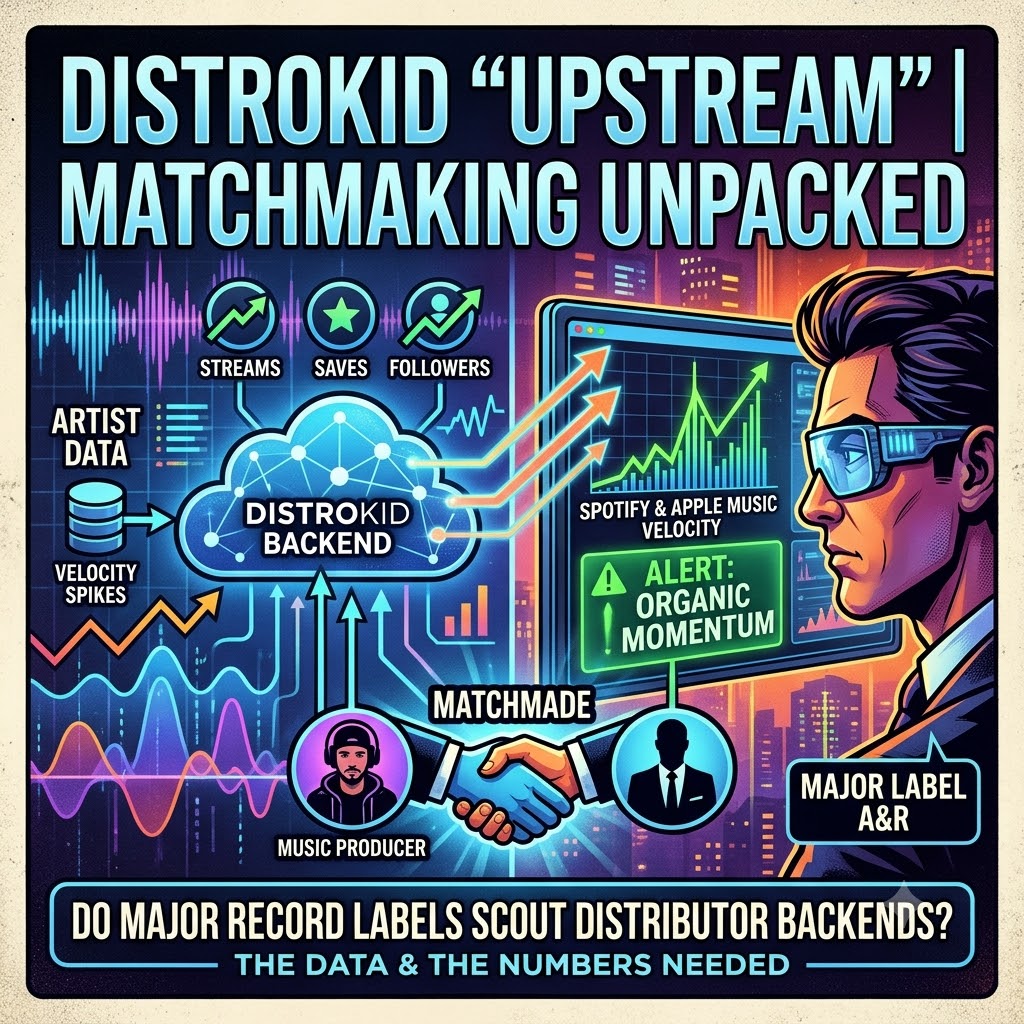
If you have stumbled across the feature on your dashboard and asked yourself what is distrokid upstream record label matchmaking, here is the short answer: it is an automated data-sharing pipeline designed to connect independent distribution data straight into major label A&R databases.
Launched by DistroKid in collaboration with powerhouses like Republic Records, Upstream gives independent artists an opt-in pathway to broadcast their real-time streaming metrics directly to talent scouts. But how does it actually work behind the scenes? What metrics are label executives filtering for, and how can independent artists trigger those alerts without waiting years for a lucky break?
Let’s unpack how backend scouting works, demystify the telemetry data labels care about, and look at the exact numbers you need to trip label radar tools.
The Shift From A&R Intuition to Automated Telemetry
Historically, A&R was driven by gut instinct. A talent scout heard a voice, saw a crowd react at a local gig, and made a high-stakes gamble. While human intuition still plays a role in signing deals, the initial discovery process has been entirely automated.
With over 100,000 new tracks uploaded to digital streaming platforms (DSPs) every single day, human beings simply cannot process the sheer volume of new music. To handle this flood of data, major record companies built proprietary intelligence platforms—tools like Warner’s Sodatone or Universal’s internal tracking dashboards.
These platforms act as search engines for raw music metrics. Instead of listening to songs, scouts query backend databases with specific parameters. They run searches looking for sharp upward curves, geographic clustering, and abnormal engagement spikes across major aggregators.
When you opt into features like DistroKid Upstream, you give these automated systems permission to index your release data. Rather than waiting for a human scout to accidentally find your Instagram page, your performance metrics are analyzed by software every 24 hours.
How Major Label Scouts Query Backend Aggregator Databases
When an A&R executive opens their dashboard in the morning, they do not see a list of song titles or album art. They see spreadsheets, graph lines, and alert notifications.
Because vanity metrics can easily be inflated through click farms and cheap social media bots, label tools ignore raw stream counts on their own. A track sitting at one million total streams might look impressive at first glance, but if those streams accumulated slowly over three years without any user interaction, labels view it as a dead asset.
Instead, automated label filters query backend systems for dynamic behavioral metrics:
1. Listener-to-Follower Conversion Ratios
When a random user hears your track on a passive background playlist, do they keep walking, or do they stop to find out who you are? Scout databases monitor how many unique listeners take active steps after hearing your music—such as clicking through to your artist profile, hitting “Follow,” or saving your track to their personal library.
2. Geographic Clustering & Density
Fake streams usually come from randomized bot networks scattered across disjointed geographic locations. Real organic momentum creates tight local clusters. If a track suddenly begins generating thousands of streams concentrated in specific zip codes—like Atlanta, Chicago, or London—without a massive paid ad campaign behind it, label tools flag it as a genuine grassroots movement.
3. Cross-Platform Acceleration
Label analytics tools pull data from multiple APIs simultaneously. They cross-reference Spotify play counts with Shazam search spikes, TikTok audio usage, and Apple Music library adds. If a song experiences a sudden bump on Spotify while simultaneously rising in Shazam queries in the same region, the backend algorithm marks it as a high-probability breakout candidate.
The Exact Velocity Numbers That Trip Scout Alerts
What does it take to get an automated alert to pop up on an A&R executive’s monitor?
Backend algorithms are programmed to ignore static noise. An artist whose stream count ticks upward by 5 or 10 plays a day will never trigger an alert system. To trip major label radar tools, your track must demonstrate velocity—a rapid change in speed over a tight timeframe.
[Phase 1: Baseline Activity]
       │ (10–50 streams/day — Flatline noise)
       ▼
[Phase 2: The Velocity Spike]
       ├─► 1,000 to 5,000 organic plays in 48 hours
       ├─► Save-to-Stream ratio exceeds 15%
       └─► Multi-platform traction (Shazam + DSP Saves)
       │
       ▼
[Phase 3: Backend Scout Trigger]
       └─► Track surfaces on label A&R telemetry dashboards
While exact label thresholds remain closely guarded trade secrets, industry patterns show that clearing the following benchmarks will reliably push a track into scout filter results:
The 48-Hour Velocity Threshold
A release needs to jump from baseline numbers to 1,000–5,000 organic streams within a concentrated 48-hour window. It is not the total number of streams that matters most; it is the steepness of the curve. A track gaining 3,000 streams in two days gets flagged far faster than a track gaining 3,000 streams over two months.
The Save-to-Stream Ratio (The 15% Rule)
On Spotify and Apple Music, labels pay close attention to the save rate. A healthy organic release maintains a save-to-stream ratio of 15% to 20% (meaning for every 100 streams, 15 to 20 users manually add the track to their personal library). If a track has 10,000 streams but only 20 saves, label algorithms instantly flag it as bot traffic and filter it out of results.
The Repeat Listener Multiplier
Calculated by dividing total streams by unique monthly listeners, this ratio proves fan retention. If 500 unique listeners generate 2,500 total plays, your multiplier is 5.0—meaning your average listener played the song five times. Labels love high repeat ratios because they signal long-term replay value rather than one-off casual clicks.
To generate the clean velocity data that trips label radar tools using our curated rap playlists, you can submit your tracks directly through our platform to reach engaged, real hip-hop fans who save and replay your tracks: generate clean velocity data with our curated rap playlists.
Bot Traffic vs. Organic Velocity: Why Manipulation Backfires
It can be tempting for independent artists to buy cheap play packages to force their numbers into these velocity ranges. However, attempting to game automated backend systems almost always backfires.
Modern telemetry tools used by major record labels are built specifically to detect fraud. Fraud detection engines evaluate micro-data that bot providers cannot fake, including:
-
Session Lengths: Bots typically disconnect immediately after hitting the 30-second payout mark. Real human listeners stay for the whole track or loop it.
-
User Account Integrity: Algorithms check the age and activity history of the profiles streaming your song. Thousands of plays coming from newly created, inactive free accounts get flagged immediately.
-
Device Diversification: Organic streams originate from a healthy mix of mobile devices, desktop apps, smart speakers, and car audio systems. Clean streams show varied hardware signatures.
When label databases catch artificial manipulation, the outcome is worse than just being ignored: your distributor profile can be blacklisted from opt-in programs like Upstream entirely, and your releases risk being removed from major streaming platforms.
Strategy: How to Position Your Releases for Upstream Discovery
Knowing how the backend works allows you to adjust your independent release strategy so you can capture real algorithmic momentum. Here is how to structure your campaigns for maximum impact:
-
Concentrate Your Promotional Push: Do not spread your marketing budget thinly across a three-month window. Focus your energy, ad spend, and pitch efforts on a tight 7-to-14 day period post-release to create the sharp velocity curve algorithms look for.
-
Focus on Playlist Placement with High Engagement: Target active, niche-specific playlists where real fans listen continuously rather than massive, generic background lists that yield low save rates.
-
Drive Active User Actions: Direct your fan base to perform specific actions—such as saving the song, adding it to personal playlists, and following your artist profile—rather than just telling them to “go stream the new single.”
By focusing on genuine listener retention and strategic release timing, you give distributor backend systems the clean, high-velocity data they need to push your profile directly onto major label dashboards.
🚀 Ready to Scale Your Release Velocity?
Deliver tracked, organic streaming plays directly to your profile and build the engagement metrics labels look for. Submit your track today on our Music Submission Page.