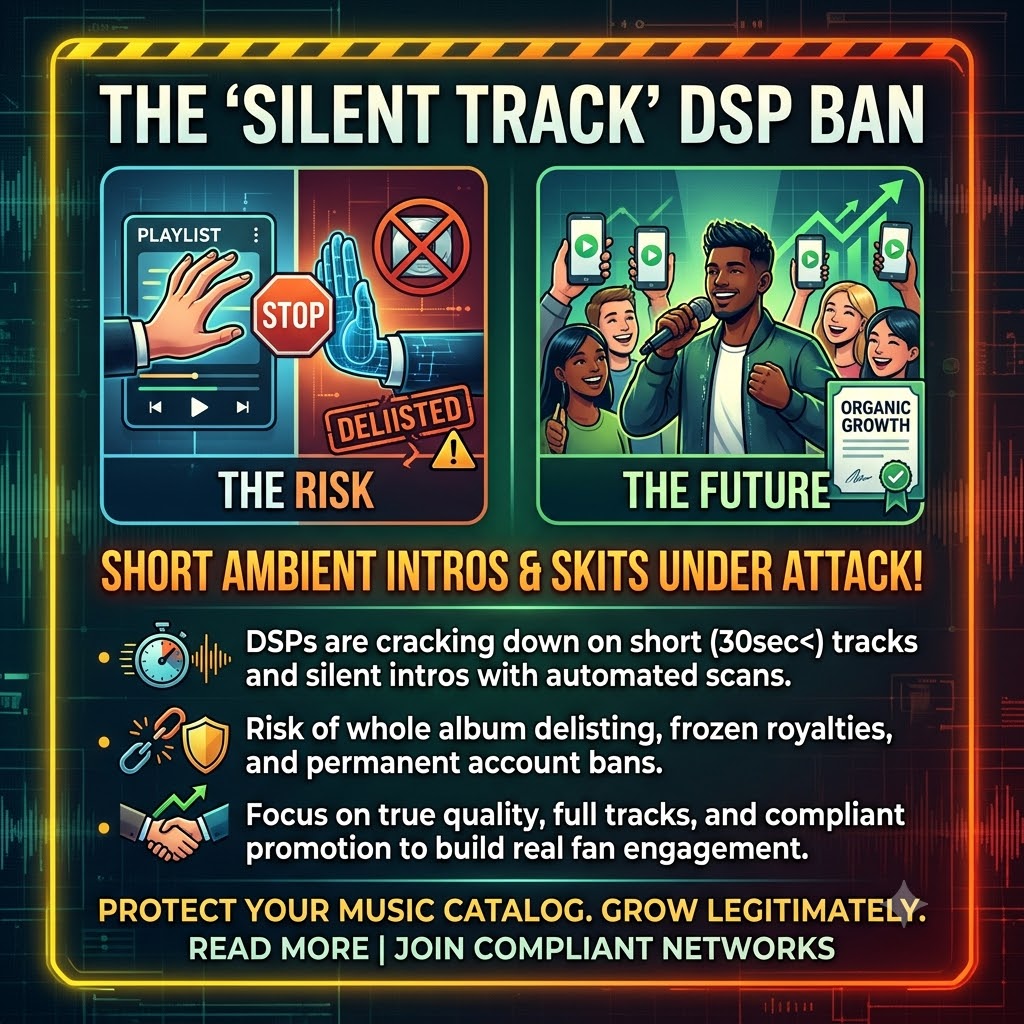
The “Silent Track” DSP Ban: Why Short Ambient Intros Risk Store Delisting
If you’ve spent any time studying streaming algorithms over the last few years, you’ve probably seen the trick: drop a brief 10-second ambient intro, a short spoken skit, or a low-fi loop at the front of an album or EP to pump up your overall stream count. For a long time, artists and indie labels viewed these track-stacking tactics as harmless growth hacks.
That era is officially over.
Digital service providers (DSPs) like Spotify, Apple Music, and Amazon Music have rolled out aggressive anti-fraud updates designed to wipe out artificial stream manipulation. What used to pass as a clever marketing shortcut can now get your entire catalog yanked off major platforms overnight, freeze your royalty earnings, and even trigger financial penalties from your distributor.
Understanding how these policies operate, why short silent or ambient tracks put your entire discography in jeopardy, and how to build a safe, compliant promotion strategy is essential for protecting your music career.
What Is the “Silent Track” DSP Ban?
To understand why platforms are cracking down, it helps to look at how streaming royalties have historically worked. For years, the industry benchmark for a “billable stream” was simple: a user needed to listen to a track for at least 30 seconds.
Recognizing this, a trend emerged where creators uploaded high volumes of ultra-short audio files—often consisting of low-effort ambient noise, brief spoken interludes, or 30-to-40-second beat loops. By placing these filler tracks throughout a project, an artist could effectively double or triple the total stream count generated by a single listener playing an album from front to back.
In response to pressure from major labels, independent rights holders, and legitimate creators who were losing pool royalties to artificially inflated plays, DSPs revamped their delivery rules and monitoring systems.
Today’s enforcement goes far beyond counting play durations:
-
Strict Minimum Duration Thresholds: Platforms have raised the bar for royalty payouts, specifically targeting functional audio, ambient tracks, and short interludes that lack substantial musical composition.
-
Acoustic Fingerprinting & Audio Analysis: Advanced AI algorithms continuously scan catalog uploads. They don’t just look at file metadata; they inspect the raw audio waveform for near-zero dynamic range, silent passages, white noise, or repeated low-effort loops.
-
Zero-Tolerance Store Delisting: When suspicious pattern flags trigger on a release, DSPs don’t just hide the offending interlude—they frequently remove the entire album, wipe historical play counts, and flag the associated distributor account.
Why Short Ambient Intros Endanger Your Music Catalog
If you think uploading a short, 10-second ambient intro is harmless art direction, think again. The automated systems scanning DSP libraries operate on strict algorithmic heuristics. Here is why keeping these short tracks in your release schedule poses a serious threat to your music business.
1. Automated Fraud Flags Don’t Give Benefit of the Doubt
Streaming platform detection systems analyze millions of uploads every week. When an automated scanner detects a 10-second track with minimal sound activity followed immediately by high repeat loops, it automatically tags the upload with a potential fraud strike. Because these checks are automated, your profile can be penalised long before a human reviewer ever listens to the actual audio context.
2. Distributor Fines, Royalty Holds, and Account Bans
Distributors bear the brunt of DSP policy enforcement. When a platform detects artificial inflation on a distributor’s network, the platform imposes severe financial fines directly on that distributor. To protect their own operational margins, distributors pass these consequences straight down to the artist:
-
Immediate freezing of pending royalty balances.
-
Pass-through financial penalties charged to your account.
-
Permanent ban of your account and removal of your entire discography from stores.
3. Destruction of Algorithmic Reach and Playlist Authority
A successful release relies heavily on algorithmic placements like Spotify’s Release Radar, Discover Weekly, and personalized radio feeds. When anti-fraud algorithms flag an artist profile for policy violations, the account’s internal health score plummets. Even if your distributor manages to appeal the delisting, the algorithmic penalty can permanently suppress your future organic reach, preventing genuine listeners from discovering your music.
How to Protect Your Catalog and Build Organic Reach
Sustaining a long-term career as an independent artist requires moving away from stream-counting shortcuts and focusing on genuine fan acquisition. Building a resilient catalog starts with clean delivery practices and verified marketing channels.
Here are the crucial steps every independent artist and manager should follow:
1. Ensure Full Musical Value on Every Track
If your vision calls for an intro, skit, or interlude, make sure it functions as a complete audio composition. Keep track lengths comfortably above platform standards, incorporate dynamic sound design, and avoid releasing isolated snippets of room noise, silent skits, or static ambient loops.
2. Focus on Retention Over Inflated Track Counts
Track stacking might seem like a quick way to squeeze an extra dollar out of a project, but true listener retention drives long-term revenue. High completion rates, user saves, and playlist additions signal to platform algorithms that your music is engaging, driving natural organic growth without triggering policy flags.
3. Partner with Compliant Promotion Networks
One of the fastest ways to get flagged by DSP anti-fraud teams is using shady third-party promotion services that rely on bot farms or sketchy stream-matching schemes. Safe growth comes from real audience engagement. You can protect your catalog from distributor flags by launching compliant campaigns through our subgenre-specific hip-hop playlisting network.
Final Thoughts: Quality and Compliance Win the Long Game
The era of tricking DSP algorithms with filler audio and short silent tracks is officially over. As streaming services continue to sharpen their anti-fraud tools, taking shortcuts puts your entire catalog, income, and industry reputation at risk.
By prioritizing quality audio production, adhering strictly to platform guidelines, and backing your releases with verified, compliant promotional strategies, you ensure that your music stays online, your royalties remain safe, and your fanbase grows legitimately.
Grow Your Catalog Safely
Build sustainable streaming numbers with compliant, verified promotion. Avoid DSP strikes and connect with real listeners today.