Bandcamp “Name Your Price” Psychology: Monetizing Underground Hip-Hop Catalogs
If you’re an independent hip-hop artist or running a boutique underground label, relying on Spotify or Apple Music to pay your bills is a losing battle. When DSPs pay somewhere between $0.003 and $0.005 per stream, hitting a million plays—an enormous milestone for an indie act—nets you barely enough cash to cover rent for a month.
While streaming is great for discovery, it’s a terrible business model for actual revenue. That’s why serious underground rap artists keep coming back to Bandcamp. The platform has funneled over $1 billion directly into artists’ pockets for a reason: it taps into real fan ownership rather than passive background listening.
When setting up a digital album or EP release on Bandcamp, most artists default to what feels safe: a flat $10 price tag. On paper, it makes sense. Ten bucks feels fair for a full-length project. But if you look closely at consumer behavior and pricing data, that rigid sticker price might actually be capping your income.
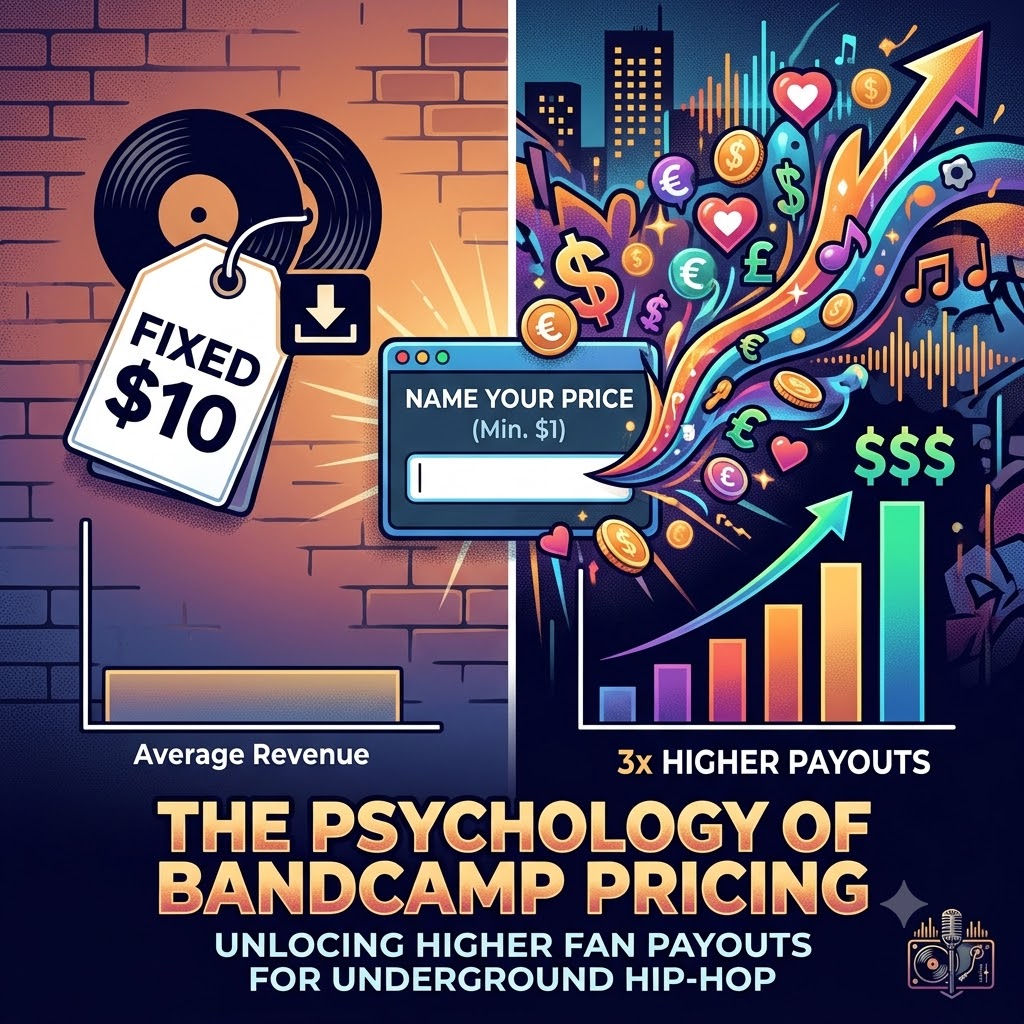
Swapping that flat $10 fee for a strategic “Name Your Price” (NYP) model with a $1 minimum often leads to average fan payouts that are up to 3 times higher than a static price tag.
Here is a breakdown of why this works, the psychology behind underground rap collectors, and how you can structure your catalog to turn casual listeners into long-term financial supporters.
The Mindset of the Underground Hip-Hop Collector
To understand why flexible pricing works, you have to understand the specific culture surrounding underground hip-hop.
Mainstream pop listeners are generally content hitting shuffle on a curated playlist. Underground rap fans are completely different. They are collectors. They care about producer credits, sample flips, raw mixing, guest features, and limited-edition pressings. Whether it’s vinyl, cassette tapes, or uncompressed WAV files stored on a hard drive, this audience treats music as a passion project, not background noise.
When you slap a fixed $10 price tag on a digital album, you flatten that connection into a standard retail transaction. You’re putting your project in the same mental bucket as a subscription service or a grocery bill.
By switching to a Pay-What-You-Want setup with a low barrier to entry, you completely change the dynamic. You move away from a transactional mindset and step into a model built on community support and fan identity.
The Behavioral Science: Anchoring vs. The Reciprocity Principle
Why does a flexible pricing model generate more money than a fixed price? It comes down to two major concepts in behavioral economics: Price Anchoring and The Reciprocity Principle.
1. Breaking the Price Ceiling
When you charge a flat $10, two things happen:
- Casual or budget-conscious listeners hesitate. If they only have a few extra dollars to spare, they walk away without buying.
- Superfans pay $10 and stop there—even if they were secretly willing to hand over $20, $50, or more to support your movement.
A fixed price creates a ceiling. It caps the generosity of your most dedicated supporters while locking out fans who are curious but hesitant.
2. How the $1 Minimum Triggers Generosity
When you lower the minimum price to $1, you remove almost all purchasing friction. Anyone with a dollar in their bank account can buy your music.
This is where reciprocity kicks in. Underground rap fans value authenticity. When a fan realizes they can download a full, high-quality project for just a buck, a strange thing happens: they feel like $1 is insulting.
To a dedicated hip-hop head, paying $1 for an album they genuinely love creates cognitive dissonance. They don’t want to feel like a cheapskate. To align their purchase with their identity as a true supporter of the culture, they voluntarily overpay.
Doing the Math: The Superfan Surplus
Let’s look at how this plays out in real-world revenue using a simple comparison of 10 purchasers:
Scenario A: Flat $10 Sticker Price
- 10 buyers × $10 fixed price = $100 total revenue
- Average payout per fan: $10.00
Scenario B: “Name Your Price” ($1 Minimum)
- 7 casual fans pay $3 each = $21
- 2 core fans pay $15 each = $30
- 1 die-hard superfan pays $50 = $50
- Total revenue across 10 buyers: $101
At first glance, $100 versus $101 looks like a tie. But Scenario B leaves out a critical variable: conversion rates.
Because the barrier to entry in Scenario B is just $1, you won’t get the same 10 buyers—you might get 25 or 30 buyers. When you scale those numbers across a release rollout, your average payout per fan frequently climbs to $15, $20, or even $30, crushing the rigid $10 baseline.
Why You Should Never Set the Minimum to $0
A common mistake artists make with “Name Your Price” is leaving the minimum at $0, effectively giving the album away for free.
While free downloads sound like a good way to build an audience, setting a $0 floor usually backfires for three reasons:
- It Invades Your Value: When something costs $0, people subconsciously perceive it as worthless.
- It Attracts Download Bots and Scrapers: A $0 option means your store will get hit by people who hoard free files and never actually listen to your songs.
- It Misses Bandcamp’s Algorithm: On Bandcamp, fan accounts only show purchases in their public collection if money actually changes hands. A $1 purchase forces the album into that fan’s collection page, giving your project valuable visibility when other collectors browse that fan’s library.
Setting a strict $1 minimum floor keeps real value attached to your work while keeping the door wide open for everyone.
A Step-by-Step Playbook to Optimize Your Bandcamp Store
If you want to pull real revenue out of your underground catalog, pricing is only part of the equation. You also need to structure your store to give fans a reason to spend.
Include Exclusive Extras in the Digital Zip
Don’t just upload standard MP3s. Underground audiophiles want lossless FLAC or 24-bit WAV files. Sweeten the deal by bundling exclusive digital assets into the download:
- Instrumental versions of the tracks
- High-resolution digital booklets or original artwork scans
- PDF lyric sheets or producer commentary notes
- Unreleased bonus tracks or rough demos
Offer a “Full Discography” Bundle
Bandcamp allows you to offer your entire back-catalog as a single discounted purchase. If a fan finds your new project and loves it, give them a seamless way to buy your last 5 EPs and 2 albums in one click. Setting a flexible minimum on discography bundles regularly results in $50 to $100 transactions from newly converted fans.
Build an Intentional Funnel
A great store setup doesn’t matter if nobody sees it. Social media platforms make it notoriously hard to drive traffic to outside store links. To build a reliable stream of paying supporters, you need to drive targeted traffic straight to your storefront. A proven strategy is securing media placement and editorial coverage to drive dedicated collectors directly to your digital storefront using our music submission portal.
Ownership Beats the Algorithm Every Time
At the end of the day, building a sustainable career as an underground hip-hop artist isn’t about gaming social media algorithms or chasing millions of fractional-cent streams. It’s about cultivating a dedicated core audience and making it easy for them to support you directly.
By moving away from rigid $10 price tags and implementing a strategic “Name Your Price” model with a $1 floor, you stop capping your income and give your biggest fans the freedom to back your movement at full capacity.
🚀 Maximize Your Music’s Reach
Ready to turn casual plays into high-value sales and real streaming growth? Reach an audience of active rap collectors today. Submit your track through our Music Submission Form.