Is a Live Freestyle a “Song”? Dissecting Billboard’s Top 7 Jay-Z Ranking and The Breakfast Club Debate
If you spend any amount of time scrolling through hip-hop Twitter or waking up to morning morning-radio hot takes, you already know that the culture loves a good debate. But lately, the biggest argument in rap isn’t about a messy album rollout, a sudden diss track, or a surprise chart battle. No, this one is entirely philosophical.
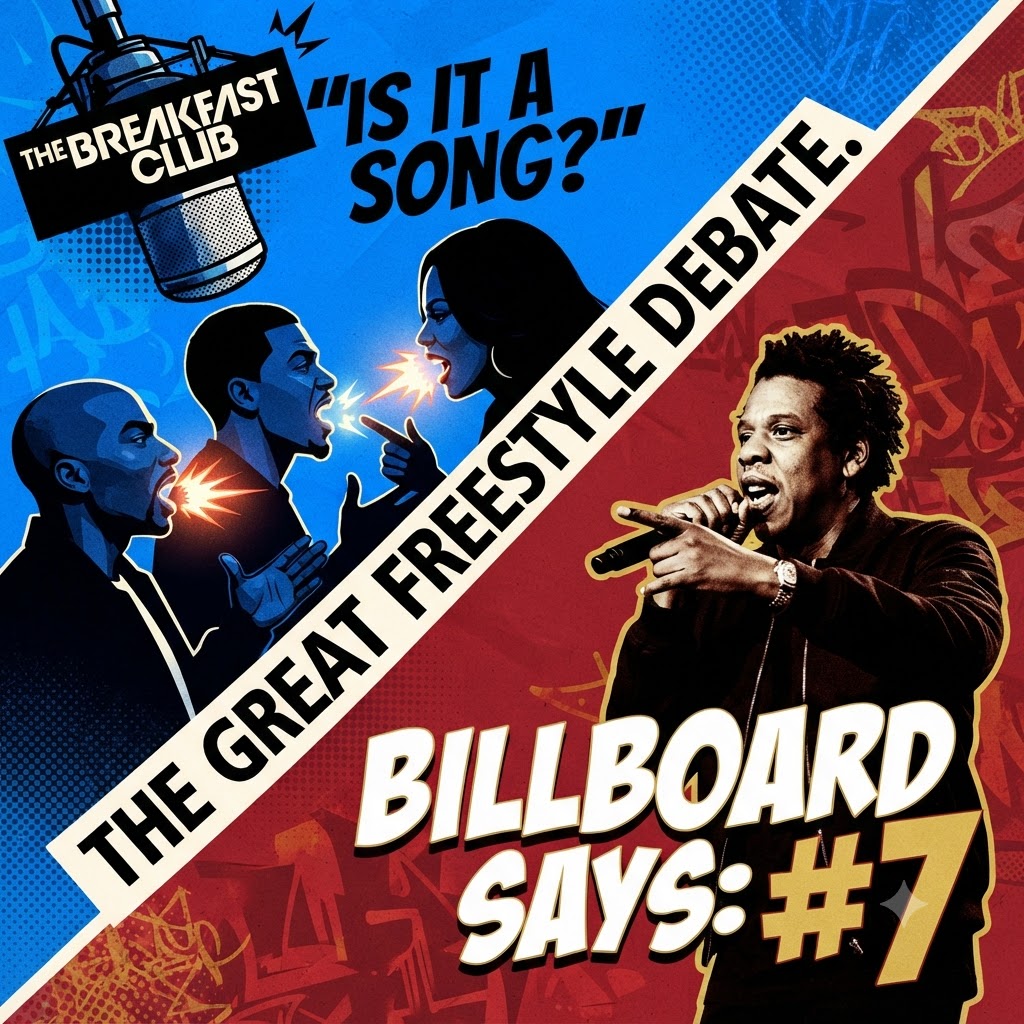
It all centers around Billboard’s Top 50 Best Songs list. When the publication dropped its rankings, Jay-Z’s live “Roots Picnic Freestyle” pulled up at a stunning No. 7.
Naturally, the internet did what the internet does best: it exploded. On one side, Hov stans celebrated the billionaire mogul effortlessly claiming a top-10 spot without even dropping a commercial single. On the other side, purists, critics, and the entire crew over at The Breakfast Club slammed the brakes, asking a very valid question: How on earth is a live festival freestyle qualifying as a song?
Let’s unpack how a few off-the-cuff bars sparked a massive industry debate, what Charlamagne and the rest of the Breakfast Club hosts had to say, and why this moment changes how we look at music lists forever.
The Spark: How a Festival Moment Crashed the Billboard Charts
To understand why this ranking caused so much friction, we have to rewind to Jay-Z’s headlining set at The Roots Picnic. Festival sets are meant to be special, but Hov used his stage time to deliver a masterclass in modern lyricism. Dropping unscripted gems, sharp cultural commentary, and subtle industry messaging, the freestyle immediately went viral.
By the next morning, clips were dominating TikTok, reaction channels were breaking down every bar, and fans were treating the verse like the event of the year.
Fast forward to Billboard’s editorial team compiling their year-end best-of list. Instead of sticking strictly to the traditional playbook—singles serviced to streaming platforms with radio loops, polished mixing, and standard verse-chorus-verse structures—they decided that Jay-Z’s live performance deserved the No. 7 slot.
Right away, the hip-hop community split down the middle:
-
The Culture Champions: Argued that impact is impact. If a rap verse shakes the entire industry and dominates the cultural conversation more than any radio hit, it deserves recognition regardless of technicalities.
-
The Traditionalists: Pointed out that a freestyle isn’t a song. It doesn’t live on Spotify or Apple Music as an official single, it lacks a structured composition, and giving it a top-10 placement on a “best songs” list feels more like an honorary lifetime achievement award than an objective ranking of actual music.
Inside The Breakfast Club Showdown: Is It Art or an Event?
The debate inevitably spilled over into morning radio. On The Breakfast Club, Charlamagne Tha God, DJ Envy, and the rest of the team didn’t hold back when dissecting Billboard’s controversial choice.
The Anti-Qualifiers’ Stance
Charlamagne and Envy took up the mantle for the skeptics, pushing back against what they viewed as industry pandering. Their main argument boiled down to definitions:
-
A song has structure: A traditional record goes through writing, mixing, mastering, and a commercial rollout. It has a beat meant to be replayed, a hook, and a defined lifecycle.
-
A freestyle is a moment: Performing live at a festival with a live band or a looping beat is a performance.
-
The unfair advantage: The hosts raised concerns that slotting a live rap verse into a song category takes away a well-deserved spot from artists who spent months grinding in the studio to engineer a structured, commercial track.
The Counter-Perspective
Of course, you can’t talk about Jay-Z without acknowledging the weight he carries. Defenders of the ranking noted that hip-hop was literally built on live cyphers, park jams, and unwritten freestyle delivery. If a 3-minute verse has more substance, lyricism, and cultural resonance than a hundred cookie-cutter trap songs on the Billboard Hot 100, why should a technicality keep it off the list?
Why This Debate Matters for the Future of Hip-Hop
Strip away the fan bias, and you’ll realize that the Jay-Z freestyle controversy points to a much deeper identity crisis in modern music consumption. We are living in an era where traditional definitions of “what makes a hit” are completely broken.
1. The Death of Traditional Album Cycles
Artists no longer have to follow the standard 3-year album rollout to dominate the cultural landscape. A surprise verse, a live freestyle, or a viral snippet can completely eclipse a polished studio release. Platforms like TikTok, Instagram Reels, and YouTube Shorts have conditioned listeners to crave raw, unfiltered moments over heavily engineered commercial singles.
2. The “Hov Effect” and Event Programming
Let’s be honest: Jay-Z operates on a completely different plane of existence. Decades into his legendary career, he doesn’t need to drop an album to command the global spotlight. When a billionaire icon who rarely raps anymore steps up to a festival mic and delivers bars, it isn’t just music—it’s event programming. Billboard capitalized on that massive gravitational pull, even if it meant bending their own rules.
3. Impact vs. Engineering
This whole situation forces music critics and award platforms to answer a tough question: Should year-end lists reward technical composition or overall cultural impact? If a song is technically well-produced but nobody cares about it a week later, is it really one of the “best songs” of the year? Conversely, if a live verse isn’t on streaming services, can a fan actually “listen” to it the same way?
Where Do You Stand?
At the end of the day, lists like Billboard’s aren’t meant to be universally agreed upon—they are designed to start conversations. Whether you think putting a live festival freestyle at No. 7 was a genius nod to hip-hop’s roots or a lazy cop-out by editors chasing clicks, it certainly got the entire industry talking.
Where do you land on the great 2026 hip-hop debate? Does a raw, unreleased festival moment deserve to stand shoulder-to-shoulder with the year’s biggest commercial records, or should Billboard have kept the category strictly to official singles?