Rewriting Grime History: 25 Years of the Sound That Defined Modern London
If you stood on an East London housing estate back in the early 2000s, you could practically hear the future crackling through the static.
It didn’t come from a sleek, polished recording studio with expensive lighting and soundproofed booths. It came from bedrooms, council flat rooftops, and cramped, improvised setups where teenagers were messing around with software like FruityLoops, blending the bouncy, upbeat rhythm of UK garage with the heavy, menacing low-end of drum and bass, dancehall, and American hip-hop.
That chaotic, high-energy collision of sounds became known as grime.
Fast forward a quarter of a century, and grime isn’t just a nostalgic footnote in British music history. It’s a global blueprint. To understand how a gritty subgenre spawned from illegal airwaves managed to conquer the world, we have to look back at the past 25 years of its evolution—tracing the sweat, the struggle, and the sheer cultural force that put UK music on the international map.
The Pirate Radio Era: Where It All Began (Early 2000s)
Before algorithms, Spotify playlists, and viral TikTok trends, breaking a new sound meant breaking the law—literally.
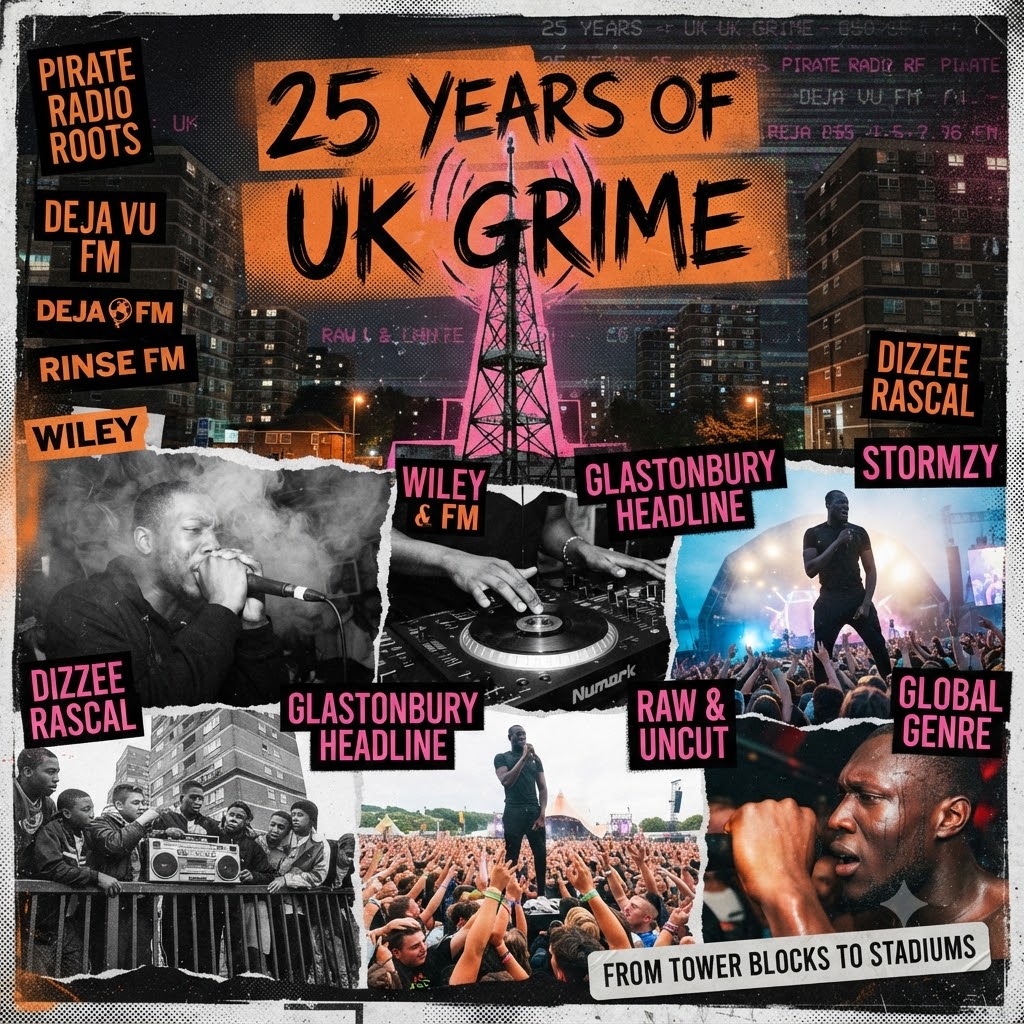
In the formative years of grime, pirate radio stations like Deja Vu FM, Rinse FM, and Mission FM were the undisputed lifelines of the underground. DJs would lug heavy transmitters up dodgy stairwells in London tower blocks, broadcasting illegal signals across the city just to reach kids sitting in their bedrooms with a cassette tape ready to record.
This was a DIY culture in its purest form. Producers were crafting frantic, skeletal beats at 140 BPM, while young MCs—often barely out of their teens—lined up in cramped studio spaces to spit rapid-fire bars over instrumental dubplates.
Names like Wiley, Dizzee Rascal, Kano, Tinchy Stryder, and crews like Roll Deep and Pay As U Go Cartel were cutting their teeth in this environment. It was hyper-local, fiercely competitive, and entirely unpolished. You had to have thick skin to survive a clash, and your lyrics had to reflect the raw, unfiltered reality of inner-city London life—the boredom, the street politics, the aspirations, and the constant hustle.
The Breakthrough and the Backlash (Mid-2000s)
For a long time, mainstream the music industry didn’t quite know what to do with grime. It was too aggressive for commercial radio, too independent to be easily packaged, and heavily stigmatized by local authorities who tried to shut down raves and pirate broadcasts alike.
Then came Dizzee Rascal.
In 2003, a 18-year-old Dizzee released his debut album, Boy in da Corner. It was a dark, jarring masterpiece that captured the claustrophobia and paranoia of London council estates. When it won the prestigious Mercury Prize, it sent shockwaves through the UK music industry. Suddenly, people outside of East London realized grime wasn’t just a passing fad—it was high art.
Other artists began crossing over. Wiley dropped crossover hits like “Wot Do You Mean?” and Kano released Home Sweet Home, proving that grime MCs could write deeply introspective, emotionally resonant music without losing their street credibility.
However, success brought friction. As major labels tried to water down the sound to make it radio-friendly, the scene experienced a brief identity crisis. Some artists chased pop charts, while others felt the culture was losing its soul.
The Underground Resurgence: YouTube, Mixtapes, and Clashes (Early 2010s)
When traditional industry doors started closing, grime simply went digital.
The early 2010s marked a fascinating transitional phase. Traditional pirate radio was fading out, but a new digital infrastructure was taking its place. Platforms like SBTV (founded by Jamal Edwards) and Link Up TV became the new pirate radio stations, giving a camera and a platform to a fresh wave of talent.
At the same time, DVD series like Lord of the Mics—created by Jammer—kept the sport of grime alive through legendary live MC clashes in tiny basements. It was raw, confrontational, and deeply entertaining.
During these years, while dubstep and electronic dance music were dominating clubs globally, the core grime audience kept the underground flame burning. Producers continued tweaking the 140 BPM formula, laying the groundwork for a massive, inevitable comeback.
The Global Takeover and the Stormzy Effect (Late 2010s–Present)
If the 2000s were about survival and the 2010s were about rebuilding, the late 2010s belonged to global domination.
Grime had evolved from an insular London sound into a cultural export embraced worldwide. And no one personified this shift quite like Stormzy.
When Stormzy dropped “Shut Up” via a freestyle video on YouTube, it became a grassroots viral sensation that forced the mainstream to bend to its will. His subsequent album, Gang Signs & Prayer, debuted at number one on the UK charts and won British Album of the Year at the BRIT Awards.
The crowning moment came in 2019, when Stormzy headlined Glastonbury Festival, walking out in a custom Union Jack stab-proof vest designed by Banksy. It was a watershed moment for British music: a kid from South London who grew up spitting bars on council estates was now commanding the biggest stage in the world, entirely on his own terms.
Today, grime’s DNA is everywhere. It has influenced American hip-hop artists, spawned thriving localized scenes in countries like Japan and Australia, and laid the structural foundation for UK drill, which currently dominates the contemporary charts.
Why Grime’s 25-Year Legacy Still Matters
Looking back across a quarter of a century, the true beauty of grime isn’t just found in the platinum-selling records or stadium tours. It’s in the ethos.
Grime was built by young people who were told they didn’t have a voice, using cheap software and pirate signals to make the world listen anyway. It taught an entire generation that you don’t need a golden ticket from a corporate record label to build something monumental—you just need authenticity, a relentless work ethic, and a community that backs you up.
As the genre moves well past its 25th anniversary, its sound continues to morph and adapt. But that raw, 140-BPM heartbeat born in the tower blocks of London? That’s never going away.