How Independent Curators Spot “Fake Followers” on Spotify Profiles Before Accepting Pitches
If you’ve spent any time at all trying to get your music heard online, you already know how brutal the pitching grind is. You spend weeks writing, recording, mixing, and mastering a track. You build out your assets, polish your press release, and start firing off emails and submission forms to independent playlist curators. Then… silence. Or worse, a polite automated rejection.
You start wondering if your mix isn’t punchy enough, if your artwork is weak, or if you just picked the wrong single. But very often, the issue has nothing to do with the audio file sitting inside that private SoundCloud or Spotify link.
The issue is sitting right there on your artist profile for the whole world to see: your metrics.
Independent playlist curators are tired. The rise of cheap, bot-driven growth services promising “instant credibility” has completely flooded the industry. Every single day, curators are swimming through thousands of pitches sent by artists who tried to cheat the system. And here is the brutal truth: long before a curator even presses play on your track, they are running your profile through a mental bullshit detector.
If you are wondering why your pitches are getting left on read, your backend analytics might be telling a story you didn’t intend to share. Let’s pull back the curtain and talk about how tastemakers actually audit profiles, the exact ratios that give botted accounts away, and how you can clean up your act to get taken seriously.
The Wild West of Modern Music Promotion
Let’s address the elephant in the room. The music industry has always been obsessed with numbers. Labels, booking agents, and A&Rs have historically used crowd size as a shortcut to determine talent. In the streaming era, that obsession shifted to follower counts, monthly listeners, and playlist placements.
Naturally, a multi-million dollar gray market popped up to exploit this. For ten bucks, you can buy 5,000 followers. For fifty bucks, you can juice a track with thousands of automated streams from server farms in remote corners of the globe.
To an inexperienced artist, this looks like a genius hack to fake it ’til you make it. To an experienced independent curator who manages high-traffic playlists, it looks like a flashing neon sign that screams: “Stay away.”
Curators have a lot to lose. If a curator accepts tracks filled with botted streams or artificial engagement, Spotify’s anti-fraud algorithms notice. Whole playlists can get buried, flagged, or stripped of their algorithmic reach. Because of this, curators have become amateur forensic accountants, checking your data points before they ever risk adding your song to their rotation.
The Golden Rule: Monthly Listeners vs. Follower Ratios
When an independent curator opens your Spotify artist profile, they aren’t looking at your bio, your press photos, or your Spotify Canvas first. Their eyes go straight to two numbers: Monthly Listeners and Follower Count.
On a healthy, organically growing artist profile, these two metrics maintain a logical, proportional relationship. They tell a story about community. When that story doesn’t make sense, alarm bells go off instantly.
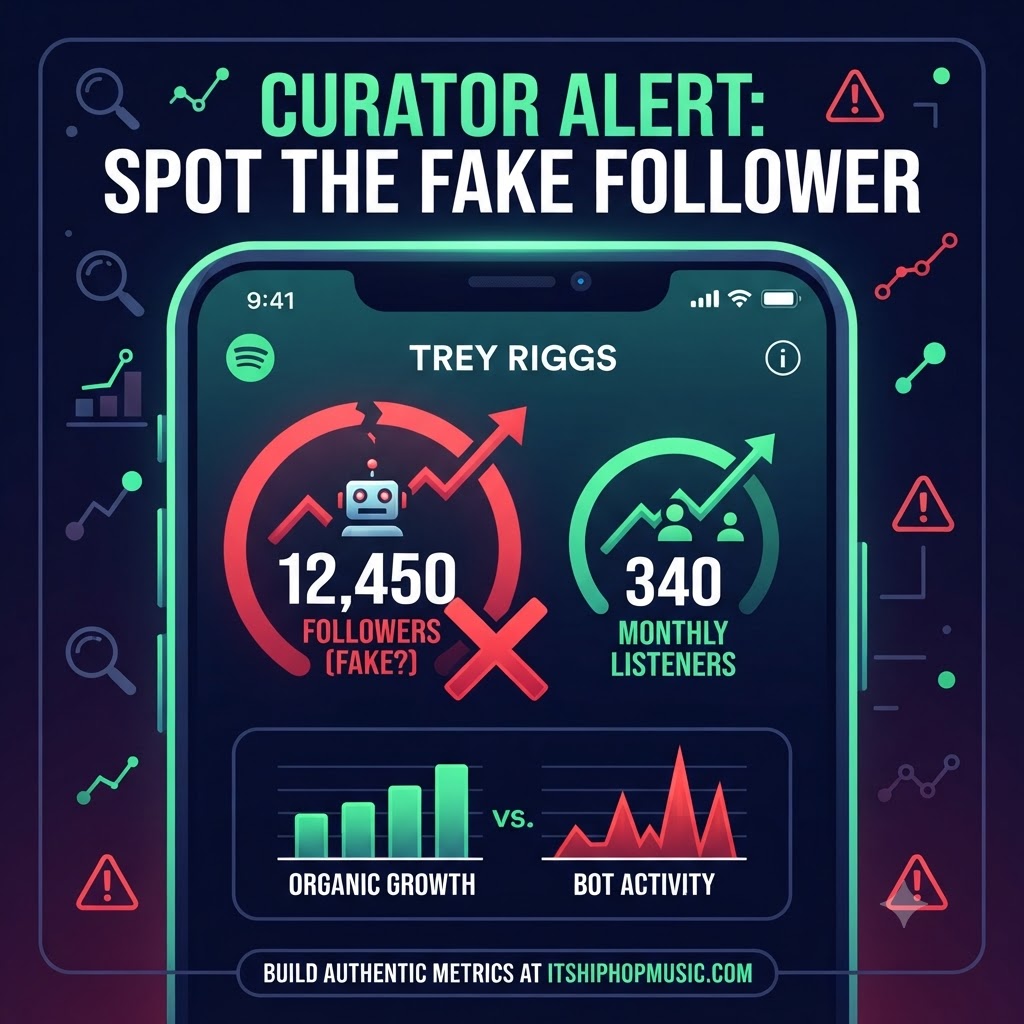
Red Flag #1: The “Digital Ghost Town” (High Followers, Low Monthly Listeners)
-
What it looks like: 12,000 followers, but only 350 monthly listeners.
-
What it signals: This is the classic footprint of cheap, low-quality bot panels from years past. An artist bought a bulk package of followers to look established. Those bot accounts hit “follow” once and then either went dormant or got swept up in Spotify’s regular purge of fake accounts. Now, the profile sits there with thousands of followers who never actually stream anything.
-
The Curator’s Take: Instant rejection. Curators know that an artist with thousands of followers who can’t pull even a fraction of that in monthly listeners has a dead audience. It proves the engagement isn’t real.
Red Flag #2: The “Bot-Net Surge” (Low Followers, Massive Monthly Listeners)
-
What it looks like: 180 followers, but 45,000 monthly listeners.
-
What it signals: While it is possible for a brand-new track to catch fire overnight via a viral TikTok moment or an unexpected algorithmic push, a massive disparity where monthly listeners vastly outnumber followers usually points to sketchy automated streaming services. Bot programs will stream a track on repeat for hours to juice play counts, but automated scripts almost never click the “Follow” button.
-
The Curator’s Take: Red flag. A sudden mountain of monthly listeners paired with a handful of followers tells the curator the streams are artificial. They won’t risk their playlist’s standing for a track that smells like a bot farm.
The Organic Sweet Spot
Real audiences grow in tandem. When you run targeted campaigns, pitch to real blogs, and connect with actual human fans, your followers and monthly listeners scale upward together. There might be fluctuations depending on when you dropped your last single, but the baseline relationship remains grounded in reality. Curators look for that steady, balanced consistency.
Beyond the Numbers: Other Backend Red Flags
Follower-to-listener ratios are just the baseline. If a curator smells something fishy, they will dig a little deeper into your profile’s metadata and catalog behavior. Here are a few other things they look out for:
-
Geographic Anomalies: If an independent rap artist based out of Chicago has 80% of their monthly listeners coming from a single, random city in Eastern Europe with zero cultural connection to hip-hop, curators know automated proxies are at work. Real organic growth reflects the places where you perform, market, or naturally build a community.
-
The “One-Hit Wonder” Catalog Trait: If an artist has 80,000 monthly listeners on a single song, but their three previous releases have under 100 total plays combined, it signals inauthentic manipulation. Real organic traction almost always spills over into an artist’s broader catalog because engaged fans check out what else you’ve made.
-
The Social Media Vacuum: Curators love to cross-reference Spotify stats with external platforms. If a profile boasts massive streaming numbers, but the artist’s Instagram or TikTok has 62 followers and zero comments or shares, the math simply doesn’t add up. Real music creates real conversations outside of DSPs.
How to Clean Up Your Strategy and Build Real Momentum
If you’ve previously experimented with growth shortcuts, or if you’re looking at your own analytics right now and panicking, take a deep breath. You aren’t permanently locked out of the industry, but you do need to pivot your strategy.
Stop buying cheap shortcuts that trigger Spotify’s algorithmic tripwires and burn your reputation with tastemakers. Cleaning up your profile means embracing transparency and focusing on sustainable, grassroots audience acquisition.
Instead of chasing empty numbers, focus on building clean, authentic backend metrics by sourcing real listeners through our independent rap playlist campaigns. When your metrics reflect actual human beings who are actively listening to your music, saving it to their libraries, and adding it to their daily rotations, independent curators notice the difference immediately.
When your analytics are honest, transparent, and robust, pitching stops feel like shouting into a void. It transforms into what it’s supposed to be: a straightforward conversation between an artist who made a great track and a curator looking for great music.