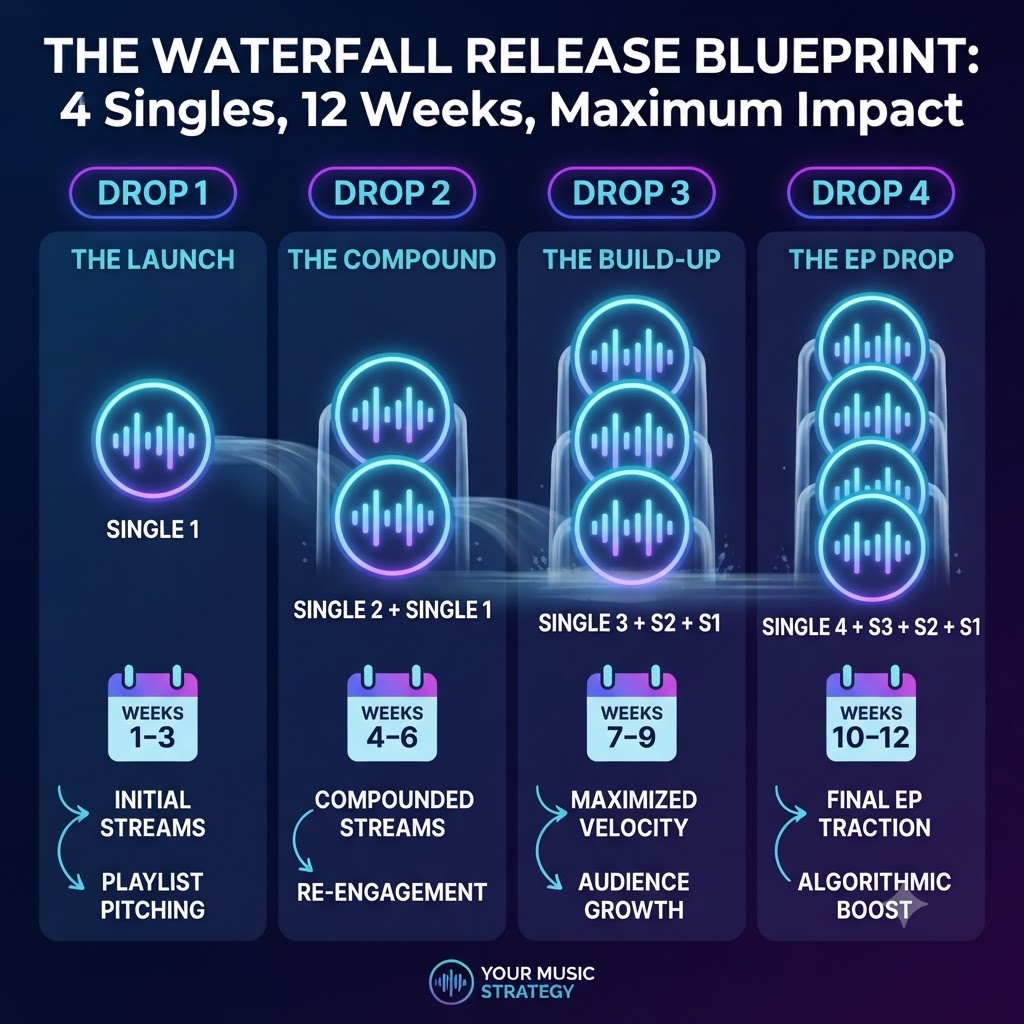
How to Map a 4-Single Waterfall Release Schedule Over 12 Weeks
Dropping a single every six months and hoping for the best just doesn’t cut it anymore. If you want to keep algorithms working in your favor and give your audience a real reason to stick around, the standard release cycle needs an upgrade.
Enter the waterfall release strategy.
Instead of scattering your singles as standalone moments that fade in a week, a waterfall rollout stacks your tracks into a growing ecosystem. It compounds your stream numbers, breathes new life into older tracks, and builds genuine momentum leading straight into a full EP.
Here is how to map out a 4-single waterfall release over 12 weeks without losing your sanity.
What is a Waterfall Release, Anyway?
The concept is simple: you release a track, and then a few weeks later, you drop the next one packaged together with the first. By the time you reach your final project, you’ve built a neat little bundle where every stream adds up.
-
Drop 1: Single A drops on its own.
-
Drop 2: Single B drops, bundled with Single A.
-
Drop 3: Single C drops, bundled with Singles B and A.
-
Drop 4: Single D drops, completing the full EP.
Instead of fragmenting your listener data across four completely separate release pages, your primary streams consolidate. When fans stream the new track, they’re often pulling up the whole mini-collection, lifting your older catalog right along with it.
The 12-Week Blueprint: Step-by-Step
Phase 1: Setting the Hook (Weeks 1–3)
The Goal: Launch your first piece of the puzzle and get early data flowing.
-
Week 1: Drop Single 1. This is your opening statement. Focus your energy on playlist pitching, gathering early pre-saves or saves, and letting the track breathe.
-
Weeks 2–3: Keep the conversation going. Share behind-the-scenes clips, lyric breakdowns, or live snippets on socials. Let the song find its initial footing.
Phase 2: The First Compound (Weeks 4–6)
The Goal: Re-engage early listeners and introduce the bundle.
-
Week 4: Drop Single 2. When people click your link this time, they get a two-track bundle with the new song and Single 1.
-
The Play: Use this drop to reach out to people who missed the first single. It’s an easy excuse to pop back onto your fans’ radar (“Hey, I dropped a new one, and if you missed the last track, it’s right here too”).
Phase 3: Building the Momentum (Weeks 7–9)
The Goal: Expand your footprint right in the middle of the rollout.
-
Week 7: Drop Single 3, making it a three-track bundle.
-
The Play: By now, you have three distinct entry points for new listeners. Update your artist bio, sharpen your SEO metadata to reflect the growing tracklist, and give listeners a glimpse of where this whole story is heading.
Phase 4: Crossing the Finish Line (Weeks 10–12)
The Goal: Wrap up the cycle with your final EP release.
-
Week 10: Drop Single 4. This completes the puzzle, turning your singles into a cohesive 4-track EP.
-
Weeks 11–12: Shift your messaging entirely to the completed project. Because your streaming numbers from the individual drops have all fed into this final release page, you aren’t starting from scratch—you’re launching the EP with built-in traction.
Why It Works
Streaming platforms reward consistency. Dropping a fresh piece of content every few weeks keeps you relevant in Release Radar algorithms and notification feeds. More importantly, it respects how modern fans actually consume music: they love grazing on a steady drip of singles rather than waiting in the dark for a massive album drop.
Need help planning your rollout? Maintain consistent release momentum with our multi-stage options.
Ready to Build Your Rollout?
Stop leaving your streaming numbers to chance. By structuring your releases strategically, you turn casual click-throughs into a dedicated, engaged fanbase.
[CTA BOX] Maximize Your Reach Maintain consistent marketing velocity across every drop. Options available on our website to help you map, promote, and execute your next release.