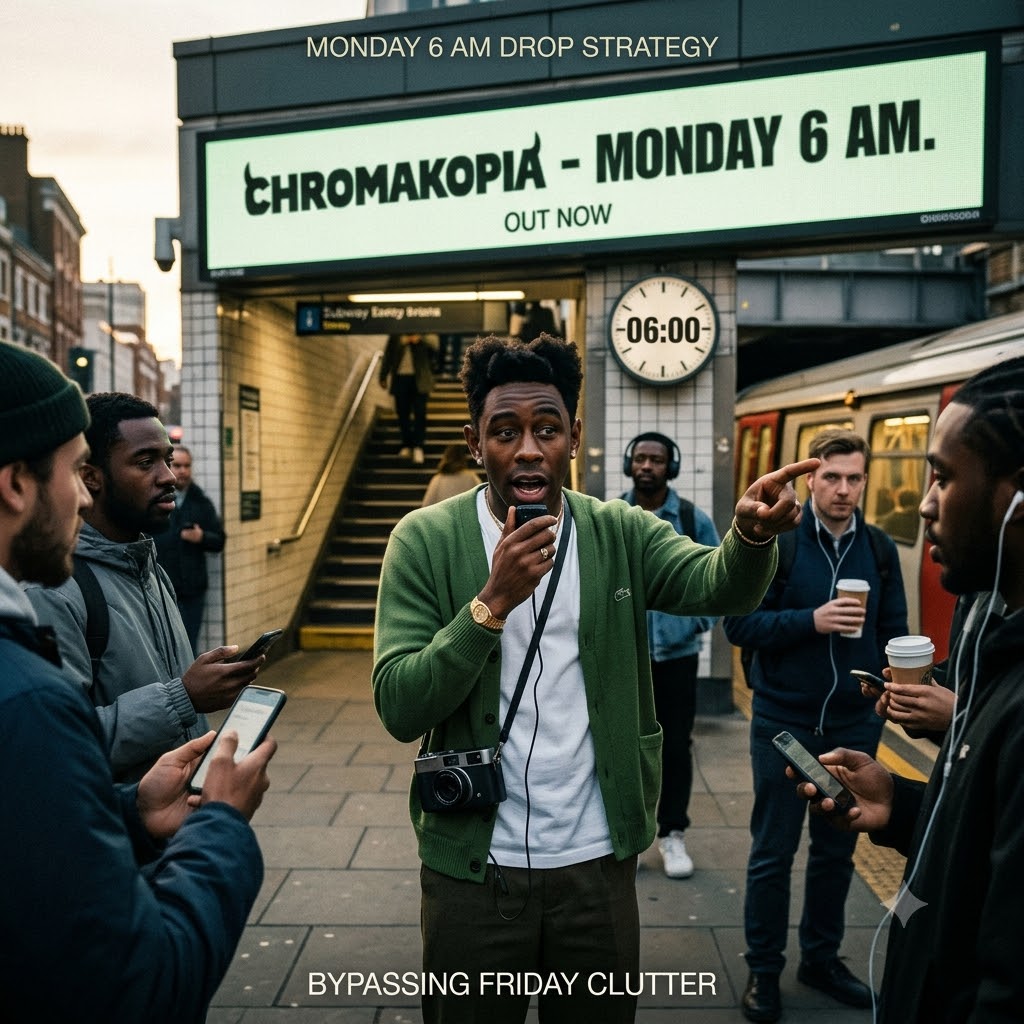
Tyler, The Creator’s Monday 6 AM Drop Strategy (CHROMAKOPIA): Bypassing Friday DSP Clutter
For nearly ten years, every corner of the music industry has moved to the exact same clock. Back in July 2015, major record labels, digital streaming platforms, and global music trade groups agreed to set Friday at midnight EST as the global standard release window. The idea was simple: build a unified global system so fans could hear new songs at the exact same moment everywhere.
Fast forward to today, and that global standard has turned into an absolute nightmare for artists trying to be heard.
Every single Thursday night, streaming networks like Spotify, Apple Music, and Amazon Music take on a massive digital traffic jam. Tens of thousands of tracks hit the system all at once. Independent acts, mid-tier touring artists, and multi-platinum stars end up fighting for the exact same homepage banners, playlist spots, and brief moments of listener attention. By Friday afternoon, most of those releases get buried under the noise.
Then Tyler, The Creator stepped in and flipped the script.
When Tyler rolled out his album CHROMAKOPIA, he ignored the traditional Thursday midnight countdown entirely. Instead, he dropped the project on a Monday at 6:00 AM ET.
It was not a random stunt or an accidental schedule shift. It was a calculated move built on modern attention economics, audience habits, and streaming chart mechanics. By moving outside the Friday midnight congestion, Tyler captured early morning commuter focus, dominated the music news cycle on a quiet day, and built a full seven days of steady streaming growth. Here is a close look at how the Monday 6 AM strategy worked, why it disrupts standard music rollouts, and how independent artists can use these ideas to get real results.
1. Breaking Free from the New Music Friday Bottleneck
To understand why the Monday release worked so well, you have to look at what happens every Thursday night across the major DSPs.
Around 11:59 PM EST, curators update major editorial playlists like New Music Friday, RapCaviar, Most Necessary, and Release Radar. Getting placed on those playlists is great, but the surrounding environment is crowded and distracting.
When you release a song at midnight on Friday, your music gets thrown directly into a crowded arena:
-
Listeners get notification fatigue: Anyone opening a streaming app on Friday morning sees a wall of pop-ups, new album banners, and fresh singles from dozens of artists at once.
-
Media channels are overwhelmed: Music blogs, social channels, and media outlets receive hundreds of press releases within a few hours. Only a tiny fraction get proper coverage.
-
Social feeds turn into noise: Every timeline turns into a sea of identical “OUT NOW ON ALL PLATFORMS” posts, making it hard for any single project to stand out.
By picking Monday morning at 6:00 AM ET, Tyler completely removed himself from that overcrowded environment.
On Monday morning, CHROMAKOPIA had zero major competition on streaming feeds. Music writers logging into work on Monday were not dealing with a midnight surge of rival releases. Feed timelines were quiet, clean, and open. By stepping out of line, Tyler made his project the single biggest music topic on the internet at the exact start of the week.
2. Tapping Into Listener Mindset and Daily Routines
Timing is not just about picking a date on a calendar; it is about reaching people when they are actually ready to listen.
Releasing a track at midnight on a Thursday relies on late-night streaming habits. Some fans stay up to listen, but many are scrolling in bed, hanging out with friends, or getting ready to sleep. Late-night attention is often passive, split between phone screens and late hours.
A Monday 6:00 AM ET release connects directly with the start of the weekly routine:
| Time Slot | Daily Activity | Listener Behavior & Impact |
| 6:00 AM ET | Official Global Drop | Clean digital timeline, zero competing releases, exclusive focus |
| 7:00 AM – 8:30 AM | Morning Commute | Car speakers, headphones, train rides with continuous audio playback |
| 9:00 AM – 12:00 PM | Work & School Day | Discussions in group chats, social shares, early word-of-mouth growth |
Think about how people move on a Monday morning. Millions of people get into cars, step onto trains, or put on headphones to start their day. They need audio for their commute, and they want something new to set the mood for the week.
CHROMAKOPIA became the soundtrack for that morning drive. Instead of catching people when they were tired at midnight, the drop hit them when they were awake, focused, and ready for a full front-to-back album listen. That early morning run sparked group chat debates and social media posts before lunch, giving the album natural word-of-mouth reach all day long.
3. How Early Momentum Drives Algorithmic Charts
From a data perspective, picking a non-standard release window might seem like a risk for chart placements. Billboard and Luminate calculate weekly charts from Friday morning through Thursday night. The traditional logic says you need to drop at Friday midnight to catch all 168 hours of the tracking window.
However, modern streaming charts on Spotify and Apple Music run heavily on dynamic algorithms. These systems track initial engagement velocity—meaning how fast users click, listen, replay, and save a project right after it goes live.
Releasing on Monday morning helps spark those algorithmic triggers in a unique way:
-
Consistent Daily Plays: Releasing early on Monday allows a project to build steady streaming numbers across Monday, Tuesday, Wednesday, and Thursday. That consistent play count keeps the music high on daily charts like Spotify’s Top 50.
-
Stronger Recommendation Triggers: Because engagement stays steady on days when overall platform traffic is lighter, streaming algorithms start pushing the music to non-followers via autoplay and radio queues.
-
A Second Boost on Friday: By the time the weekend hits, the project is already trending upward. Instead of relying on a Friday playlist spot to find an audience, the music enters weekend playlists backed by several days of solid streaming data.
What Independent Artists Can Take Away from the Monday Model
You do not need a major label budget to take advantage of these behavioral dynamics. The takeaway here is not that every artist must release every single track on a Monday at 6 AM, but that automatic habits often lead to predictable results. Releasing on Friday midnight simply because everyone else does often means getting lost in the crowd.
If you want your music to stand out, rethink your release planning:
-
Take a close look at your audience data to see when your followers are actually active online, then rethink your drop-day calendar to maximize listener focus, then channel that early momentum directly through our hip-hop music promotion channels.
-
Avoid the late-night release wave by dropping at times when people are awake and looking for fresh audio content, like early morning commute hours or mid-day launch windows.
-
Turn your drop into a clear event by explaining why you chose your timing, making the release feel purposeful instead of routine.
Building long-term growth means taking control of your launch schedule, testing new drop windows, and bringing your music to fans when they are ready to give it their full attention.
🚀 Ignite Your Release Momentum: Put your new single into active listener rotation. Submit your track through our Music Submission Portal.