Is Spotify’s “Discovery Mode” a Gold Mine or a Trap? The Math Behind the Payout Cut
If you’re an independent artist, you’ve likely seen that “Try Discovery Mode” notification pop up in your Spotify for Artists dashboard.
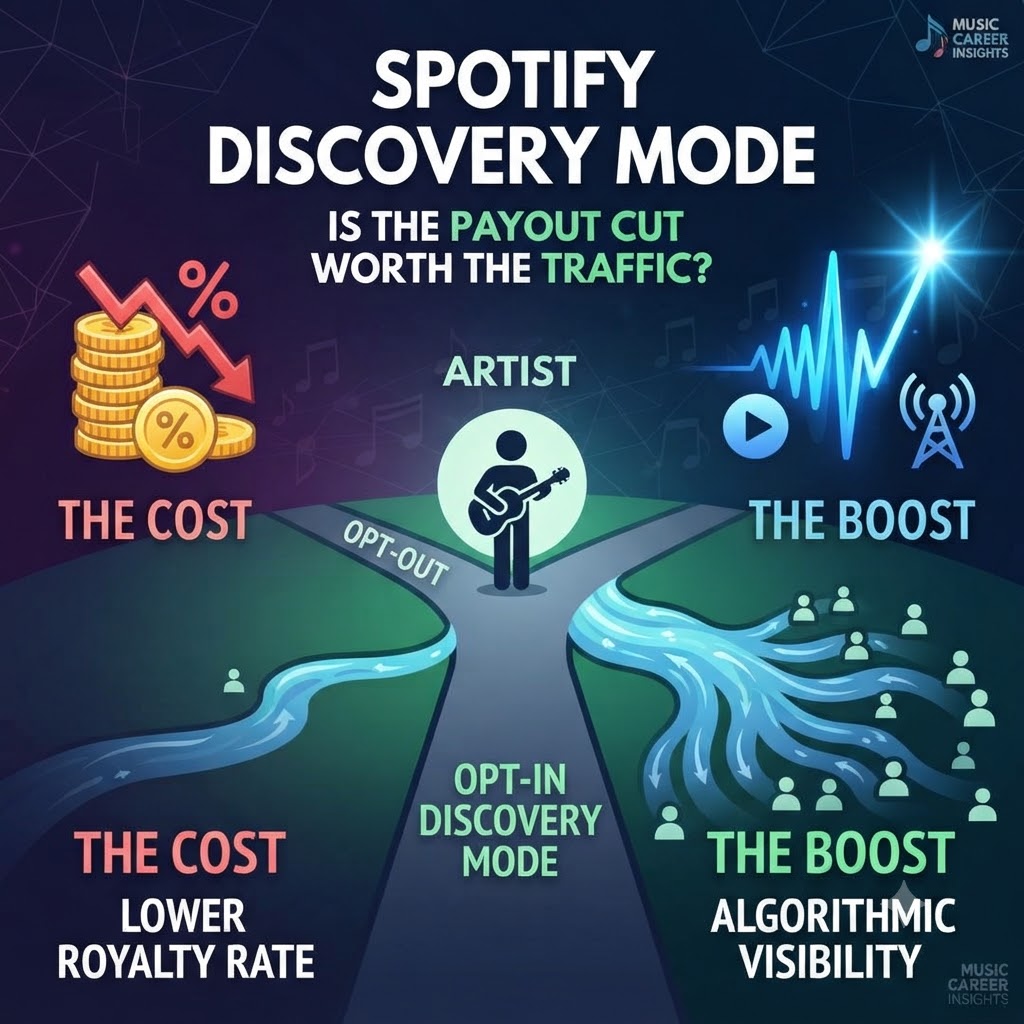
It sounds like a no-brainer. Spotify offers to push your tracks into their radio and autoplay algorithms—prime real estate for discovery—in exchange for a lower royalty rate. But for many of us, the question remains: Is sacrificing your streaming income actually worth the algorithmic boost?
Let’s stop looking at the marketing fluff and break down the math, the strategy, and the reality of trading pennies for potential growth.
How Discovery Mode Actually Works
Think of Discovery Mode as a trade-off. You’re essentially agreeing to take a pay cut on streams that come from specific algorithmic sources (Radio and Autoplay). In return, Spotify’s system prioritizes your song, serving it up to listeners who have already shown a taste for similar artists or genres.
On paper, it’s a customer acquisition tool. The idea isn’t to get rich off those specific streams—it’s to find new listeners who will follow your profile, save your music, and start streaming your stuff organically outside of those algorithmic sessions.
The Math: Is the Payout Cut Worth It?
Let’s be real about the numbers. The royalty cut on these streams can be significant. If your margins are already razor-thin, losing a chunk of that revenue stings.
The real question is the Long-Term Value (LTV) of those listeners. If Discovery Mode puts your song in front of 500 new “superfans” who go on to stream your entire catalog, buy your vinyl, or grab tickets to a show, that short-term royalty loss is worth it.
The danger is “empty traffic.” If the algorithm pushes your song to people who aren’t actually vibing with it (maybe they skip your track after 31 seconds), you’re effectively paying a premium for bad data. Worse, you’re training the algorithm that your song is “skippable,” which can actually hurt your reach in the long run.
The “Baseline” Problem
Here is the part most artists get wrong: Discovery Mode is not a fix for a brand-new track with zero traction.
If your song has no data behind it—no saves, no playlist adds, no listener history—the algorithm is basically throwing darts in the dark. It doesn’t know who to show your music to. You end up wasting money and getting low-quality, “uninterested” streams.
Discovery Mode works best when you already have some momentum. Kickstart that initial activity with a smart, targeted release strategy first. That way, when you do turn on Discovery Mode, the algorithm has a real “seed” audience to work from.
How to Actually Use It
If you’re going to run Discovery Mode, don’t treat it like a “set it and forget it” button. Use these three rules:
-
Don’t start at zero: Make sure your track has a solid foundation of organic streams and a decent save rate before you opt in.
-
Watch your conversion: Keep an eye on your “Listener-to-Follower” ratio while the campaign is running. If streams are up but nobody is following you, the algorithm is likely targeting the wrong crowd.
-
Tidy up your house: Discovery Mode is going to drive people to your profile. Make sure your bio, social links, and “Artist Pick” are updated and look professional before you flip the switch.
The Bottom Line
Discovery Mode is a tool for scaling, not starting. If you treat it like an advertising spend—something you pay to acquire fans—it can be a solid asset. But if you’re using it to try and fix a lack of organic marketing, you’re likely going to find that the payout cut isn’t worth it.
Ready to Scale Your Streams?
Algorithms prioritize songs that people are already choosing to listen to. Before you touch the automated tools, you need to build the organic foundation that actually makes them work.