PluggnB vs. Rage Beats: Tagging Underground Rap Subgenres for Algorithmic Discovery
Dropping a new song through your distributor and slapping a generic “Hip-Hop/Rap” label on it is the quickest way to watch an underground release stall at a few hundred streams. Streaming platforms do not treat rap as one giant bucket anymore. Today, recommendation engines rely on micro-genre mapping, audio fingerprinting, and listener habit clusters to decide who hears your music first. Getting a handle on pluggnb vs rage beats spotify genre tags gives independent rappers and producers a real shot at feeding Spotify the exact signals it needs to push a record into personalized playlists.
Even though both waves grew out of the same post-2019 SoundCloud underground, PluggnB and Rage live on completely different planets sonically. If you upload a dreamy, R&B-laced track and pitch it like an aggressive mosh-pit anthem—or do the reverse—you end up putting your song in front of listeners who hit skip inside the first five seconds. Once those early skip rates spike, the algorithm quietly pulls the plug on your reach.
Sonic Breakdown: Dreamy PluggnB vs. Blown-Out Rage
Before you touch your release metadata, you need to look at what your track actually sounds like under the hood. When you upload a master, Spotify’s audio analysis scans everything from spectral density and distortion to chord movement and vocal timbre. It uses those raw audio traits to group your song with similar records before a single fan even presses play.
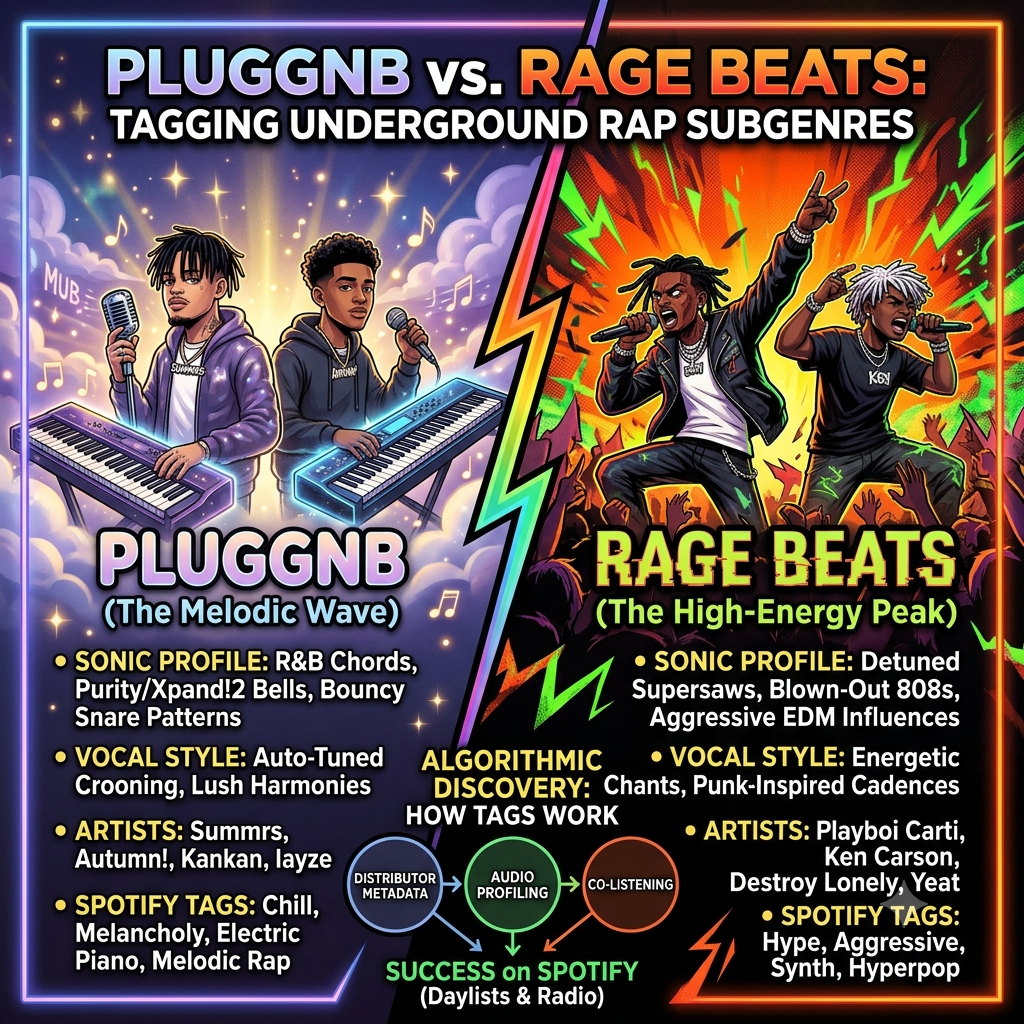
| Sonic Element | PluggnB | Rage Beats |
| Core Melody & Synths | Lush electric pianos (Rhodes), Purity and Xpand!2 bells, airy pads, soft string plucks | Detuned supersaws, harsh Serum leads, distorted synth arpeggios |
| Harmonic Influence | 1990s and 2000s R&B chord progressions, warm major 7th and 9th intervals | Minor-key EDM festival drops, hyperpop tension, dissonant synth stabs |
| Drums & Percussion | Zaytoven-style bouncy snare patterns, sparse hi-hats, soft open hats | Rapid trap hi-hat rolls, sharp snare claps, heavy transient punch |
| 808 & Low-End | Round, melodic Spinz 808s with smooth glides and clean low-end weight | Blown-out, clipped, heavily saturated sub-bass dominating the mix |
| Vocal Delivery | Auto-Tuned crooning, vulnerable melodies, stacked harmonies | High-energy chants, punk-inspired cadences, distorted ad-libs |
| Key Artists | Summrs, Autumn!, Kankan, Iayze, Thrillboy | Playboi Carti, Ken Carson, Destroy Lonely, OsamaSon, Yeat |
What Actually Makes a Track PluggnB?
PluggnB evolved straight out of the Atlanta Plugg blueprint built by producers like MexikoDro and StoopidXool, blending bouncy, minimalist trap drums with smooth, nostalgic R&B chords. If you open up a classic PluggnB session, you are almost guaranteed to see legacy VST plugins like Purity or Xpand!2 stacked with warm Rhodes keys, twinkling bells, and soft orchestral strings.
On the mic, pioneers like Summrs and Autumn! treat the voice like another melodic instrument. The focus sits on emotional cadence, Auto-Tuned runs, and lush background harmonies rather than sheer volume. In Spotify’s backend audio metrics, PluggnB tracks register moderate overall energy, richer harmonic complexity, and a much cleaner dynamic range than standard trap.
What Actually Makes a Track Rage?
On the flip side, Rage took off after Playboi Carti’s Whole Lotta Red reshaped underground production, with Opium heavyweights like Ken Carson and newer voices like OsamaSon pushing the sound even further into the red. Rage beats pull directly from EDM and hyperpop sound design. The signature move is a massive wall of detuned supersaw synths slammed against a blown-out, clipped 808 that intentionally pushes past digital zero.
The vocal style has to match that distortion just to cut through the beat. Instead of intricate singing, artists lean into repetitive chants, punk-rap energy, and raw ad-libs. To Spotify’s audio scanner, a Rage record scores near the very top for loudness, high energy, and spectral roughness.
How Spotify Genre Tags Feed Daylists and Algorithmic Radio
A lot of indie artists assume that picking “Hip-Hop/Rap” in DistroKid or TuneCore is the end of the metadata conversation. In reality, Spotify builds its taste profiles—the same ones behind its internal micro-genre classifications—by cross-referencing three separate layers of data:
-
Distributor Metadata and Pitch Tags: When you submit an unreleased song through Spotify for Artists, the subgenres, mood tags, and instrument tags you check give the platform an initial routing guess for release week.
-
Acoustic Audio Profiling: The moment your WAV file hits the server, machine learning models analyze its frequency spectrum, rhythm, and distortion. The system automatically separates bright, buzzy supersaw beats from mellow R&B-trap hybrids.
-
Co-Listening and Playlist Co-Occurrence: This is where momentum actually locks in. When real listeners add your song to their personal playlists alongside Summrs and Autumn!, Spotify links your artist profile to the PluggnB cluster. When fans queue your track right next to Ken Carson and OsamaSon, you get pulled into the Rage cluster.
When your tags, your audio profile, and your listener habits all point in the same direction, your music becomes eligible for Spotify Daylists. Because Daylists refresh multiple times a day around hyper-specific moods and niche micro-genres—pulling titles like “melodic pluggnb late night,” “distorted rage gym,” or “underground hypertrap”—accurate tagging is often the difference between getting buried and catching an organic wave of algorithmic streams.
Practical Metadata Strategy for Indie Underground Releases
Getting your tracks into the right algorithmic lanes comes down to preparation before release day. Instead of guessing at your tags five minutes before midnight, treat your metadata like part of the rollout.
-
Pitch Early Through Spotify for Artists: Upload your release at least two to three weeks ahead of schedule so you have plenty of time to submit a pitch. Keep Hip-Hop/Rap as your primary genre, then choose the closest subgenre pairings available—such as Trap paired with R&B/Soul influences for PluggnB, or Trap paired with Electronic crossovers for Rage. Use the written pitch box to state your exact micro-genre and name two or three clear sonic peers (for example, “Melodic PluggnB single built around warm Purity keys and bouncy 808s, ideal for fans of Autumn! and Summrs”).
-
Dial In Mood and Instrument Descriptors: Do not check every box just to fill space. If you are dropping PluggnB, stick to moods like Chill, Romantic, or Melancholy, and tag instruments like Electric Piano, Synth, and Bass. If you are releasing Rage, select Energetic, Aggressive, or Hype, and highlight Synth and Electronic Drums.
-
Seed Co-Occurrence With Targeted Playlists: Algorithms learn fastest by watching what listeners queue together. Build a public playlist on your own Spotify artist profile that blends your new single with staples from your exact subgenre. Beyond your own profile, you can place your underground rage and melodic plugg singles on targeted tastemaker lists via our subgenre-specific hip-hop playlisting channels to build clean co-listening data early on.
-
Keep Your Sound Cohesive Across a Project: While experimenting is part of being an independent artist, bouncing back and forth between soft PluggnB ballads and blown-out Rage tracks on a four-song EP confuses your listener graph. Grouping cohesive sounds together on single runs or focused EPs helps Spotify’s “Fans Also Like” section lock onto one dedicated audience before you pivot to a new wave.
Ready to put your next drop in the right algorithmic lane? Land your underground sound directly in front of Gen-Z rap fans. Apply via our Playlisting and Music Promotion Hub.