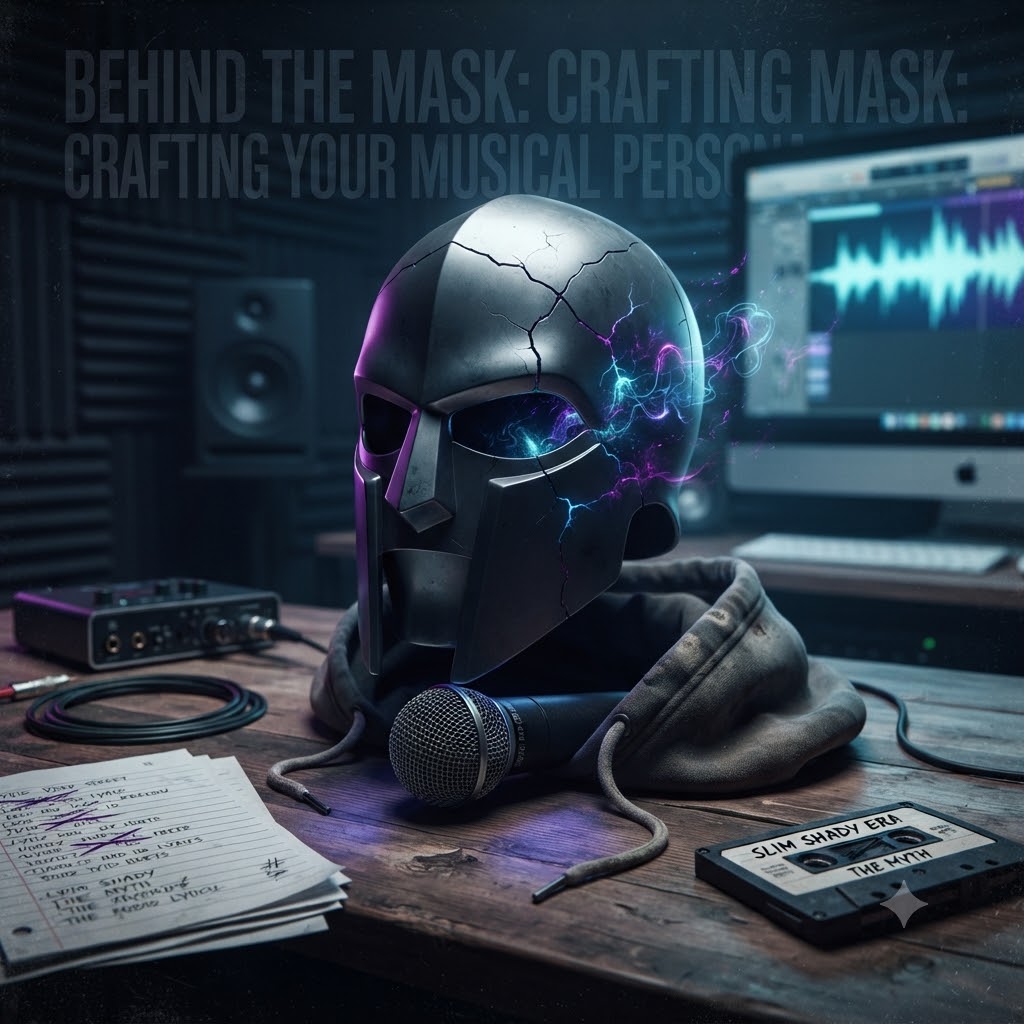
The Myth Behind the Mic: Why Your Music Needs a Persona
In hip-hop, the artist is often more than just a name on a track—they are an entire mythology.
Think about the way MF DOOM built a universe around his metal mask, or how Eminem used the unhinged energy of Slim Shady to push his boundaries. Even Kendrick Lamar plays with different versions of himself to tackle complex ideas. These aren’t just gimmicks. They’re deliberate creative choices that give the artist room to explore parts of their personality—the darker, the more intense, or the more imaginative parts—that might not fit a “normal” public profile.
For an indie artist trying to break through, developing an alter ego or a distinct persona isn’t just about being different. It’s a masterclass in PR. When you’re sending your music out to blogs and magazines, you’re not just asking them to listen to a song; you’re asking them to buy into a story.
If you want to grab the attention of a journalist who gets hundreds of emails a day, you need a story that actually makes them curious. Here is how to sharpen your narrative and make your pitch impossible to ignore.
1. Give Your Persona a Purpose (Beyond the Look)
A persona without a reason to exist is just a costume. When you sit down to write your bio or your pitch email, skip the generic marketing speak and get straight to the “why.”
-
Ask yourself: What does this character allow me to express that I can’t say as myself? Is this an outlet for your anger? A way to play with satire? A projection of who you want to become?
-
The Pitch: Don’t lead with, “I wear a mask because it looks cool.” Lead with, “I created [Name] to deconstruct the toxic parts of the industry by embodying the very cynicism I’m trying to fight against.” That’s a hook a writer can actually sink their teeth into.
2. Weave in Some Conflict
The best stories are never smooth sailing. A persona that’s just “the greatest rapper alive” or “the toughest guy in the room” is forgettable. Writers—and their readers—are drawn to tension and vulnerability.
When you’re telling your story, don’t be afraid to show the struggle. Is your character fighting against their own nature? Are they trying to survive in a world you’ve built? Think of how Kendrick’s personas often clash with their environment. Give the listener (and the writer) someone to root for.
3. Keep the Lore Consistent
If you’re telling a story, you have to commit to the bit. Journalists are looking for artists who have a clear vision. If your press release says you’re a gritty, street-level storyteller, but your social media and music videos don’t match that vibe, the disconnect will be obvious. Use your backstory as the compass for everything you do—from your lyricism to your visuals.
4. Give the Writer a Reason to Care
At the end of the day, music journalists are fans who got tired of waiting for other people to say what they wanted to say. They are looking for that “something else”—a fascinating concept or persona that makes an editor run to listen. Tell us your story through our submission form for an official write-up.
Is Your Music High-Concept?
You don’t need a pseudonym to be compelling, but you do need a narrative that hooks the listener from the first bar. If you’ve built a world, a character, or a sound that deserves a deeper look, stop hiding it.