Kid Cudi’s Visions in the Night Under “RAGER”: Why Smart Artists Use Alternate Profiles on Spotify
When Kid Cudi announced his December 2026 instrumental dance album, Visions in the Night—recorded during a whirlwind two-day creative burst in Paris—he didn’t just drop it onto his main Spotify page and hope for the best. Instead, he made a calculated business decision right alongside his artistic pivot. Cudi revealed the electronic project would arrive under a completely separate artist alias: RAGER, a direct nod to the iconic alter ego from his 2010 classic Man on the Moon II: The Legend of Mr. Rager.
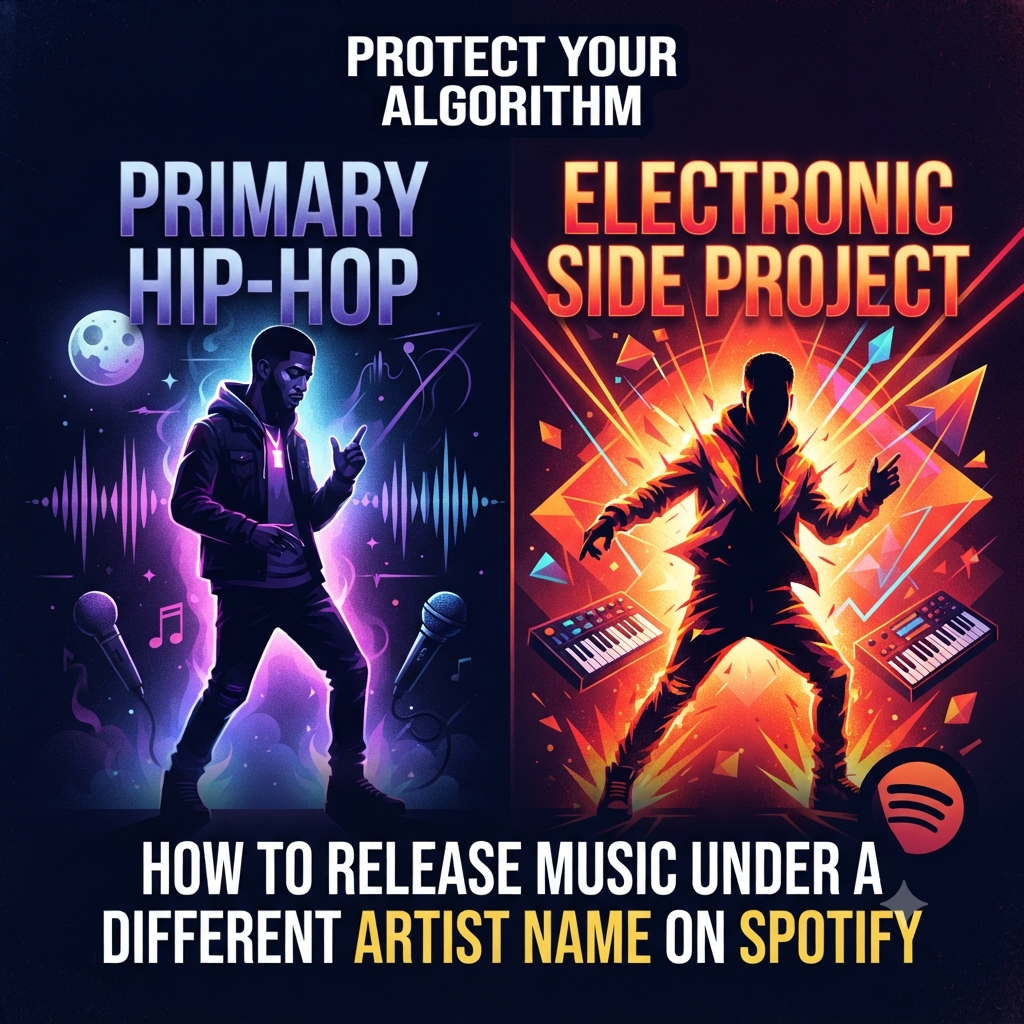
For independent rappers, beatmakers, and cross-genre artists, Cudi’s move is way more than clever branding or fan service. It is a blueprint for surviving modern streaming algorithms. If you have ever found yourself searching how to release music under a different artist name on Spotify, paying attention to why Cudi separated these two worlds is crucial before you upload an experimental EP, an ambient beat tape, or a sudden genre switch to your main profile.
The Hidden Danger of Dropping Genre Pivots on Your Main Profile
Every artist wants creative freedom. Maybe you spent all year dropping heavy trap singles, and now you want to put out a stripped-back acoustic project, a house remix pack, or an instrumental synth record. The instinct is to upload everything under your main name so your existing followers see it immediately. On paper, that sounds logical. In reality, it is one of the fastest ways to confuse Spotify’s recommendation engine.
Spotify’s automated playlists—especially Release Radar, Discover Weekly, and Artist Radio—run almost entirely on listener behavior and audio matching. Every single Friday, when a new track goes live, the algorithm tests the waters by pushing it to your core followers and recent listeners first. It watches closely to see what those people do in the first 24 to 72 hours.
When a hip-hop artist suddenly drops an instrumental dance record onto their primary page, a very predictable chain reaction happens:
First, your skip rates shoot through the roof. Your core rap fans open Release Radar expecting 808s, punchlines, and familiar vocal cadences. When a four-on-the-floor Parisian house beat starts playing with no verses in sight, most of them hit skip before the 20-second mark. To Spotify’s system, a rapid skip is a loud signal that the song isn’t resonating.
Second, your audience data gets muddied. Spotify maps out where your music belongs by tracking “Fans Also Like” connections and analyzing which tracks get saved to the same user playlists. If half your catalog is gritty street rap and the other half is ambient techno, the algorithm struggles to figure out who your actual listener is. Instead of placing you cleanly alongside similar hip-hop artists, your profile gets stuck in a sonic gray area where neither rap fans nor electronic fans get served your tracks consistently.
Third, that algorithmic drag carries over to your next major release. Streaming momentum is cumulative. When an experimental side project underperforms with your primary audience, it weakens the initial algorithmic push your next flagship rap single receives.
By isolating Visions in the Night under the RAGER moniker, Kid Cudi sidesteps that entire trap. Electronic and club listeners can discover the Paris sessions organically through dance playlists and genre-specific radio, while Cudi’s primary catalog stays completely insulated from skip-rate penalties. Even an artist with decades of legacy and millions of monthly listeners understands that protecting the data behind your main profile matters.
How to Release Music Under a Different Artist Name on Spotify
Setting up a secondary alias on Digital Service Providers (DSPs) is actually much simpler than most independent artists realize. In most cases, you do not even need to pay for a brand-new distributor subscription—you just need to manage your release metadata carefully so the platforms don’t accidentally link the two profiles together.
If you are ready to launch a side project without risking your main page, here is how to set it up properly:
Start by checking your distributor’s artist slot limits. Most major independent distributors—including DistroKid, TuneCore, CD Baby, and UnitedMasters—allow you to add extra artist names either within your existing plan or through a small multi-artist tier upgrade. Check your dashboard before uploading so you know how many primary artist slots your account supports.
Next, pick a distinct, unclaimed alias. Before you finalize your cover art or metadata, type your proposed side-project name into Spotify’s search bar. If five other artists are already using that exact name, your release could easily get mapped onto someone else’s page on launch day, creating a headache that takes weeks of support tickets to untangle. Choose something unique that fits the vibe of the side project.
When you go to upload the release, select the option to create a brand-new artist profile. Enter your new alias in the Primary Artist field. Your distributor will ask whether this name already exists on Spotify or if this is the artist’s first release. Always choose the option to generate a brand-new profile so Spotify assigns it a fresh Artist URI.
Just as importantly, do not cross-tag your main rap name as a primary or featured artist on the track. It can be tempting to list the song as “New Alias feat. Main Name” to borrow clout from your primary account, but doing that defeats the entire purpose. Adding your main profile as a primary or featured artist pushes the song straight onto your main Spotify page and triggers Release Radar for your core rap fanbase. Keep the alias completely standalone—if you want a subtle connection for die-hard fans, credit your main name or real name strictly in the behind-the-scenes producer or composer fields.
Finally, claim your new Spotify for Artists dashboard as soon as the release is ingested. Once your distributor delivers the audio and Spotify generates the new artist page, log into Spotify for Artists, request access to the new URI, and upload dedicated profile photos, a bio, and social links so the side project looks like a real, intentional brand from day one.
Let Your Main Catalog and Side Projects Grow in Their Own Lanes
Look at the broader history of hip-hop and electronic music, and you will see that separate aliases have always been a secret weapon for prolific creators. Madlib built an entire universe of alter egos like Quasimoto and Beat Konducta to house different sonic moods. MF DOOM separated Viktor Vaughn, King Geedorah, and his instrumental Special Herbs series so each project lived in its own world. Today, that same creative instinct simply happens to double as smart data hygiene for streaming platforms.
You don’t have to box yourself into one sound forever to build a sustainable career. Creating an alternate alias gives you total freedom to experiment—whether you want to drop late-night lo-fi beats, melodic R&B demos, or Paris-inspired dance records like Cudi—without second-guessing how your core fanbase will react.
At the same time, keeping your flagship profile focused ensures that every single stream, save, and playlist add reinforces your true lane as a hip-hop artist. As you experiment with secondary aliases, you can protect your primary profile’s algorithmic metrics while building momentum for new releases via our hip-hop music promotion (https://itshiphopmusic.com/submit/music-submission/) channels. Separating your sonic worlds lets both projects thrive in front of the listeners who actually want to hear them.
🚀 Protect Your Algorithm & Scale Your Streams: Put your main rap singles in front of dedicated hip-hop listeners. Submit your track through our Music Submission Portal (https://itshiphopmusic.com/submit/music-submission/).