Belly Gang Kushington’s GOOD DOPE SELL ITSELF: Using Regional Feature Stacking to Break Out
If you have been watching Atlanta’s street rap circuit lately, you already know Belly Gang Kushington is not playing around with his rollout strategy. Breaking out of a crowded local scene takes a lot more than just recording hard verses in the studio—you actually have to outsmart how streaming platforms categorize your music. If you want a real-world blueprint for how regional rappers use features to grow on Spotify, look closely at Kushington’s 12-track 2026 project, GOOD DOPE SELL ITSELF.
A lot of up-and-coming artists fall into the trap of buying a random feature from whoever has clout that month, slapping it on Track 1, and hoping for a miracle. Kushington did the exact opposite. Instead of chasing scattered hype, he used a deliberate tactic we call regional feature stacking. By pairing heavyweight hometown co-signs with a smooth R&B crossover record, his LVRN-backed project bridges totally different pockets of listeners and practically forces Spotify’s recommendation engine to push his solo catalog to new ears.
What Is Regional Feature Stacking, Anyway?
Regional feature stacking is pretty simple in theory, even if most artists mess up the execution. Instead of throwing random names onto a tracklist, you intentionally stack guests who share your geographic roots or sonic DNA, while adding just enough melodic crossover to pull in outside crowds. The goal isn’t just getting a one-week spike on a single song; it is surrounding your core sound with established artists whose fans are naturally going to rock with your solo records, too.
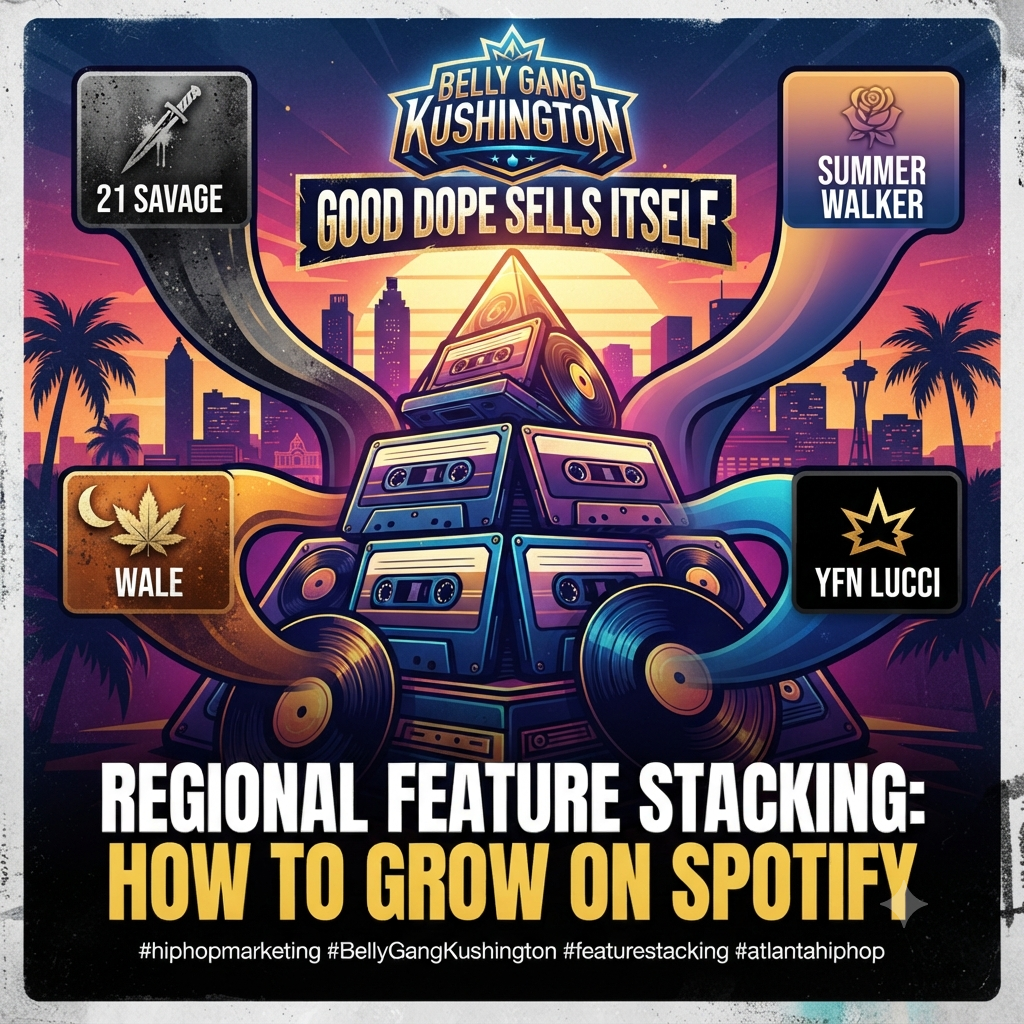
Across a tight, 33-minute run on GOOD DOPE SELL ITSELF, Belly Gang Kushington builds out the tracklist with surgical precision:
-
The Hometown Heavyweight: “WTF GOIN (feat. 21 Savage)”
-
The R&B and Melodic Crossover: “Bonnet (feat. Summer Walker & Wale)”
-
The Street Reinforcements: “Doctor Mama (feat. YKNIECE)” and “Show Me Sum (feat. YFN Lucci)”
-
The Solo Core: Eight solo cuts—including “Intro,” “Tellin Ya,” “Color Blind,” and “Cocaine Gospel”—woven right between the guest appearances.
Inside the Math: How Spotify’s Algorithm Reads Feature Clusters
To understand why this tracklist works so well, you have to think about what happens behind the scenes on Spotify. Streaming algorithms aren’t listening to your bars with human ears; they are tracking listener behavior through a process called collaborative filtering. Basically, Spotify watches what people do. If thousands of die-hard fans of Artist A click on your song, play it all the way through, save it to their library, and let the next track play, Spotify connects your two profiles. Once that bridge is built, your music starts showing up in Discover Weekly, Release Radar, and Radio autoplay queues.
When an independent rapper drops a tape with four features that sound completely unrelated—say, a Detroit punchline rapper, a melodic Latin pop singer, a UK drill artist, and a local trapper—Spotify’s system gets confused. It doesn’t know who to recommend your music to, so your reach stalls out. Kushington sidesteps that problem completely by pulling two very specific algorithmic levers.
1. Locking In the Core Audience with Hometown Co-Signs
Slotting 21 Savage onto Track 4 (“WTF GOIN”) and YFN Lucci onto Track 10 (“Show Me Sum”) immediately tells Spotify’s data models exactly where Belly Gang Kushington sits in the Atlanta ecosystem.
21 Savage brings massive global reach that is still undeniably rooted in Zone 6 grit, while YFN Lucci taps into a fiercely loyal Southern fanbase that loves emotional, street-certified records. Throw in rising hometown voice YKNIECE on “Doctor Mama,” and Kushington has his local foundation completely locked down. Because those three collaborations match the raw energy and tempo of solo tracks like “OK” and “No Jewelry,” anyone who finds the album through a 21 Savage or YFN Lucci Release Radar notification isn’t going to experience musical whiplash. They are far more likely to let the album ride, which drives up completion rates and tells Spotify the music is sticky.
2. Expanding the Ceiling with a Melodic R&B Hook
Here is the catch, though: stacking street features will solidify your base, but it can also box you in. To break into bigger monthly listener tiers, you need a bridge to a wider demographic. That is where Track 6, “Bonnet (feat. Summer Walker & Wale),” does the heavy lifting.
Bringing in an R&B giant like Summer Walker alongside a smooth, lyrical veteran like Wale opens the door to two massive listener groups that might never click on a pure street record:
-
Late-night R&B and mood playlist listeners who follow Summer Walker’s every move.
-
Mid-tempo, lyrical hip-hop fans who still spin Wale’s catalog daily.
What makes “Bonnet” feel authentic instead of like a forced label mashup is that Summer Walker is also from Atlanta and shares the LVRN camp connection. Her hook acts as an easy, low-friction entry point. Once those R&B and crossover fans land on Kushington’s profile for “Bonnet,” Spotify naturally starts serving them adjacent solo tracks like “Answer” and “Color Blind.”
Tracklist Pacing: Why You Never Front-Load Your Features
One of the biggest rookie mistakes in hip-hop is putting every single big feature in the first three tracks of an album. Think about how people actually listen to music on their phones. If a casual listener clicks on your project because they saw a big name on Track 1, Track 2, and Track 3, and then Track 4 is a solo song they aren’t expecting, a huge percentage of them are going to hit skip or click off the album entirely. High skip rates tell Spotify’s algorithm that listeners are losing interest, which kills your momentum fast.
Belly Gang Kushington spaces his guest spots evenly across the 12 songs, placing them at Tracks 4, 6, 8, and 10. Every single feature works like a checkpoint that keeps listeners engaged through the middle and back half of the tape. Someone who tunes in for 21 Savage on Track 4 naturally rolls right into the solo cut “Answer” on Track 5 before hitting Summer Walker and Wale on Track 6. By the time they reach solo standouts like “Color Blind,” they are already locked into the vibe of the project. That pacing is a huge reason why his solo tracks are holding their own in daily stream counts right alongside the collaborations.
How Independent Rappers Can Steal This Blueprint
You obviously don’t need a major-label budget or 21 Savage’s phone number to run this exact play on your next EP or mixtape. Independent regional artists can scale this framework down to their own city and budget right now:
| Strategy Layer | How Belly Gang Kushington Did It | How You Can Do It Independently |
| The Local Anchor | 21 Savage (“WTF GOIN”) | Team up with the most respected, active rapper in your immediate city or region whose fans actually show up to shows and stream consistently. |
| The Melodic Bridge | Summer Walker & Wale (“Bonnet”) | Find a local R&B singer or melodic hook artist who gets heavy love on chill, late-night, or relationship playlists in your market. |
| The Scene Builders | YFN Lucci & YKNIECE | Grab 1 or 2 hungry peers in your exact subgenre so your Release Radar feeds cross-pollinate on release Friday. |
| Smart Sequencing | Features placed at Tracks 4, 6, 8, and 10 | Never put two features back-to-back. Always sandwich your strongest solo records right after a big guest verse. |
Getting the right features on your hard drive is only half the battle, though. Once release day hits and those collaborations start bringing fresh eyes to your Spotify profile, you have to keep that traffic moving so the algorithm doesn’t cool off after week one. Independent artists can capitalize on guest-feature momentum and keep new listeners looping your solo tracks via our subgenre-specific hip-hop playlisting channels, reinforcing the exact listener-overlap signals Spotify looks for when deciding which artists to push next.