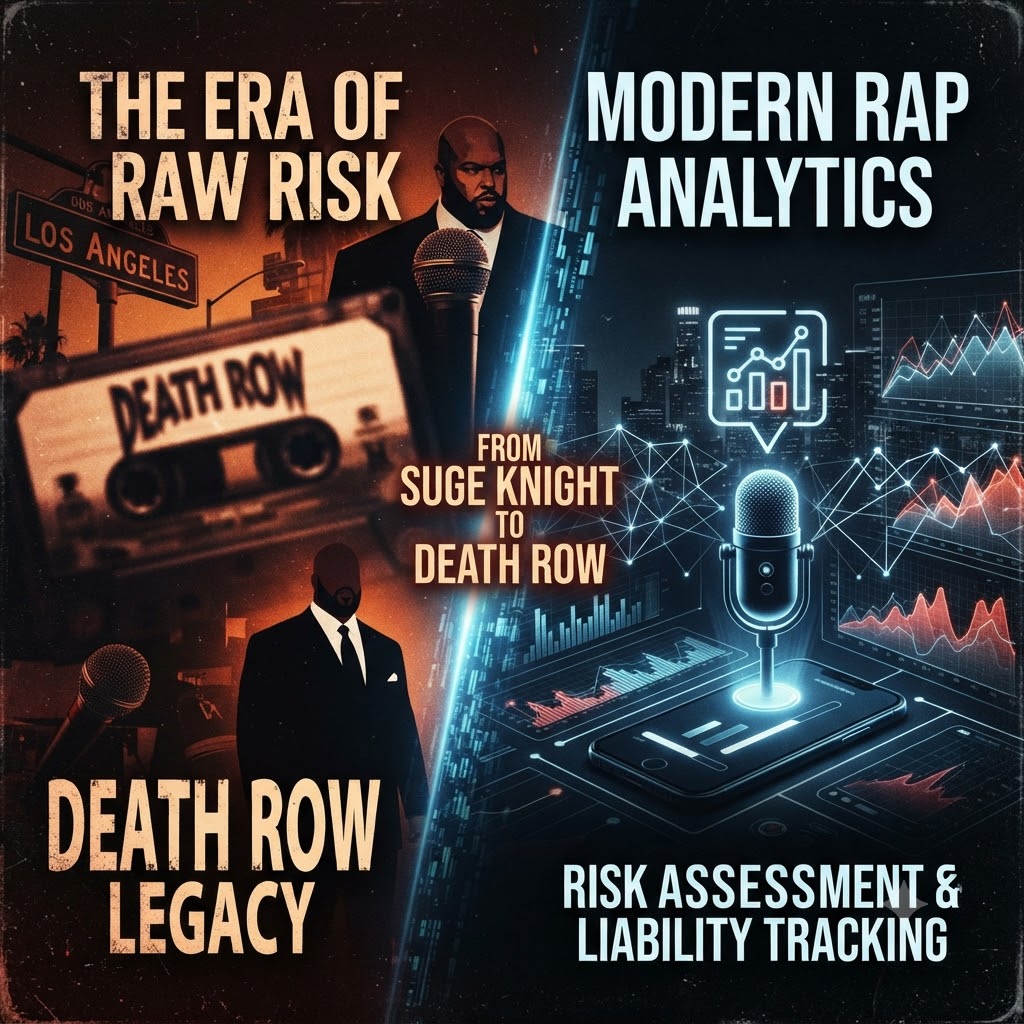
From Suge Knight and Death Row Records to modern federal indictments, hip-hop has always danced on a razor’s edge between raw street authenticity and rigid corporate boardrooms. Decades ago, the gangsta rap era operated on a wild-west ethos where real-world street dynamics bled straight onto wax.
When you look back at the monumental legal battles and civil liabilities that followed the peak of the 90s West Coast movement, you aren’t just reading history books. You’re looking at the exact blueprint for modern street rap analytics.
Today, major labels, boutique distributors, and legal teams don’t just analyze streaming numbers, playlist adds, and TikTok viral moments. They run deep data models on risk assessment, liability tracking, and street affiliation analytics.
The Death Row Blueprint: How Legal Precedents Changed Label Risk
Back in the golden era, powerhouse labels like Death Row blurred the lines between executive oversight, neighborhood politics, and corporate infrastructure. The fallout from that era—marked by high-profile criminal cases, civil lawsuits, and the ultimate downfall of figures like Suge Knight—sent massive shockwaves through the entire music industry.
Corporate boardrooms woke up to a terrifying liability: A record label could be held legally and financially responsible for the off-record behavior and street entanglements of its roster.
That realization forced the industry to completely overhaul how talent is scouted, signed, and managed. The days of funding reckless, lifestyle-driven chaos quietly died out, replaced by corporate risk-mitigation strategies. Fast forward to the streaming era, and those exact legal lessons have evolved into sophisticated algorithms and data-driven risk models.
How Modern Labels Use Street Analytics and Risk Modeling
If you peek behind the curtain of modern A&R divisions, today’s analytics go far beyond tracking monthly listeners. Labels use specialized intelligence tools to map out an artist’s full ecosystem before writing a check:
-
Affiliation Mapping: Social graph data and public records are routinely analyzed to map an artist’s immediate circle, neighborhood ties, and exposure to systemic liabilities.
-
Content and Lyrical Auditing: Natural language processing tools scan lyrics, old interviews, and social media commentary to flag potential self-incrimination or content that could trigger RICO-adjacent investigations.
-
Tightened Indemnification: Modern recording contracts feature ruthless moral turpitude and liability-shifting clauses born directly out of 90s and 2000s rap litigations. If an artist brings severe legal exposure, the label’s legal armor protects them first.
For independent artists, this corporate tightening creates a massive bottleneck. If you want to transition from the underground grind to a legitimate corporate partnership, you can’t just drop hot tracks—you need a commercially viable, legally clean enterprise. Making sure your independent brand operates with clean commercial authority is easier when you work directly through our artist submission portal.
Navigating the Paradox: Street Narrative vs. Corporate Viability
The great irony of modern rap is that fans still demand authentic street stories, yet corporate structures demand sterile, risk-free compliance. Walking that tightrope requires independent artists to move like sharp business executives rather than just raw talents.
To survive and scale in today’s ecosystem, independent rappers need a shift in perspective:
-
Separate Personal Brand from Street Liability: Keep your business entities clean, separate, and professionally managed away from the chaos.
-
Understand Publishing Infrastructure: Protect your masters and your publishing while making sure your promotional channels don’t trigger red flags from major distributors.
-
Partner with Professional Networks: Aligning yourself with established curators and transparent industry submission platforms helps validate your brand’s legitimacy to major gatekeepers.
The complex legal history of street rap taught the music business some brutal lessons. Today, those lessons dictate everything from contract clauses to algorithmic risk scores. By understanding how these legal precedents shape modern analytics, independent artists can position themselves not just as cultural disruptors, but as bulletproof business entities ready for global scale.