FL Studio vs. Logic Pro vs. Ableton Live: Which DAW Actually Wins for Rap Beats in 2027?
If you spend five minutes on music production Reddit or YouTube, you’ll see people arguing to the death over which Digital Audio Workstation (DAW) is the best. Here is the truth that nobody tells beginners: none of them sound better than the others.
A kick drum exported out of FL Studio has the exact same digital audio fidelity as the same kick exported out of Ableton or Logic. You can make a Billboard-charting rap beat in any of them—and plenty of platinum producers do.
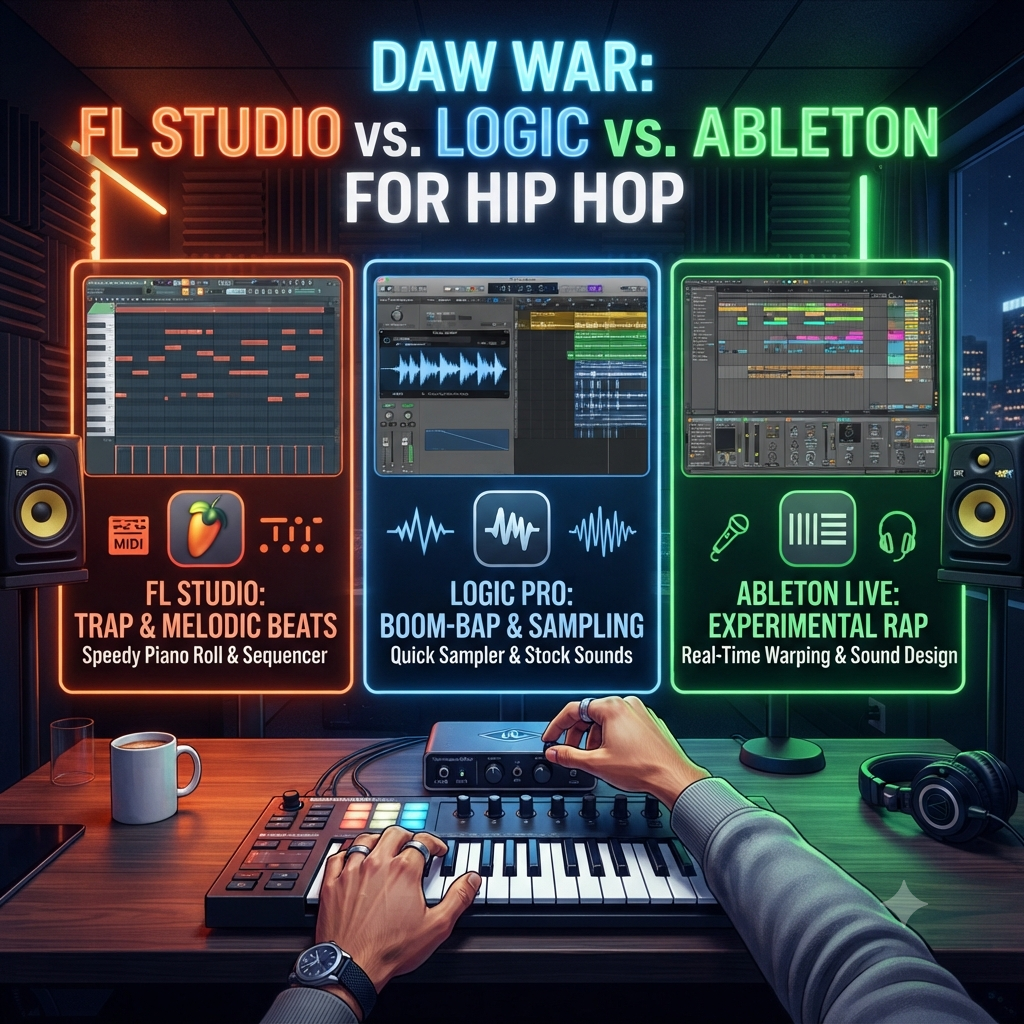
When you are comparing FL Studio vs Logic Pro vs Ableton for hip hop in 2027, what you are actually comparing is speed and muscle memory. How fast can you get the melody stuck in your head out into your speakers before you lose the vibe? How annoying is it to chop a sample, slide an 808, or track a rapper in your bedroom?
If you are trying to pick your home base as an aspiring producer, skip the fanboy debates. Here is an honest, producer-to-producer breakdown of what it actually feels like to make beats in these three programs.
The Quick Cheat Sheet
| What Matters Most | FL Studio | Logic Pro | Ableton Live |
| Sweet Spot Subgenre | Trap, Drill, Melodic Rap | Boom-Bap, Soulful/Sampled Rap | Experimental, Alternative, Glitch |
| Secret Weapon | The Piano Roll & Step Sequencer | Quick Sampler & Massive Stock Library | Real-Time Audio Warping |
| Computer Needed | Windows or Mac | Mac Only | Windows or Mac |
| Damage to Your Wallet | $99–$499 (Free updates for life) | $199.99 flat | $99–$749 (Paid major upgrades) |
| Beginner Frustration | Low at first, messy later | Very low | High at first, fast once it clicks |
1. FL Studio: The Undisputed King of Trap & Drum Programming
There is a reason almost every modern trap and drill producer—from Metro Boomin and Southside to Wheezy and Nick Mira—lives in FL Studio. Image-Line didn’t just build a DAW; they accidentally built the rhythmic blueprint for modern rap.
Why It’s So Good for Rap Beats
-
The Piano Roll is Untouchable: Ask any producer who switched away from FL Studio what they miss most, and 99% of them will say the Piano Roll. Writing rapid 1/32 or 1/64 hi-hat rolls, drawing smooth velocity ramps, strumming dark piano chords, and setting up gliding 808 slides takes literal seconds. Tools like the Chopper, Strumizer, and slide notes feel like they were invented specifically for hip-hop.
-
The Step Sequencer: FL’s Channel Rack lets you click in a bounce almost immediately. You don’t have to set up tracks, arm inputs, or overthink routing. You open it up, drop a clap on the 3, click in a bouncy kick pattern, and you’re already nodding your head.
-
Lifetime Free Updates: If you are making beats on a budget, this is huge. You pay once, and you never pay for an upgrade again. People who bought FL Studio 10 over a decade ago are using the newest 2027 version for free.
The Catch
Because FL Studio lets you paint patterns anywhere on the Playlist without strict track rules, your sessions can turn into an absolute nightmare if you aren’t disciplined. One minute you’re cooking, and twenty minutes later you have “Pattern 14” buried under an automation clip with no idea where your snare went. Also, if you plan on recording full rap vocals with dozens of punch-ins and vocal comps, FL’s recording workflow still feels a bit clunky compared to Logic.
2. Logic Pro: The Boom-Bap & Value Powerhouse
If you own a Mac and your taste leans toward soulful, gritty, sample-heavy production—think J Dilla, Madlib, Kanye, or Conductor Williams—Logic Pro is easily the best bargain in music production.
Why It’s So Good for Rap Beats
-
Quick Sampler Feels Like Hardware: Dragging an old soul record into Logic’s Quick Sampler and clicking “Slice” automatically chops the audio across your MIDI keyboard or drum pads by transients or beat divisions. Pair that with Drum Machine Designer, and flipping samples feels remarkably close to sitting in front of a classic Akai MPC.
-
Insane Stock Sounds: You do not need to pirate or spend thousands on third-party plugins when you buy Logic. For $199, Apple gives you over 70GB of killer instruments, vintage-modeled EQs, dirty compressors, Phat FX, and Step FX. You can make warm, dusty boom-bap right out of the box on day one.
-
Built for Recording Artists: Logic runs on a traditional left-to-right timeline. If you are a producer-rapper, or you have artists coming over to your house to lay down verses, Logic’s take folders and vocal comping tools make recording and mixing a full song effortless.
The Catch
First, the obvious: if you use Windows, Logic isn’t an option. Second, while Logic’s MIDI editor is totally fine, programming intricate trap hi-hat rolls and sliding 808s takes noticeably more mouse clicks and menu diving than it does in FL Studio. It’s built more like a traditional recording studio than a beat-making toy box.
3. Ableton Live: The Laboratory for Experimental Rap
Over the last few years, Ableton Live has quietly taken over the underground and experimental rap scene. Producers like Kenny Beats, BNYX, JPEGMAFIA, and countless left-field sound designers swear by it because it encourages you to break rules.
Why It’s So Good for Rap Beats
-
Audio Warping Like Magic: Ableton treats audio files like clay. Its real-time warping engine lets you stretch, pitch, and twist samples to extreme lengths while keeping them locked to your tempo. Modes like Complex Pro keep vocals sounding clean when pitched down, while Beats and Texture let you turn a basic guitar loop into a rhythmic, glitchy percussion bed.
-
Happy Accidents in Session View: Ableton gives you two ways to work. Besides the standard timeline, Session View acts like a giant clip launcher where you can mix and match different drum loops and melodies on the fly. You can jam out ideas in real time, hit record, and capture spontaneous arrangements you never would have planned on a grid.
-
Resampling & Drum Racks: Ableton’s Drum Rack lets you drop separate effects chains onto individual drum hits inside a single kit. Want heavy distortion on just your open hi-hat and reverb only on every second snare? Easy. Plus, freezing and flattening tracks to resample your own melodies takes one click.
The Catch
Ableton Live Suite is expensive, and you have to pay whenever a major new version drops. Its interface also looks like a spreadsheet at first—gray, flat, and devoid of flashy graphics. It can feel cold and intimidating during your first week, and you won’t get the instant gratification of FL’s Piano Roll shortcuts right out of the gate.
So, Which One Should You Actually Download?
Stop overthinking it and match the software to how you actually want to make music:
-
Get FL Studio if you want to make hard-hitting trap, drill, or melodic beats as fast as possible, love clicking in MIDI patterns, or work on a Windows PC.
-
Get Logic Pro if you have a Mac, love chopping vinyl and soul samples for boom-bap, want incredible stock plugins without spending extra money, or plan on recording vocals.
-
Get Ableton Live if you want to push boundaries, mangle audio, build weird textures, or eventually perform your beats live on stage.
Download the free trials for all three, spend a weekend trying to make one simple 8-bar loop in each, and stick with whichever one feels the least annoying to use.
Of course, locking in your DAW workflow is just the starting line. Once your hard drive is stacked with records you are proud of, you can turn your DAW productions into polished, commercial releases with our artist packaging packages so your music actually gets heard outside of your bedroom.
Ready to Take Your Music Seriously?
Package your brand like an established industry artist. Apply for promotion via the Artist Submission Feature.