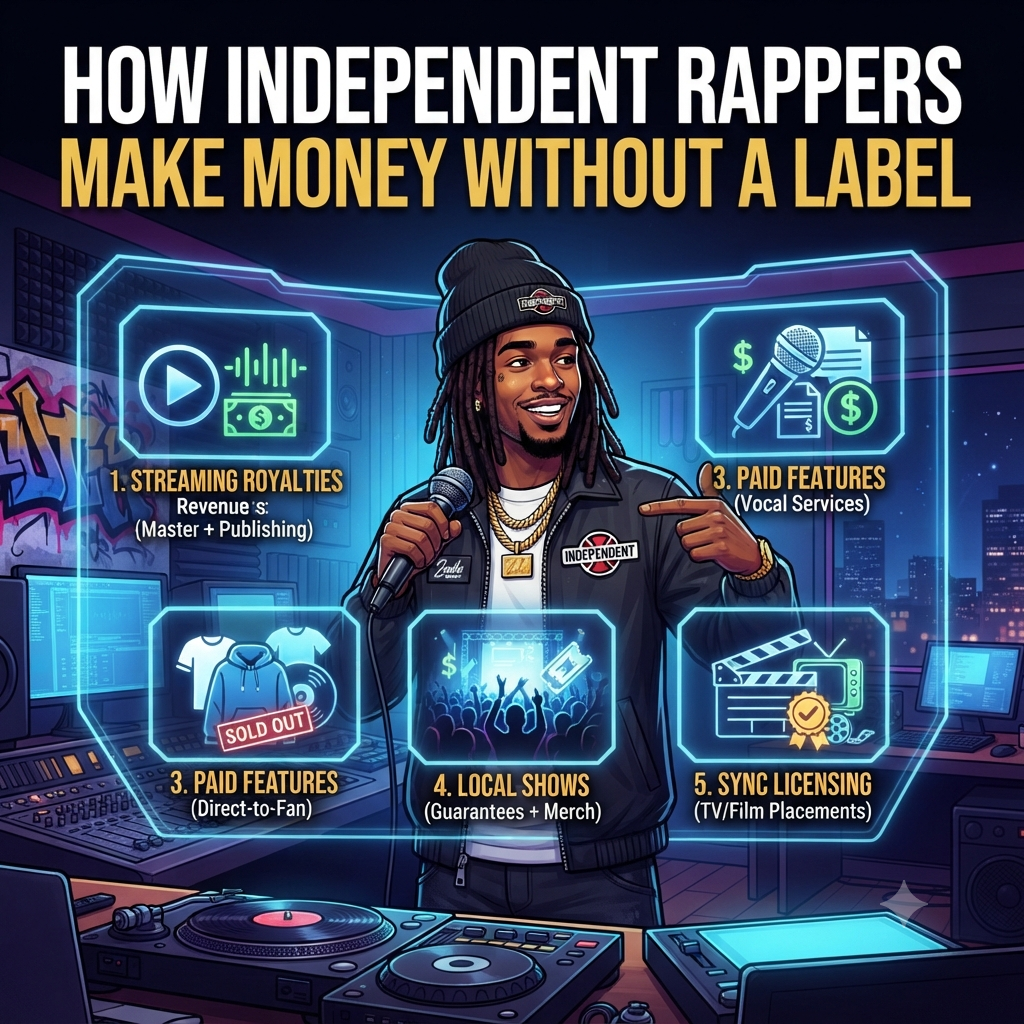
How to Make Money as an Independent Rapper Without a Record Label (5 Income Streams)
If you have been trying to figure out how independent rappers make money without a label, you have probably noticed that most advice online sounds either painfully outdated or completely disconnected from how the music business actually works right now. Everybody tells you to “just drop consistently” or “go viral on TikTok,” nobody shows you the actual accounting behind how unsigned artists pay their rent without signing away 85% of their masters to a major.
Here is the truth: you do not need millions of monthly listeners to make a living in hip-hop. What you actually need is to stop treating your music like a lottery ticket and start running it like a small business with multiple cash registers. When you own 100% of your rights, you do not need massive volume to see real money—you just need to make sure you are actually collecting from every lane your music touches.
Below is the real-world financial breakdown of the five income streams keeping independent MCs profitable right now.
1. Master and Publishing Streaming Royalties (Collecting Both Checks)
Most independent rappers leave a ridiculous amount of money sitting in unclaimed royalty pools because they think uploading a song to DistroKid or TuneCore covers everything. It does not. Every time somebody hits play on your track, two separate copyrights generate money, and your distributor only pays you for one of them.
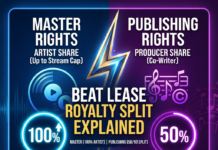
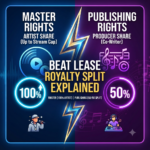
The first check is your master recording royalty. That is the money paid to whoever owns the actual audio file. When you stay independent and keep 100% of your masters, Spotify pays roughly $3,000 to $4,000 per million streams, while Apple Music and Tidal usually pay noticeably more per play. You should also set up a free account with SoundExchange—they collect digital performance royalties from non-interactive radio like Pandora and SiriusXM that standard distributors never touch.
The second check is your publishing royalty, which belongs to the songwriters and publishers who wrote the lyrics and composed the beat. If you wrote your verses—and especially if you produced the beat or bought exclusive rights—you are owed both performance royalties and mechanical royalties. To get them, you need to register your songs with a Performing Rights Organization like ASCAP or BMI, and sign up with The Mechanical Licensing Collective (The MLC) so you actually get paid when your songs stream on-demand.
The bottom-line math: Registering your publishing does not require a single extra stream, yet it routinely adds 15% to 25% onto what you are already making from your distributor.
2. Direct-to-Fan Merch Capsules
Streaming is great for discovery, and it is terrible for fast cash flow. If you want to put real money in your bank account this month, physical and direct-to-fan merch is still undefeated. The mistake most rappers make is printing 200 generic t-shirts with their logo slapped on the chest, letting them sit in their closet for two years, and calling merch “dead.”
The artists making serious money right now do limited-edition capsule drops instead of running an always-open store.
Here is how that plays out financially. Say you are dropping a new EP or a big music video. You design one heavyweight custom hoodie or vintage-wash tee tied specifically to the aesthetic of that project, and you open a strict 10-day pre-order window. Because it is a pre-order, you do not spend a dime on inventory upfront—your fans literally fund the manufacturing before you place the order with your printer.
Look at the margins on a setup like that:
-
Production + shipping cost per hoodie: ~$20
-
Retail price to fans: $70
-
Net profit per unit: $50
You do not need a stadium fanbase to make that work. If just 120 core supporters buy that hoodie during your 10-day window, you walk away with $6,000 in net profit. To make $6,000 strictly from Spotify streams, that same song would need roughly 1.5 to 2 million plays. Add a digital deluxe version of the EP or an autographed lyric sheet into a bundle, and your average order value climbs even higher.
3. Paid Feature Verses
Once you have built a recognizable sound, a solid catalog, and real engagement in your city or niche, your voice becomes a service other artists are willing to pay for. Up-and-coming rappers and producers constantly look for credible features to help their records travel further—and if you treat features like a structured B2B service instead of casual favors, they turn into reliable monthly income.
Instead of guessing what to charge every time somebody DMs you, set clear tiers based on what they are asking you to do:
-
16-bar verse (audio only): $150 – $500+
-
Verse + hook: $300 – $1,000+
-
Verse + music video cameo and social rollout: $500 – $2,500+
Two rules keep this lane profitable and headache-free. First, always take 50% upfront before you write a word, and collect the remaining 50% after you send a low-res reference snippet—never send dry, unmixed vocal stems until the invoice is paid in full. Second, decide upfront whether the fee is a clean work-for-hire buyout or if you are keeping 15% to 25% of the publishing split on the record.
4. Local Show Guarantees and Door Splits
Early in your career, you are probably going to do a few free showcases just to sharpen your stage presence and network. After that phase, though, paying a promoter $200 to perform for five minutes in an empty club on a Tuesday is a dead end. Real live-show income starts when you focus on guarantees and door splits in markets where you can actually put bodies in the room.
Once you know you can reliably bring 50 to 150 paying fans out to a local venue, you have real leverage. Reach out directly to local talent buyers and independent promoters and pitch a flat guarantee ($300 to $1,500 depending on venue size and ticket price) or a door split where you take 70% to 80% of ticket sales once the venue covers its basic room cost.
Even better, treat the show guarantee as your base pay and your merch table as your real profit margin. People who just watched you tear down a stage are ten times more likely to buy a $40 shirt or a $20 physical CD/vinyl on the spot than someone scrolling past your link on Instagram. A rapper making $500 for the set can easily clear another $500 to $800 at the merch booth before the venue closes. And do not forget to log your setlists inside your ASCAP or BMI portal afterward—they pay performance royalties for live gigs too.
5. Sync Licensing Placements
If you want to know how independent rappers make money without a label at the highest level, look at sync licensing. Every time a song plays in a Netflix series, a Madden soundtrack, an indie film, or a car commercial, the people who own that track get paid an upfront licensing fee—plus backend performance royalties every time the episode or ad airs.
This is actually the one area where being unsigned gives you a massive advantage over major-label artists. Music supervisors work on brutal deadlines. If they want to use a major-label song, they have to clear it through a label executive, a publishing administrator, and sometimes three different co-writers. If you own 100% of your master and 100% of your publishing, you can offer “one-stop” clearance—meaning one email and one signature clears the entire song immediately.
Depending on the budget of the project, indie sync payouts generally fall into these brackets:
-
Social media / branded creator campaigns: $50 – $1,500
-
Indie films and indie video games: $500 – $5,000
-
Cable and streaming TV placements: $3,000 – $50,000
-
National commercials and major video game titles: $10,000 – $250,000+
To make your catalog sync-ready, avoid uncleared samples on tracks you plan to pitch, get signed split sheets from your producers that explicitly give you sync clearance rights, and always save clean (radio edit) and instrumental bounces alongside your main mix. Supervisors will pass on a great song in five seconds if you cannot send them an instrumental by the end of the day.
Side-by-Side Breakdown: Where to Focus First
| Revenue Stream | Setup Difficulty | Income Potential | What Makes It Work |
| Streaming (Master + Pub) | Low–Medium | ~$3,500–$4,500 per 1M streams | Registering with PRO + The MLC + SoundExchange |
| Merch Capsules | Medium | $1,500 – $10,000+ per drop | Short 7–14 day pre-orders tied to new music |
| Paid Features | Low | $150 – $2,500+ per track | Clear tier pricing and 50% upfront deposits |
| Local Show Guarantees | High | $300 – $1,500+ per night + merch | Proven local ticket draw + high-margin merch table |
| Sync Licensing | Medium | $500 – $50,000+ per placement | 100% one-stop ownership + clean & instrumental stems |
Putting All Five Lanes Together
None of these five streams have to carry your entire career by themselves. A realistic month for a disciplined independent rapper might look like $800 coming in from catalog streaming and publishing, two paid features bringing in $700, one local headlining show clearing $900 between the guarantee and merch, and a quarterly merch drop adding another $4,000. None of those numbers require a major-label co-sign—they just require owning your paperwork and putting your music in front of the right ears consistently.
When you pair full ownership of your masters and publishing with consistent media visibility and playlist momentum, you give every single one of these income streams fuel to grow—allowing you to build a profitable, sovereign music career supported by our elite artist submission services.
Take Control of Your Independent Rollout
Commit to the long-term growth of your music career today. Secure your brand’s future through our Artist Submission Services.