How to Split Royalties with a Producer When You Buy a Beat Lease
Figuring out the royalty split when buying a beat lease is one of those boring business details most rappers ignore—right up until a track starts catching real momentum and payouts suddenly freeze. When you drop $40 or $80 on a beat from BeatStars or Airbit, it feels like a clean transaction. You paid the producer, you got the WAV file, you recorded your verse, and now the song is yours.
Except it’s not quite that simple. A non-exclusive beat lease doesn’t actually sell you the beat; it sells you permission to release a song using that beat under very specific rules. And because music copyright splits every song into two completely separate buckets of money, paying upfront doesn’t mean the producer disappears from the backend.
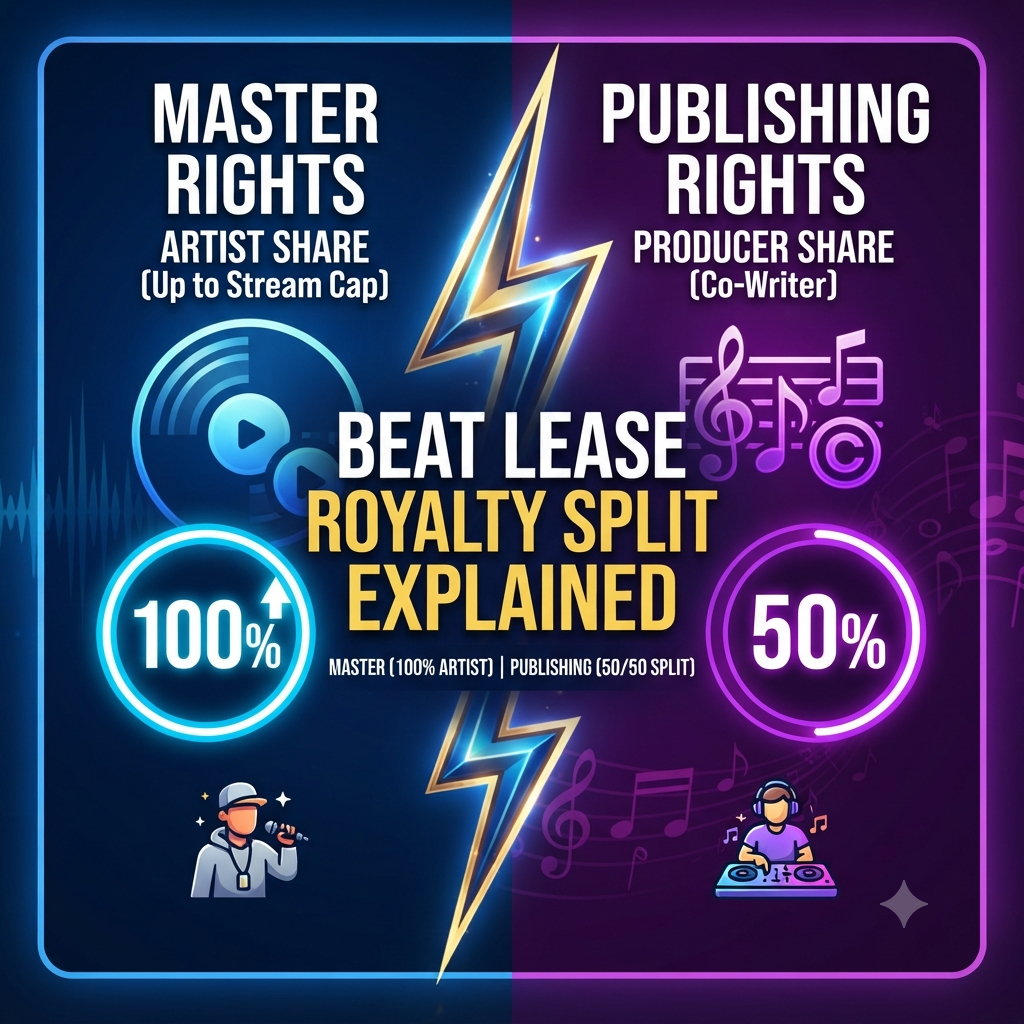
Under almost every standard beat lease agreement in hip-hop today, the rapper keeps 100% of the master streaming royalties (up to a set stream cap), while the producer still owns 50% of the songwriting and publishing split. Here is what that actually means when checks start clearing, why the split is structured that way, and how both sides can avoid messy disputes after upload day.
Master Rights vs. Publishing: Why One Song Has Two Paychecks
To make sense of a beat lease contract, you have to separate the recording from the song itself. In the music business, every track you upload to Spotify or Apple Music generates two different copyrights at the exact same time.
1. The Master Recording (Sound Recording Copyright) This is the actual finished audio file—your vocals mixed over the instrumental. Whenever someone hits play on Spotify, Apple Music, Tidal, or YouTube Music, that stream generates master royalties. Your distributor (DistroKid, TuneCore, UnitedMasters, CD Baby, etc.) collects this money and sends it straight to your account.
2. The Composition (Publishing & Songwriting Copyright) This covers the underlying musical DNA of the track: the beat’s melody, chord progression, drum bounce, and the lyrics and vocal cadence you wrote over top. Performance Rights Organizations (PROs) like ASCAP, BMI, SESAC, or PRS collect performance royalties here, while mechanical agencies like The MLC collect mechanical streaming royalties.
Even when you buy a beat online without ever speaking to the producer, copyright law treats the two of you as co-writers of that composition. You wrote the words; they wrote the music. Neither piece exists as a finished song without the other, which is why the publishing side automatically divides down the middle.
How the Standard Beat Lease Split Works in Practice
If you open up the PDF contract attached to a standard non-exclusive lease from any major producer marketplace, the financial breakdown almost always looks like this:
| Income Stream / Legal Right | Recording Artist Share | Beatmaker / Producer Share | Who Collects & Pays It Out |
| Master Streaming & Sales | 100% (up to stream cap) | 0% (covered by lease fee) | Digital Distributor (DistroKid, TuneCore, etc.) |
| Writer’s Share (Publishing) | 50% | 50% | PRO (ASCAP, BMI, SESAC, PRS) |
| Publisher’s Share (Publishing) | 50% | 50% | Publishing Admin (Songtrust, etc.) or PRO |
| Sync Licensing (TV, Film, Games) | 50% (requires approval) | 50% (requires approval) | Direct sync licensing contract |
Why Rappers Keep 100% of Master Royalties
From a beatmaker’s perspective, a non-exclusive lease is built for volume. Since the producer can license that exact same instrumental to fifty other independent artists, they aren’t relying on backend distributor points from every single buyer. Instead, they take guaranteed cash upfront ($30 to $150 depending on the file tier) and let the artist keep 100% of the master streaming revenue. That gives the rapper breathing room to earn back studio time, engineering fees, and marketing costs without splitting every fraction of a cent inside DistroKid.
Why Beatmakers Keep 50% of Publishing
Flip the coin to the publishing side, and the logic reverses. When you buy a lease, you aren’t buying the copyright to the instrumental—you are licensing the right to use it. If your song takes off on TikTok, gets spun on local radio, or lands on a major editorial playlist, the composition is generating real publishing money. Retaining 50% of the songwriting and publishing split ensures the beatmaker gets paid fairly for writing the music that carried the record, without dipping into the artist’s master royalty pot.
The Catch: Stream Caps and Tier Limits
That “100% of master royalties” rule isn’t permanent. Every non-exclusive beat lease comes with a ceiling—usually measured in audio streams, video views, or physical units sold.
Producers price their tiers around how far you plan to push the record:
-
MP3 Lease ($25–$40): Usually caps out between 50,000 and 100,000 audio streams. Often leaves out trackout stems, making proper vocal mixing tough.
-
WAV Lease ($40–$80): Typically gives you 250,000 to 500,000 audio streams and cleaner audio quality for streaming platforms.
-
Trackout / Stems Lease ($80–$150+): Usually bumps your limit to 500,000 or 1,000,000+ streams and gives your engineer individual drum and melody stems.
Once your single crosses that stream cap, your lease expires. You can’t just keep collecting 100% of the master revenue on an expired contract. At that point, you have to reach back out to the producer to renew the lease, upgrade to an unlimited tier, or negotiate an exclusive buyout. And if the track is already pulling serious numbers, an exclusive buyout will usually introduce a negotiated master royalty split—often anywhere from 15% to 50% going to the producer—on all future streams.