How to Write a Rap Artist Bio for Spotify and Apple Music (With Copy-and-Paste Templates)
Someone clicks on your profile after hearing twenty seconds of a new track. You have maybe five seconds—ten if the beat is crazy—before they decide whether to hit follow or bounce back to their queue. A strong bio doesn’t do the heavy lifting alone, yet a sloppy or generic one kills momentum fast. Using a solid rap artist bio template for Spotify and Apple Music gives you a clean starting point so you sound sharp, intentional, and ready for real listeners, playlist curators, and A&Rs.
Why Your Streaming Bio Actually Matters
Plenty of rappers treat the “About” box on Spotify like an afterthought. They paste a quick paragraph from three years ago or leave it blank until a distributor nags them. That is a missed spot.
On Spotify for Artists, you get up to 1,500 characters to frame who you are. Apple Music for Artists takes a slightly more editorial route, pairing your write-up with details like hometown, influences, and release context. Both spaces serve real functions:
-
Curators check receipts: Independent playlist curators and editorial teams look at bios to see if an artist is active, focused, and building real traction rather than throwing darts at the wall.
-
Writers and supervisors pull from it: Bloggers, radio hosts, and music supervisors often grab quick context straight from DSP profiles when prepping coverage or pitches.
-
Strangers turn into regulars: A clear story helps a first-time listener connect your voice to a real person and a real catalog, not just one random song in a playlist.
How to Write a Bio That Sounds Like a Real Person
Most bad artist bios fail for the exact same reasons. They lean on stiff phrasing, empty adjectives, or recycled lines that could belong to anyone with a microphone and a SoundCloud link. Fix those habits first.
Open With a Real Hook, Not a Birth Certificate
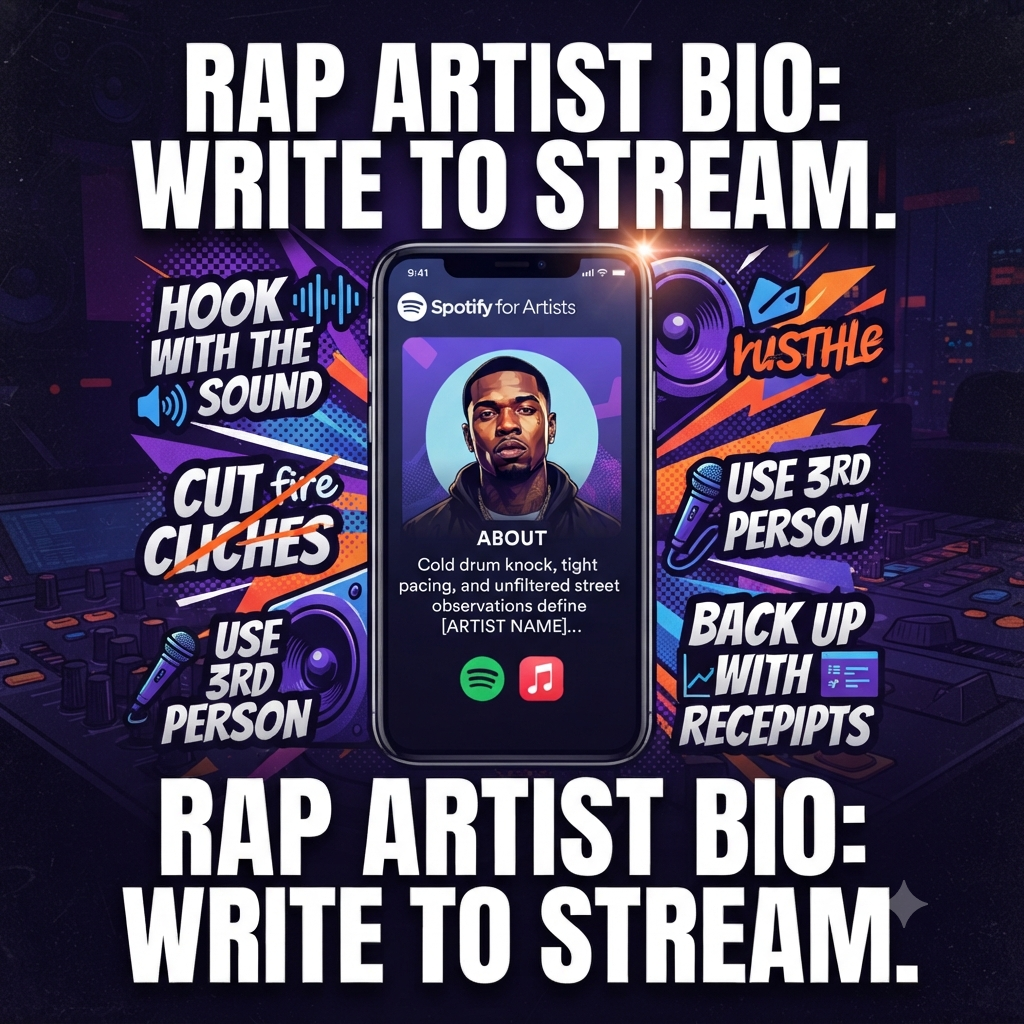
Nobody needs to read “Born and raised in [City], [Artist Name] has loved music from a young age.” That tells the reader nothing. Start with the sound, the mood, the scene, or a detail that separates your record from the noise.
Compare those two openers:
-
Skip this: “Marcus Vale is an upcoming hip-hop artist from Chicago who started writing raps in high school.”
-
Try this: “Cold drum knock, tight pacing, and unfiltered street observations define Chicago rapper Marcus Vale, whose records sound built for 2 a.m. expressway drives.”
Stick to Third Person
Write your Spotify and Apple Music bios in the third person (“he,” “she,” “they,” or your stage name). First-person bios can feel loose or overly casual, like a quick status update. Third-person copy reads like an official artist profile and carries a little more weight when someone outside your circle reads it.
Back Up Your Claims With Specifics
Saying you are “taking over the scene” or “dropping heat” doesn’t convince anyone. Point to concrete things you have actually done:
-
Real stream counts or listener milestones on a specific single or EP
-
Playlist placements, college or local radio spins, or press mentions
-
Show history, opening slots, festivals, or notable features and producers
Cut Clichés That Mean Nothing
If you can swap in another rapper’s name and the sentence still works, cut it. Phrases like “versatile artist who refuses to be put in a box,” “bringing real hip-hop back,” “making major waves,” and “putting [city] on the map” have been run into the ground. Say what you actually sound like and what you actually do.
Copy-and-Paste Rap Artist Bio Templates
Pick the rap artist bio template for Spotify and Apple Music that fits your lane best. Swap in your details, keep an eye on the 1,500-character limit on Spotify, and make sure your profile photo matches the energy of the words.
Street / Trap / Drill Template
[Artist Name] is a [City/Neighborhood] rapper whose music pairs [beat style, e.g., heavy 808s and eerie piano loops / stripped-back drill drums] with blunt stories about survival, loyalty, and getting out the way. Coming up around [Neighborhood/Scene], [Artist Name] first caught local attention in [Year] with “[Breakout Track],” pulling in [Number]+ streams and building early traction across [City].
Rather than chasing gimmicks, [Artist Name] built a core audience track by track and visual by visual, following up with projects like [Project Title] ([Year]). Known for [delivery/cadence trait, e.g., a raspy, urgent delivery / calm, deadpan pocket], [he/she/they] has shared bills with [Artist 1] and [Artist 2] while picking up early looks from [DJ, Producer, or Outlet].
With “[Latest Single/Project],” [Artist Name] tightens the formula—delivering tense, high-stakes street records made for car speakers and late-night rotations.
Lyrical / Boom-Bap / Conscious Template
Grounded in classic East Coast penmanship with a modern edge, [City] emcee [Artist Name] approaches every verse with focus on cadence, double meanings, and vivid storytelling. Pulling cues from [2–3 Influences, e.g., Black Thought, Freddie Gibbs, and soul-sample era records], [he/she/they] favors dense writing and sample-driven production that holds up on repeat spins.
Since putting out [First Single/Project] in [Year], [Artist Name] has steadily grown a loyal listener base around sharp lyricism, racking up [Number]+ organic streams along with support from [Playlist, Radio Show, or Blog]. Working closely with [Producer Name(s)], the catalog balances pointed commentary with personal reflection on cuts like “[Track 1]” and “[Track 2].”
After playing tight, high-energy sets across [Cities/Region], [Artist Name] returns with “[New Release],” a [Number]-track set showing that clean bars and real intent still hit hard.
Melodic / Alt-Rap / Emo-Rap Template
Moving easily between moody R&B melodies and punchy hip-hop drums, [Artist Name] makes late-night records for people stuck in their own heads. Based in [City], the [rapper-singer / artist] mixes [vocal style, e.g., melodic hooks and subtle auto-tune / hazy vocals and sharp rap verses] with honest lyrics about heartbreak, pressure, and personal shifts.
[Artist Name] broke through in [Year] when “[Breakout Song]” started picking up algorithmic and organic traction, passing [Number]+ streams and reaching listeners well outside [City]. Building on that momentum across releases like [EP/Mixtape Title], [he/she/they] earned early nods from [Outlet or Curator] for blending genre-blurring beats with straight-up vulnerability.
Now stepping into “[New Single/EP],” [Artist Name] keeps stretching past standard rap templates—turning quiet late-night thoughts into songs built for big rooms.
Quick Polish Before You Hit Publish
A good draft still benefits from a quick pass inside your artist dashboard:
-
Link artists and releases: In Spotify for Artists, highlight names of collaborators, producers, or songs you mention and attach clickable links so listeners can jump straight into the catalog.
-
Keep it current: Swap out old “upcoming single” lines whenever a new song or project drops. A stale bio makes an active artist look inactive.
-
Add real proof: Strong outside coverage helps back up your story—once your artist bio is polished, build verifiable press citations to link inside it through our music review portal.
-
Connect your links: Make sure your social handles and merch/tour links are active so curious listeners have somewhere clear to go next.
Want Real Press Behind Your Release?
Find the right editorial write-up option for your latest release. Secure your slot via our Music Review Portal.